

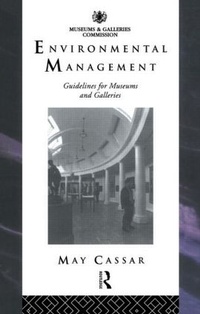
Environmental Management
Guidelines for Museums and Galleries
1st Edition
Published on 4. November 2011
Book
Paperback/Softback
180 pages
978-0-415-51492-7 (ISBN)
Description
The key to the survival of museum collections is a stable indoor environment and vital to this is a well-maintained building with effective environmental services. Environmental Management sets out clearly the theory and practice of achieving an appropriate museum environment for both collections and people.
The book emphasises the need for planning and places the environmental needs of museum collections at the forefront of the responsibilities of museum managers. May Cassar stresses the role of the building as the first line of defence against environmental instability, recognising the importance of regular environmental monitoring and control, and the division of museum spaces into critical areas housing collections and non-critical areas accommodating offices, cafes and communal spaces.
Environmental Management presents a strategic approach to environmental management, in contrast to the piecemeal approach to environmental monitoring and control still practised by many museums. However, rather than providing ready solutions and rigid rules, the book introduces principles and ideas on which to base decisions about creating the appropriate environment.
The book emphasises the need for planning and places the environmental needs of museum collections at the forefront of the responsibilities of museum managers. May Cassar stresses the role of the building as the first line of defence against environmental instability, recognising the importance of regular environmental monitoring and control, and the division of museum spaces into critical areas housing collections and non-critical areas accommodating offices, cafes and communal spaces.
Environmental Management presents a strategic approach to environmental management, in contrast to the piecemeal approach to environmental monitoring and control still practised by many museums. However, rather than providing ready solutions and rigid rules, the book introduces principles and ideas on which to base decisions about creating the appropriate environment.
Reviews / Votes
`This is an essential textbook for museum conservators, and their non-conservator colleagues would do well to have it close to hand.' - Museums JournalMore details
Series
Language
English
Place of publication
London
United Kingdom
Publishing group
Taylor & Francis Ltd
Target group
College/higher education
Professional and scholarly
Dimensions
Height: 246 mm
Width: 174 mm
Weight
330 gr
ISBN-13
978-0-415-51492-7 (9780415514927)
Copyright in bibliographic data and cover images is held by Nielsen Book Services Limited or by the publishers or by their respective licensors: all rights reserved.
Schweitzer Classification
Other editions
Additional editions
E-Book
10/2013
1st Edition
Routledge
€65.99
Available for download
E-Book
10/2013
1st Edition
Routledge
€65.99
Available for download
Book
12/1994
1st Edition
Routledge
€215.41
Shipment within 15-20 days
Person
May Cassar
Content
Foreword Preface Acknowledgements Part I: The Principles of Museum Environmental Management 1. Managing Resources 2. Objects, People and Space 3. Developing an Environmental Strategy Part II: Managing and Monitoring the Built Environment 4. Weather, Buildings and Environmental Design 5. The Monitoring Programme Part III: Controlling the Display Environment 6. Controlling from the Centre: Building Management and Environmental Conditioning 7. Control where it's Needed: Room-based Environmental Systems 8. On the Spot: Local Control Part IV: Storage and Transportation: Managing Hidden Stresses 9. Out of Sight, Not Out of Mind 10. Transportation: The Moving Environment Datasheet 1: Record form, spot readings of light and ultraviolet radiation Datasheet 2: Record form, spot readings of relative humidiy and temperature Datasheet 3: Summary chart, weekly minimum and maximum RH, temperature and light readings over 12 months Datasheet 4: Lamp characteristics Select Bibliography Sources of Other Information Glossary Index