

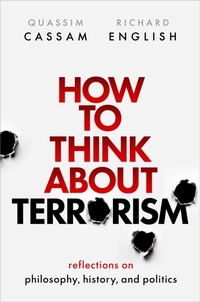
How to Think About Terrorism
Reflections on Philosophy, History, and Politics
Will be published approx. on 8. October 2026
Book
Hardback
272 pages
978-0-19-891107-4 (ISBN)
Description
What is terrorism? How do people become terrorists? To what extent can terrorism be considered rational? Quassim Cassam and Richard English tackle these vital questions in How to Think About Terrorism.
How to Think About Terrorism transforms how we understand terrorism, through innovative engagement with philosophical ideas and arguments as they intersect with historical and political thinking. This book reflects on the vital question of definition, recognizing that a useful description of terrorism should be sufficiently flexible and open-ended to accommodate the great variety of terrorist methods, motives, objectives, perpetrators, and targets.
Quassim Cassam and Richard English offer a philosophical (but empirically and historically grounded) account of the differences between non-state terrorism and state terrorism, and of the dynamics and nature of state terrorism itself. The authors address the question of how people become terrorists, combining in a Hybrid View the strengths of generalist and of particularist approaches; and offer a realist middle way between irrationalism and rationalism.
How to Think About Terrorism offers a complex and historically nuanced account of the relationship between religion and terrorism, and reflects systematically on the extent to which terrorism can, in principle, be morally justified. In terms of counter-terrorism, this book argues that philosophical thinking about torture should focus on real rather than artificial scenarios; it also draws together its cumulative argument in an innovative assessment of the moral, political, and practical foundations for a range of counter-terrorist approaches, an analysis intended to be as practically relevant as it is analytically compelling.
How to Think About Terrorism transforms how we understand terrorism, through innovative engagement with philosophical ideas and arguments as they intersect with historical and political thinking. This book reflects on the vital question of definition, recognizing that a useful description of terrorism should be sufficiently flexible and open-ended to accommodate the great variety of terrorist methods, motives, objectives, perpetrators, and targets.
Quassim Cassam and Richard English offer a philosophical (but empirically and historically grounded) account of the differences between non-state terrorism and state terrorism, and of the dynamics and nature of state terrorism itself. The authors address the question of how people become terrorists, combining in a Hybrid View the strengths of generalist and of particularist approaches; and offer a realist middle way between irrationalism and rationalism.
How to Think About Terrorism offers a complex and historically nuanced account of the relationship between religion and terrorism, and reflects systematically on the extent to which terrorism can, in principle, be morally justified. In terms of counter-terrorism, this book argues that philosophical thinking about torture should focus on real rather than artificial scenarios; it also draws together its cumulative argument in an innovative assessment of the moral, political, and practical foundations for a range of counter-terrorist approaches, an analysis intended to be as practically relevant as it is analytically compelling.
Reviews / Votes
How to Think About Terrorism blows open the doors of perception. The rigorous philosophical approach taken by Cassam and English, rooted in real world examples not abstract thought experiments, shows what terrorism studies have been lacking. It is now clear that questions of justification, motive, ties to religion, and radicalisation are not inherently problematic - it is just that we didn't know how to think about them. This book supplies the tools. * Jonathan Hall KC, UK Independent Reviewer of Terrorism Legislation * This radically interdisciplinary work combines the best of two worlds: the conceptual clarity and argumentative rigor of analytic philosophy and the empirical richness and historical depth of political history. The result is an innovative book, which goes beyond the classical philosophical questions about terrorism that focus on issues of definition and morality. It provides the first full-blown philosophy of terrorism and adopts a highly context-sensitive approach to numerous real-life cases. * Rik Peels, main editor of the Extreme Belief and Behavior Series * This fascinating and important book by two renowned scholars tackles the crucial questions of terrorism and counterterrorism in all their complexity. By fusing philosophical insight with rigorous political and historical analysis it presents a compelling innovative approach to a crowded field. This book should be an invaluable resource for both scholars of terrorism and practitioners of counterterrorism. * Dame Louise Richardson, President, Carnegie Corporation of New York *More details
Language
English
Place of publication
Oxford
United Kingdom
Dimensions
Height: 234 mm
Width: 156 mm
ISBN-13
978-0-19-891107-4 (9780198911074)
Copyright in bibliographic data and cover images is held by Nielsen Book Services Limited or by the publishers or by their respective licensors: all rights reserved.
Schweitzer Classification
Persons
Quassim Cassam is Professor of Philosophy at the University of Warwick, an Honorary Fellow of Keble College, Oxford, and a Fellow of the British Academy. He was previously Knightbridge Professor of Philosophy at Cambridge, Professor of Philosophy at UCL, and Reader in Philosophy at Oxford University. He has been a Mind Senior Research Fellow, President of the Aristotelian Society, and President of the Mind Association. His books include Extremism: A Philosophical Analysis (Routledge 2021), Vices of the Mind: From the Intellectual to the Political (Oxford 2019), and Conspiracy Theories (Polity 2019).
Richard English is Professor of Politics at Queen's University Belfast. His books include: Armed Struggle: The History of the IRA; Irish Freedom: The History of Nationalism in Ireland; Does Terrorism Work? A History; Does Counter-Terrorism Work? He has been elected to the British Academy, the Royal Irish Academy, the Royal Society of Edinburgh, the Academia Europaea, the Royal Historical Society, and an Honorary Fellowship at Keble College Oxford. In 2018 he was awarded a CBE for services to the understanding of modern-day terrorism and political history. In 2019 he received the Royal Irish Academy's Gold Medal in the Social Sciences.
Richard English is Professor of Politics at Queen's University Belfast. His books include: Armed Struggle: The History of the IRA; Irish Freedom: The History of Nationalism in Ireland; Does Terrorism Work? A History; Does Counter-Terrorism Work? He has been elected to the British Academy, the Royal Irish Academy, the Royal Society of Edinburgh, the Academia Europaea, the Royal Historical Society, and an Honorary Fellowship at Keble College Oxford. In 2018 he was awarded a CBE for services to the understanding of modern-day terrorism and political history. In 2019 he received the Royal Irish Academy's Gold Medal in the Social Sciences.
Content
- Acknowledgements
- Abbreviations
- 1: How to Study Terrorism
- 2: How to Define Terrorism
- 3: How States can be Terrorists
- 4: How People Become Terrorists
- 5: How Terrorism can be Rational
- 6: How Terrorism Connects with Religion
- 7: How Terrorism Relates to Morality
- 8: How to Think about Torture
- 9: How to Stop Terrorism
- Bibliography