

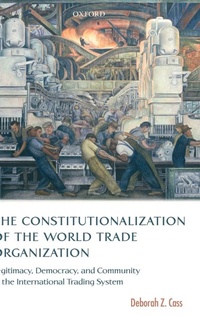
The Constitutionalization of the World Trade Organization
Legitimacy, Democracy, and Community in the International Trading System
Published on 28. July 2005
Book
Hardback
296 pages
978-0-19-928463-4 (ISBN)
Description
This is a book about the constitutionalization of the World Trade Organization, and the contemporary development of institutional forms and democratic ideas associated with constitutionalism within the world trading system.
It is about constitutionalization enthusiasts who promote institutions, management techniques, rights discourse and quasi-judicial power to construct a constitution for the WTO. It is about constitutional skeptics who fear the effect the phenomenon of constitutionalization is having on the autonomy of states, the capacity of the WTO to consider non-economic and non-free-trade goals, and democratic processes at the WTO and within the nation-state.
The aim of the study, then, is to disentangle debates about the various meanings of the term 'constitution' when it used to apply to the World Trade Organization, and to reflect upon the significance of those meanings for more general international law conceptions of constitutions.
Cass argues that the WTO is not and should not be described as a constitution, either by the standards of any received account of that term, or by the lights of any of the current WTO models. Under these definitions serious issues of legitimacy, democracy and community are at stake. The WTO would lack a proper political structure to balance the work of its judicial bodies; it may curtail the ability of states to decide matters of national economic interest; it lacks authorization by a coherent political community; and, it risks an emphasis upon economic goals and pure free trade over other, equally important, social values.
Instead, Cass argues that what is needed is a constitutionalized WTO which considers the economic development needs of states and takes account of the skewed playing field of international trade and its effect on the economic prospects of developing countries. In short, trading democracy, legitimacy and community and not trading constitutionalization, are the biggest challenges facing the WTO.
It is about constitutionalization enthusiasts who promote institutions, management techniques, rights discourse and quasi-judicial power to construct a constitution for the WTO. It is about constitutional skeptics who fear the effect the phenomenon of constitutionalization is having on the autonomy of states, the capacity of the WTO to consider non-economic and non-free-trade goals, and democratic processes at the WTO and within the nation-state.
The aim of the study, then, is to disentangle debates about the various meanings of the term 'constitution' when it used to apply to the World Trade Organization, and to reflect upon the significance of those meanings for more general international law conceptions of constitutions.
Cass argues that the WTO is not and should not be described as a constitution, either by the standards of any received account of that term, or by the lights of any of the current WTO models. Under these definitions serious issues of legitimacy, democracy and community are at stake. The WTO would lack a proper political structure to balance the work of its judicial bodies; it may curtail the ability of states to decide matters of national economic interest; it lacks authorization by a coherent political community; and, it risks an emphasis upon economic goals and pure free trade over other, equally important, social values.
Instead, Cass argues that what is needed is a constitutionalized WTO which considers the economic development needs of states and takes account of the skewed playing field of international trade and its effect on the economic prospects of developing countries. In short, trading democracy, legitimacy and community and not trading constitutionalization, are the biggest challenges facing the WTO.
Reviews / Votes
'Deborah Cass has achieved that rare thing: An account which is sophisticated at both a theoretical and a doctrinal level. Her book will be a benchmark for all future writing on this theme.' * Joanne Scott, University of Cambridge * 'This extraordinary book probes the frontier of international economic law' * From the Preface by Professor John Jackson, Georgetown University, Washington, D.C *More details
Series
Language
English
Place of publication
Oxford
United Kingdom
Target group
Professional and scholarly
Illustrations
1 table
Dimensions
Height: 240 mm
Width: 161 mm
Thickness: 21 mm
Weight
611 gr
ISBN-13
978-0-19-928463-4 (9780199284634)
Copyright in bibliographic data and cover images is held by Nielsen Book Services Limited or by the publishers or by their respective licensors: all rights reserved.
Schweitzer Classification
Other editions
Additional editions
Deborah Z. Cass
The Constitutionalization of the World Trade Organization
Legitimacy, Democracy, and Community in the International Trading System
Book
07/2005
Oxford University Press
€66.30
Shipment within 15-20 days
Person
Dr. Deborah Z. Cass (S.J.D. Harv. and LL.B Melb) is a Reader in Law at the London School of Economics and Political Science where she teaches International Economic Law.
Content
Preface ; Acknowledgements ; List of Abbreviations ; Table of Cases ; Table of International Instruments ; PART I: THE ORIGINS OF THE WTO CONSTITUTIONALIZATION DEBATE ; 1. INTERNATIONAL TRADE AND CONSTITUTIONALIZATION ; 2. CONSTITUTIONALIZATION: THE RECEIVED ACCOUNT ; 3. THE INTERNATIONAL ECONOMIC LAW BACKGROUND ; PART II: THREE VISIONS OF WTO CONSTITUTIONALIZATION ; 4. INSTITUTIONAL MANAGERIALISM ; 5. RIGHTS-BASED CONSTITUTIONALIZATION ; 6. JUDICIAL NORM-GENERATION ; PART III: TRADING DEMOCRACY ; 7. ANTI-CONSTITUTIONALIZATION CRITIQUE ; 8. CONCLUSION ; Bibiography ; Index