

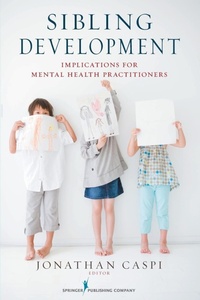
Sibling Development
Implications for Mental Health Practitioners
Published on 25. October 2010
Book
Paperback/Softback
416 pages
978-0-8261-1752-6 (ISBN)
Description
I heartily recommend Sibling Development."--CFLE Network Newsletter (National Council on Family Relations)
Sibling relationships have a major influence on a person's development and behavior, yet, until now the topic has been seriously underrepresented in the professional literature.
Sibling Development: Implications for Mental Health Practitioners addresses this gap by examining the range of developmental, clinical, and cultural issues related to sibling relationships. It highlights positive sibling relationships as a source of strength and resilience; at the other end of the spectrum, it addresses sibling abuse, a dangerous and underdiagnosed condition. It demonstrates the crucial support that siblings can provide each other in families experiencing mental illness, substance abuse, divorce, and other stressors. It also considers issues of cultural and ethnic diversity, gender, disability, and sexual orientation as they relate to siblings and their families.
Each chapter provides case studies to illustrate how theory and empirical findings can be incorporated into culturally informed treatment, and offers implications for practice and future research. It is an essential resource for all practitioners, researchers, students, and educators who work with or study siblings.
Key Features:
Examines the role of siblings as cultural educators and socializing agents Offers empirically derived treatment approaches for siblings and families Discusses lesbian, gay, bisexual, and transgender siblings Includes case studies to demonstrate how to integrate theory and empirical findings into practice Looks at sibling dynamics in families with mental illness, substance abuse, and divorce, as well as siblings of individuals with disabilities Discusses sibling relationships in transracial adoptive families
Sibling relationships have a major influence on a person's development and behavior, yet, until now the topic has been seriously underrepresented in the professional literature.
Sibling Development: Implications for Mental Health Practitioners addresses this gap by examining the range of developmental, clinical, and cultural issues related to sibling relationships. It highlights positive sibling relationships as a source of strength and resilience; at the other end of the spectrum, it addresses sibling abuse, a dangerous and underdiagnosed condition. It demonstrates the crucial support that siblings can provide each other in families experiencing mental illness, substance abuse, divorce, and other stressors. It also considers issues of cultural and ethnic diversity, gender, disability, and sexual orientation as they relate to siblings and their families.
Each chapter provides case studies to illustrate how theory and empirical findings can be incorporated into culturally informed treatment, and offers implications for practice and future research. It is an essential resource for all practitioners, researchers, students, and educators who work with or study siblings.
Key Features:
Examines the role of siblings as cultural educators and socializing agents Offers empirically derived treatment approaches for siblings and families Discusses lesbian, gay, bisexual, and transgender siblings Includes case studies to demonstrate how to integrate theory and empirical findings into practice Looks at sibling dynamics in families with mental illness, substance abuse, and divorce, as well as siblings of individuals with disabilities Discusses sibling relationships in transracial adoptive families
More details
Language
English
Place of publication
New York
United States
Target group
Professional and scholarly
Dimensions
Height: 229 mm
Width: 152 mm
Thickness: 22 mm
Weight
603 gr
ISBN-13
978-0-8261-1752-6 (9780826117526)
Copyright in bibliographic data and cover images is held by Nielsen Book Services Limited or by the publishers or by their respective licensors: all rights reserved.
Schweitzer Classification
Person
Jonathan Caspi, PhD, is Associate Professor, Department of Family & Child Studies, Montclair State University. Dr. Caspi maintains a small private practice that includes family counseling, clinical social work supervision, and parent consultation services.
Content
Preface
PART ONE: OVERVIEWS
1 Sibling Influence In Human Development
Shawn D. Whiteman, Julia M. Becerra Bernard, & Alexander C. Jensen
2 Siblings in Practice
Robert Sanders
3 Supportive Sibling Relationships
Laurie Kramer
4 Sibling Practice in Cultural Context
Marlene Watson & Monica McGoldrick
PART TWO: CULTURE, ENVIRONMENTS & ISSUES
5 Cultural Variations in Sibling Relationships
Kimberly A. Updegraff, Susan M. McHale, Sarah E. Killoren, & Sue Annie Rodriguez
6 Siblings as Cultural Educators and Socializing Agents
Jennifer Reynolds, Lisa M. Dorner, & Marjorie Faulstich Orellana
7 Lesbian, Gay, Bisexual, and Transgender Siblings
Esther D. Rothblum
8 A Sideways Look at Gender and Sibling Relationships
Rosalind Edwards and Susie Weller
9 Siblings of Individuals with Disabilities
Jennifer L. Goeke & Kristen D. Ritchey
10 Siblings in Families with Mental Illness
Ellen Lukens & Helle Thorning
11 Sibling Involvement in Substance Misuse and Abuse
Audrey L. Begun & Lisa K. Berger
12 Sibling Violence and Systems-Oriented Therapy
John Caffaro
13 Sibling Relationships in Divorcing Families
Marion F. Ehrenberg & Rotem Regev
14 Sibling Relationships in Transracial Adoptive Families
Amanda L. Baden & John Raible
15 Sibling Relationships and Out-Of-Home Care
Audrey L. Begun & Joshua P. Mersky
16 Only Children
Adriean Mancillas
17 Adolescence, Sibling Death, and Bereavement
David E. Balk
PART THREE: FUTURE DIRECTIONS
18 Future Directions for Sibling Research, Practice, and Theory
Jonathan Caspi
PART ONE: OVERVIEWS
1 Sibling Influence In Human Development
Shawn D. Whiteman, Julia M. Becerra Bernard, & Alexander C. Jensen
2 Siblings in Practice
Robert Sanders
3 Supportive Sibling Relationships
Laurie Kramer
4 Sibling Practice in Cultural Context
Marlene Watson & Monica McGoldrick
PART TWO: CULTURE, ENVIRONMENTS & ISSUES
5 Cultural Variations in Sibling Relationships
Kimberly A. Updegraff, Susan M. McHale, Sarah E. Killoren, & Sue Annie Rodriguez
6 Siblings as Cultural Educators and Socializing Agents
Jennifer Reynolds, Lisa M. Dorner, & Marjorie Faulstich Orellana
7 Lesbian, Gay, Bisexual, and Transgender Siblings
Esther D. Rothblum
8 A Sideways Look at Gender and Sibling Relationships
Rosalind Edwards and Susie Weller
9 Siblings of Individuals with Disabilities
Jennifer L. Goeke & Kristen D. Ritchey
10 Siblings in Families with Mental Illness
Ellen Lukens & Helle Thorning
11 Sibling Involvement in Substance Misuse and Abuse
Audrey L. Begun & Lisa K. Berger
12 Sibling Violence and Systems-Oriented Therapy
John Caffaro
13 Sibling Relationships in Divorcing Families
Marion F. Ehrenberg & Rotem Regev
14 Sibling Relationships in Transracial Adoptive Families
Amanda L. Baden & John Raible
15 Sibling Relationships and Out-Of-Home Care
Audrey L. Begun & Joshua P. Mersky
16 Only Children
Adriean Mancillas
17 Adolescence, Sibling Death, and Bereavement
David E. Balk
PART THREE: FUTURE DIRECTIONS
18 Future Directions for Sibling Research, Practice, and Theory
Jonathan Caspi