

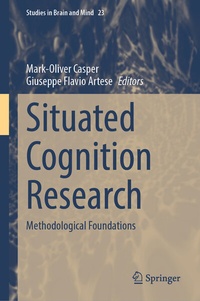
Situated Cognition Research
Methodological Foundations
Published on 27. September 2023
Book
Hardback
VI, 310 pages
978-3-031-39743-1 (ISBN)
Description
This volume assembles supporters and critics of situated cognition research to evaluate the intricacies, prerequisites, possibilities, and scope of a 4E methodology. The contributions are divided into three categories. The first category entails papers dealing with a 4E methodology from the perspective of epistemology and philosophy of science. It discusses whether to support explanatory pluralism or explanatory unification and focuses on possible compromises between ecological psychology and enactivism. The second category addresses ontological questions regarding the synchronic and diachronic constitution of cognitive phenomena, the localization of cognitive processes, and the theoretical issue of mutual manipulability. The third category analyzes how the theoretical and practical commitments of 4E approaches lead to empirically supported investigations of different phenomena, such as research on affordances and (chronic) pain. The book renews attention to the possible adverse consequences coming along with methodical fragmentation, as found among 4E positions. It provides an overdue first step towards a systematic and positive answer to methodological concerns in situated cognition research. Without this and further steps in the future, the growth of 4E´s significance for the scientific study of the mind might stall or even decrease. With such steps, situated cognition research could realize its frequently highlighted but so far not comprehensively accessed potential to change radically the modalities of how cognitive phenomena are studied. This volume is of interest to scholars of the philosophy of mind.
More details
Series
Edition
2023 ed.
Language
English
Place of publication
Cham
Switzerland
Publishing group
Springer International Publishing
Target group
Professional and scholarly
Illustrations
1 s/w Abbildung
VI, 310 p. 1 illus.
Dimensions
Height: 241 mm
Width: 160 mm
Thickness: 22 mm
Weight
698 gr
ISBN-13
978-3-031-39743-1 (9783031397431)
DOI
10.1007/978-3-031-39744-8
Schweitzer Classification
Other editions
Additional editions

Book
09/2024
Springer
€128.39
Shipment within 15-20 days
E-Book
09/2023
1st Edition
Springer
€117.69
Available for download
Persons
Mark-Oliver Casper
is PI of the research group ''Philosophy of Situated Cognition'' at the University of Kassel (Germany). He received his PhD in Philosophy at the Ruhr-University Bochum and his M.A. in Philosophy at the Humboldt University Berlin. His research is mainly focused on situated cognition theories, especially enactivism, the scaling-up problem, and methodological studies of 4E research
Giuseppe Flavio Artese is a Research Associate and Ph.D. candidate at the Institute of Philosophy of the University of Kassel (Germany) and a member of the research group ''Philosophy of Situated Cognition''. His areas of specialization concern, on the one hand, contemporary Enactive and Ecological theories of cognition and, on the other, their philosophical antecedents such as Phenomenology, American Pragmatism, and Gestalt Psychology.
Content
Chapter 1. Introduction by the Editors.- Category I - Philosophy of Science. Chapter 2. A Provisional Guide to a 4E Methodology; Mark-Oliver Casper.- Chapter 3. Explanatory Diversity and Embodied Cognitive Science: Reflexivity motivates Pluralism; Guilherme Sanches de Olivera.- Chapter 4. Putting the Brain (Back) at Its Own Place: Forms of Life and Normative Practices; Pierre Steiner.- Chapter 5. Ecological Psychology, Enaction, and the Quest for a Radical Embodied Cognitive Science; Manuel Heras-Escribano.- Category II - Ontology of the Mind.- Chapter 6. The Location of Cognition - Three Notions of Constitution and the Need for Pragmatic Norms; Beate Krickel.- Chapter 7. Dissolving the Causal-Constitutive Fallacy: Diachronic Constitution and the Metaphysics of (Extended) Cognition; Julian Kiverstein & Michael Kirchhoff.- Chapter 8. Predictive Processing and Extended Consciousness: Why the Machinery of Consciousness Is (Probably) Still in the Head and the DEUTS Argument Won't Let It Leak Outside; Marco Facchin.- Category III - Applications.- Chapter 9. The Phenomenon of Context in Affordance Perception: Empirical Evidence and Phenomenological Considerations; Giuseppe Flavio Artese.- Chapter 10. Chronic Pain, Enactivism, and the Challenges of Integration; Sabrina Coninx & Peter Stilwell.