

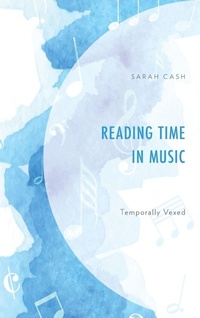
Reading Time in Music
Temporally Vexed
Published on 31. March 2023
Book
Hardback
192 pages
978-1-6669-0349-2 (ISBN)
Description
In this book, Sarah Cash examines the intersection of music and temporality in British literature of the long nineteenth century. The sound spaces created at these intersections function as antimimetic resistance to hegemonic structures. Through its temporal multiplicity, music resonates in excess of linear time, revealing a metaphoric soundedness in the text that subverts reader expectation and reveals how seemingly realist nineteenth-century novels transgress the limitations of their classic narratological structures. In even the most apparently "realist" texts, the most extravagant, excessive, and hyperbolic elements exceed the bounds of what we often consider real, disrupting mimetic bias. Cash argues that music offers the most dynamic way to expose this vexed temporality in the text. Through scholarly intervention a disruption of historic classifications show that Victorians are heirs of Romanticism's musical ideals, including the power of music to penetrate and transform space and time and the permanence of sound as it reverberates beyond human perception. Scholars of nineteenth-century literature, temporality, and gender studies will find this book of particular interest.
Reviews / Votes
This ambitious and original monograph offers a valuable contribution to the current reappraisal of literary periodization in the "long nineteenth century" through its focus on the relationship between gender and music across the genres of poetry and fiction. Exploring "non-linear music," Sarah Cash participates in the scholarly movement to connect representations of gender with the subversion of Enlightenment binaries in nineteenth-century literature. In remarkably lucid prose, Cash informs this literary study with a coherent balance of theoretical models in musicology, literature, gender studies, and philosophy. -- Kathryn Freeman, University of Miami Examining the destabilizing collision in 19th-century fiction of the stability (or fixity) of realism with "the fluidity of the unknown" in those disruptive narrative spaces where music intersects with temporality, Cash unfolds exciting new vistas on intellectual and aesthetic innovations of writers who glimpsed in music's inherent resistance to empirical strictures a metaphor for challenging the limitations of the conventional narrative structures of mimetic realism-a means of unbinding narrative from its accumulated mimetic conventions. This is good stuff-important stuff, and well worth a careful read. -- Stephen Behrendt, University of NebraskaMore details
Language
English
Place of publication
United States
Publishing group
Bloomsbury Publishing Plc
Target group
Professional and scholarly
Illustrations
3 b/w photos;
Dimensions
Height: 235 mm
Width: 157 mm
Thickness: 15 mm
Weight
437 gr
ISBN-13
978-1-6669-0349-2 (9781666903492)
Copyright in bibliographic data and cover images is held by Nielsen Book Services Limited or by the publishers or by their respective licensors: all rights reserved.
Schweitzer Classification
Other editions
Additional editions
E-Book
03/2023
1st Edition
Lexington Books
€82.49
Available for download
E-Book
03/2023
1st Edition
Lexington Books
€82.49
Available for download
Person
Sarah Cash is lecturer in the Department of Writing Studies at the University of Miami.
Content
Contents
Acknowledgments
Introduction
Chapter 1: Out of Time: Music as Temporal Excess in Thomas De Quincey's "Dream Fugue."
Chapter 2: Lamenting Ruin: Irish Musical Mourning in Sydney Owenson's Wild Irish Girl.
Chapter 3: Broken Boundaries: Disruptive Sound Spaces in William Thackeray's Vanity Fair.
Chapter 4: A Singing Call: Death and Music Charles Dickens's Our Mutual Friend.
Chapter 5: Distant Music: Temporal Disruption in James Joyce's Dubliners
Conclusion: Coda: Re-imaging Ourselves in Time
References
Index
Acknowledgments
Introduction
Chapter 1: Out of Time: Music as Temporal Excess in Thomas De Quincey's "Dream Fugue."
Chapter 2: Lamenting Ruin: Irish Musical Mourning in Sydney Owenson's Wild Irish Girl.
Chapter 3: Broken Boundaries: Disruptive Sound Spaces in William Thackeray's Vanity Fair.
Chapter 4: A Singing Call: Death and Music Charles Dickens's Our Mutual Friend.
Chapter 5: Distant Music: Temporal Disruption in James Joyce's Dubliners
Conclusion: Coda: Re-imaging Ourselves in Time
References
Index