

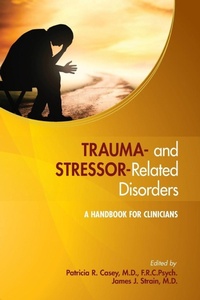
Trauma- and Stressor-Related Disorders
A Handbook for Clinicians
Published on 16. February 2016
Book
Paperback/Softback
220 pages
978-1-58562-505-5 (ISBN)
Description
Both academically rigorous and clinically practical,
Trauma- and Stressor-Related Disorders is fully informed by the
new DSM-5 category that includes adjustment disorders, acute stress
disorder, and posttraumatic stress disorder. Stress and trauma have long
been recognized as playing a role in the etiology of certain psychiatric
disorders, and this book delineates normal and pathological responses to
stress, providing a conceptual framework for understanding trauma- and
stressor-related disorders. An individual's response to stress depends on
numerous genetic, developmental, cognitive, psychological, and
neurobiological risk and protective factors, and these are examined from
both a scientific and clinical perspective. Central to the book's utility is
its presentation of clinical vignettes that help the reader to contextualize
the information presented and model effective clinical skills.
Among
the volume's critically important topics and features are
* A robust section on assessing the psychosocial factors associated
with resilience (e.g., optimism, cognitive flexibility, a social support
network), encouraging and enhancing these factors, and implementing
psychosocial interventions to aid patients who have experienced trauma to
promote resilience by targeting these factors.
* A comprehensive chapter
on the medical-legal aspects of trauma- and stressor-related disorders
because clinicians working with these patients frequently encounter
situations that have legal implications (e.g., capacity evaluations,
informed consent, confidentiality, serving as a witness in court
proceedings).
* Full coverage of controversies unique to this group of
disorders. For example, because no other set of DSM-5 diagnoses require a
stressor as an etiological agent, this dimension can add considerable
controversy to these diagnoses.
* Comprehensive overview of the
development of the stress and trauma disorders chapter of the upcoming
revision of the International Classification of Diseases (ICD-11, expected
for 2017), including crosswalk tables to compare ICD-10, DSM-5, and the
planned ICD-11 and featuring a summary of the evidence base for specific
treatments for ICD-10 or ICD-11 stress and trauma disorder categories.
In addition, key points, informative Web sites, and recommended
reading at the end of each chapter are designed to consolidate and extend
the practitioner's knowledge base. Trauma- and Stressor-Related
Disorders provides readers with the latest research and treatment
recommendations in an expertly edited, easy-to-use format that will earn its
place in the clinician's library.
Trauma- and Stressor-Related Disorders is fully informed by the
new DSM-5 category that includes adjustment disorders, acute stress
disorder, and posttraumatic stress disorder. Stress and trauma have long
been recognized as playing a role in the etiology of certain psychiatric
disorders, and this book delineates normal and pathological responses to
stress, providing a conceptual framework for understanding trauma- and
stressor-related disorders. An individual's response to stress depends on
numerous genetic, developmental, cognitive, psychological, and
neurobiological risk and protective factors, and these are examined from
both a scientific and clinical perspective. Central to the book's utility is
its presentation of clinical vignettes that help the reader to contextualize
the information presented and model effective clinical skills.
Among
the volume's critically important topics and features are
* A robust section on assessing the psychosocial factors associated
with resilience (e.g., optimism, cognitive flexibility, a social support
network), encouraging and enhancing these factors, and implementing
psychosocial interventions to aid patients who have experienced trauma to
promote resilience by targeting these factors.
* A comprehensive chapter
on the medical-legal aspects of trauma- and stressor-related disorders
because clinicians working with these patients frequently encounter
situations that have legal implications (e.g., capacity evaluations,
informed consent, confidentiality, serving as a witness in court
proceedings).
* Full coverage of controversies unique to this group of
disorders. For example, because no other set of DSM-5 diagnoses require a
stressor as an etiological agent, this dimension can add considerable
controversy to these diagnoses.
* Comprehensive overview of the
development of the stress and trauma disorders chapter of the upcoming
revision of the International Classification of Diseases (ICD-11, expected
for 2017), including crosswalk tables to compare ICD-10, DSM-5, and the
planned ICD-11 and featuring a summary of the evidence base for specific
treatments for ICD-10 or ICD-11 stress and trauma disorder categories.
In addition, key points, informative Web sites, and recommended
reading at the end of each chapter are designed to consolidate and extend
the practitioner's knowledge base. Trauma- and Stressor-Related
Disorders provides readers with the latest research and treatment
recommendations in an expertly edited, easy-to-use format that will earn its
place in the clinician's library.
More details
Language
English
Place of publication
VA
United States
Target group
Professional and scholarly
US School Grade: College Graduate Student and over
Product notice
Paperback (trade)
Illustrations
11 Tables, unspecified
Dimensions
Height: 228 mm
Width: 151 mm
Thickness: 15 mm
Weight
362 gr
ISBN-13
978-1-58562-505-5 (9781585625055)
Copyright in bibliographic data and cover images is held by Nielsen Book Services Limited or by the publishers or by their respective licensors: all rights reserved.
Schweitzer Classification
Other editions
Additional editions
E-Book
12/2015
American Psychiatric Association Publishing
€47.99
Available for download
Persons
Patricia R. Casey, M.D., F.R.C.Psych., is Professor
of Psychiatry at University College Dublin in Dublin,
Ireland.
James J. Strain, M.D., is Professor of Psychiatry
and Professor of Medical Education at Icahn School of Medicine at Mount
Sinai in New York, New York.
of Psychiatry at University College Dublin in Dublin,
Ireland.
James J. Strain, M.D., is Professor of Psychiatry
and Professor of Medical Education at Icahn School of Medicine at Mount
Sinai in New York, New York.
Content
Contributors
Foreword
Preface
Acknowledgments
Chapter 1.
Borderline Between Normal and Pathological Responses
Chapter 2. Limits
to the Phenomenological Approach to the Diagnosis of Adjustment
Disorders
Chapter 3. Conceptual Framework and Controversies in
Adjustment Disorders
Chapter 4. Adjustment Disorders: Epidemiology,
Diagnosis, and Treatment
Chapter 5. Acute Stress Disorder
Chapter 6.
Posttraumatic Stress Disorder: Epidemiology, Diagnosis, and
Treatment
Chapter 7. Disintegrated Experience: Dissociation and
Stress
Chapter 8. Persistent Complex Bereavement Disorder and Its
Treatment
Chapter 9. Therapeutic Adaptations of Resilience: Helping
Patients Overcome the Effects of Trauma and Stress
Chapter 10.
Medical-Legal Aspects of Trauma and Stressor-Related Disorders
Chapter
11. ICD-10, ICD-11, and DSM-5: New Developments and the
Crosswalks
Epilogue
Index
Foreword
Preface
Acknowledgments
Chapter 1.
Borderline Between Normal and Pathological Responses
Chapter 2. Limits
to the Phenomenological Approach to the Diagnosis of Adjustment
Disorders
Chapter 3. Conceptual Framework and Controversies in
Adjustment Disorders
Chapter 4. Adjustment Disorders: Epidemiology,
Diagnosis, and Treatment
Chapter 5. Acute Stress Disorder
Chapter 6.
Posttraumatic Stress Disorder: Epidemiology, Diagnosis, and
Treatment
Chapter 7. Disintegrated Experience: Dissociation and
Stress
Chapter 8. Persistent Complex Bereavement Disorder and Its
Treatment
Chapter 9. Therapeutic Adaptations of Resilience: Helping
Patients Overcome the Effects of Trauma and Stress
Chapter 10.
Medical-Legal Aspects of Trauma and Stressor-Related Disorders
Chapter
11. ICD-10, ICD-11, and DSM-5: New Developments and the
Crosswalks
Epilogue
Index