

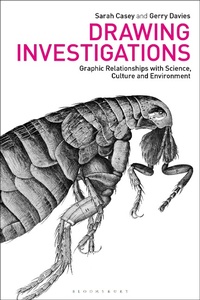
Drawing Investigations
Graphic Relationships with Science, Culture and Environment
Published on 22. February 2024
Book
Paperback/Softback
248 pages
978-1-350-44355-6 (ISBN)
Description
Using close visual analysis of drawings, artist interviews, critical analysis and exegesis, Drawing Investigations examines how artists use drawing as an investigative tool to reveal information that would otherwise remain unseen and unnoticed.
How does drawing add shape to ideas? How does the artist accommodate to challenges and restraints of a particular environment? To what extent is a drawing complementary and continuous with its subject and where is it disruptive and provocative? Casey and Davies address these questions while focusing on artists working collaboratively and the use of drawing in challenging or unexpected environments.
Drawing Investigations evaluates the emergence of a way of thinking among an otherwise disconnected group of artists by exploring commonalities in the application of analytical drawing to the natural world, urban environment, social forces and lived experience. Examples represent a spectrum of research in international contexts: an oceanographic Institute in California, the archives of Amsterdam's Rijksmuseum, the Antarctic Survey, geothermal research in Japan and the Kurdish diaspora in Iraq. Issues are situated in the contemporary theory and practice of drawing including relationships to historical precedents.
By exploring drawing's capacity to capture and describe experience, to sharpen visual faculties and to bridge embodied and conceptual knowledge, Drawing Investigations offers a fresh critical perspective on contemporary drawing practice.
How does drawing add shape to ideas? How does the artist accommodate to challenges and restraints of a particular environment? To what extent is a drawing complementary and continuous with its subject and where is it disruptive and provocative? Casey and Davies address these questions while focusing on artists working collaboratively and the use of drawing in challenging or unexpected environments.
Drawing Investigations evaluates the emergence of a way of thinking among an otherwise disconnected group of artists by exploring commonalities in the application of analytical drawing to the natural world, urban environment, social forces and lived experience. Examples represent a spectrum of research in international contexts: an oceanographic Institute in California, the archives of Amsterdam's Rijksmuseum, the Antarctic Survey, geothermal research in Japan and the Kurdish diaspora in Iraq. Issues are situated in the contemporary theory and practice of drawing including relationships to historical precedents.
By exploring drawing's capacity to capture and describe experience, to sharpen visual faculties and to bridge embodied and conceptual knowledge, Drawing Investigations offers a fresh critical perspective on contemporary drawing practice.
Reviews / Votes
Drawing is not just an art form: it is a way of both thinking of and being in the world. How drawing is used by scientists, anthropologists, medical researchers - and how artists have become involved in those disciplines - is a rich and complex subject. This book, with its attentiveness to the lives and particular approaches of artists and other people who draw to understant, in invaluable. Not only does it show how drawing can be used as an investigative tool, it also broadens and deepens our understanding of drawing as an art form. * Tony Godfrey, Independent Scholar, Philippines * This is a fascinating and timely study into the diverse and dynamic practices of drawing. Few practitioner-academics are as well places as Casey and Davies to roam so broadly and imaginatively into the rich territory of drawing. What is so rewarding about this particular volume is the diversity of perspectives - from the linear objectivity required by the archeologist to the graphic innovation pioneered by contemporary artists. A much-needed addition to the rather under-nourished field of enquiry into drawing and its practices. * Professor Paul Gough, Vice-Chancellor of Arts University Bournemouth, UK *More details
Series
Language
English
Place of publication
London
United Kingdom
Publishing group
Bloomsbury Publishing PLC
Target group
College/higher education
Product notice
Paperback (trade)
Illustrations
35 bw illustrations
Dimensions
Height: 234 mm
Width: 156 mm
Thickness: 13 mm
Weight
355 gr
ISBN-13
978-1-350-44355-6 (9781350443556)
Copyright in bibliographic data and cover images is held by Nielsen Book Services Limited or by the publishers or by their respective licensors: all rights reserved.
Schweitzer Classification
Other editions
Additional editions
Sarah Casey | Gerry Davies
Drawing Investigations
Graphic Relationships with Science, Culture and Environment
E-Book
06/2020
1st Edition
Bloomsbury Visual Arts
€30.99
Available for download
Sarah Casey | Gerry Davies
Drawing Investigations
Graphic Relationships with Science, Culture and Environment
E-Book
06/2020
1st Edition
Bloomsbury Visual Arts
€30.99
Available for download
Persons
Sarah Casey is a Senior Lecturer in Drawing and Installation at Lancaster Institute for the Contemporary Arts, Lancaster University, UK.
Gerry Davies is Senior Lecturer in Drawing at Lancaster Institute for the Contemporary Arts, Lancaster University, UK
Gerry Davies is Senior Lecturer in Drawing at Lancaster Institute for the Contemporary Arts, Lancaster University, UK
Content
List of Illustrations
Acknowledgements
Introduction
1. Drawing on the past: a historical context for graphic investigations
2. Seeing Inside: drawing in the body
3. Visualising the Invisible: drawing mathematics and the cosmos
4. On Unfamiliar Ground: drawing environment, place and space
5. Traces of Life: drawing history and culture
6. Front Lines: drawing war, conflict and the law
7. Drawing Conclusions
Concluding Remarks
Bibliography
Acknowledgements
Introduction
1. Drawing on the past: a historical context for graphic investigations
2. Seeing Inside: drawing in the body
3. Visualising the Invisible: drawing mathematics and the cosmos
4. On Unfamiliar Ground: drawing environment, place and space
5. Traces of Life: drawing history and culture
6. Front Lines: drawing war, conflict and the law
7. Drawing Conclusions
Concluding Remarks
Bibliography