

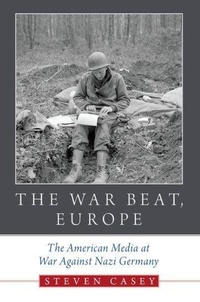
The War Beat, Europe
The American Media at War Against Nazi Germany
Published on 3. August 2021
Book
Paperback/Softback
448 pages
978-0-19-756397-7 (ISBN)
Description
From the North African desert to the bloody stalemate in Italy, from the London blitz to the D-Day beaches, a group of highly courageous and extremely talented American journalists reported the war against Nazi Germany for a grateful audience. Based on a wealth of previously untapped primary sources, War Beat, Europe provides the first comprehensive account of what these reporters witnessed, what they were allowed to publish, and how their reports shaped the home front's perception of some of the most pivotal battles in American history.
In a dramatic and fast-paced narrative, Steven Casey takes readers from the inner councils of government, where Franklin D. Roosevelt and George Marshall held clear views about how much blood and gore Americans could stomach, to the command centers in London, Algiers, Naples, and Paris, where many reporters were stuck with the dreary task of reporting the war by communique. At the heart of this book is the epic journey of reporters like Wes Gallagher and Don Whitehead of the Associated Press, Drew Middleton of the New York Times, Bill Stoneman of the Chicago Daily News, and John Thompson of the Chicago Tribune; of columnists like Ernie Pyle and Hal Boyle; and of photographers like Margaret Bourke-White and Robert Capa. These men and women risked their lives on countless occasions to get their dispatches and their images back home. In providing coverage of war in an open society, they also balanced the weighty responsibility of adhering to censorship regulations while working to sell newspapers and maintaining American support for the war.
These reporters were driven by a combination of ambition, patriotism, and belief in the cause. War Beat, Europe shows how they earned their reputation as America's golden generation of journalists and wrote the first draft of World War II history for posterity.
In a dramatic and fast-paced narrative, Steven Casey takes readers from the inner councils of government, where Franklin D. Roosevelt and George Marshall held clear views about how much blood and gore Americans could stomach, to the command centers in London, Algiers, Naples, and Paris, where many reporters were stuck with the dreary task of reporting the war by communique. At the heart of this book is the epic journey of reporters like Wes Gallagher and Don Whitehead of the Associated Press, Drew Middleton of the New York Times, Bill Stoneman of the Chicago Daily News, and John Thompson of the Chicago Tribune; of columnists like Ernie Pyle and Hal Boyle; and of photographers like Margaret Bourke-White and Robert Capa. These men and women risked their lives on countless occasions to get their dispatches and their images back home. In providing coverage of war in an open society, they also balanced the weighty responsibility of adhering to censorship regulations while working to sell newspapers and maintaining American support for the war.
These reporters were driven by a combination of ambition, patriotism, and belief in the cause. War Beat, Europe shows how they earned their reputation as America's golden generation of journalists and wrote the first draft of World War II history for posterity.
Reviews / Votes
World War II has been covered so extensively it is rare to find a book that breaks new ground. In The War Beat, Europe, Steven Casey explores a largely overlooked topic from an original perspective. Casey dives deep into the collaboration and dissention among these individuals to confront the stereotype that the media and military acted in lock-step to present a sanitized view of the war and maintain public support.... For all its deep research, historical heft, and fidelity to truth, the book has anengaging narrative flow that compels the reader on to each succeeding chapter. This is attributable, in part, to finely drawn sketches of people involved that facilitate the reader feeling as if one is in the shoes of an Ernie Pyle in combat with his beloved infantry men, or among the Writing Sixty-Ninth, getting ready to fly on a bombing run. * Kevin Bemel, Journal of Military History * This fine book works on many levels... [It] underlines the importance of a free media in wartime, but more than this it shows the need for a critical body of scholarship to probe that media's claims about itself; to unpick the threads of self-aggrandizing myth and grubby reality that make up the tapestries * Nicholas J. Cull, Journal of Modern History * Focused on the combat dimension of war, Casey's account achieves considerable momentum, while his richly descriptive prose evokes the linguistic agility of his journalistic subjects. * Susan L. Carruthers, Diplomatic History * The text is carefully written and contains comprehensive notes....Highly recommended. * R. A. Logan, CHOICE * [W]ell-researched... * Jim Michaels, World War II * A vivid contribution to media and military history. * Kirkus * Steve Casey's The War Beat is a wonderful chronicle of an extraordinary band of correspondents who covered the defeat of the Third Reich. Based on impeccable research, and written with flair and humanity, this utterly absorbing study chronicles the journalists who put themselves in harm's way to record the titanic struggle to preserve freedom. * Alex Kershaw, author of Avenue of Spies: A True Story of Terror, Espionage, and One American Family's Heroic Resistance in Nazi-Occupied Paris * Engagingly written and full of illuminating vignettes, War Beat, Europe tells the story of the brave and intrepid correspondents who reported on the European front during the Second World War. Though subject to military censorship, these courageous journalists never lost sight of their fundamental obligation to keep the public informed. * Richard R. John, Columbia Journalism School * This very impressive volume is a superbly researched and beautifully written study of US media coverage of the European theater during World War II. Its comprehensive and incisive analysis will lead to reconsideration of many standard beliefs regarding the relationship among the media, the armed forces, and the government during this conflict, as well as the individuals whose reporting and visuals helped shape the public image of the war. * Mark A. Stoler, editor of the George C. Marshall Papers * The famed American war correspondents who covered the European theater in World War II presented to their readers back home a conflict that was tough, but triumphant. The War Beat, Europe shows us the competition, hardship, criticism, distrust, and patriotism that characterized the fractious cooperation between the US military and the media. * Susan Brewer, author of Why America Fights: Patriotism and War Propaganda from the Philippines to Iraq * One of the last bastions of unexamined mythology [of the Second World War] was that surrounding the role of American war correspondents in the conflict. Unlike their successors...they have been portrayed as heroic, patriotic, in step with the needs of the nation, and an important part of the collective victory. Steven Casey's excellent scholarly examination of their performance in the European theater paints a much more complex picture...The core of Casey's book is his meticulous documenting of the many tensions between the US military and the media. Many incidents resonate with the present day. * Nicholas J. Cull, Journal of Modern History * A vivid contribution to media and military history...Casey convincingly argues that reporters were not tools of the military's public relations offices...Figures such as Eisenhower and Patton play roles in Casey's illuminating narrative, but his focus is largely on reporters and their efforts, sometimes heroic, to get the best scoop. * Kirkus * A work of historical scholarship likely to be the definitive account of its subject...Casey...has written previously on American foreign policy and public opinion during wartime, and he brings this expertise to bear on the topic, along with his considerable skills as an archival researcher and flair as a writer of narrative history...Casey writes vividly and with deep understanding. * Richard Fine, History * Clear and persuasive...This book should join the standard volumes on the media and war...and it is recommended for the interested, in and out of academe. The research is impressive, the writing engaging, and the conclusions alter the standard view of the press in the war against Nazi Germany...Perhaps the most important takeaway...is this: Though closely entwined with the military throughout the war by necessity, the press maintained its independence and pushed back in the name of truth and a free press. * Wallace B. Eberhard, American Journalism *More details
Language
English
Place of publication
New York
United States
Target group
Professional and scholarly
Product notice
Paperback (trade)
Unsewn / adhesive bound
Illustrations
23 illus.
Dimensions
Height: 234 mm
Width: 155 mm
Thickness: 28 mm
Weight
635 gr
ISBN-13
978-0-19-756397-7 (9780197563977)
Copyright in bibliographic data and cover images is held by Nielsen Book Services Limited or by the publishers or by their respective licensors: all rights reserved.
Schweitzer Classification
Other editions
Additional editions
E-Book
03/2017
1st Edition
OUP eBook
€12.99
Available for download
E-Book
03/2017
1st Edition
OUP eBook
€12.99
Available for download
Person
Steven Casey is Professor in International History at the London School of Economics and Political Science. He is the author of Cautious Crusade: Franklin Roosevelt, American Public Opinion and the War against Nazi Germany (OUP, 2001); Selling the Korean War: Propaganda, Politics and Public Opinion (OUP, 2007); When Soldiers Fall: How Americans Have Confronted Combat Casualties (OUP, 2014); and The War Beat, Pacific: The American Media at War Against Japan (OUP, 2021).
Content
Introduction
Chapter 1. Going to War
Part 1: North Africa
Chapter 2. Invasion, 1942
Chapter 3. The Advent of Ernie
Chapter 4. Defeat at Kasserine
Chapter 5. Victory in Tunisia
Part 2: Bombing Germany
Chapter 6. How-I-Almost-Got Killed-Today Stories
Chapter 7. A High-Octane Outfit
Chapter 8. Dark Days
Part 3: Sicily and Italy
Chapter 9. Invasion, 1943
Chapter 10. An Antidote to Complacency
Chapter 11. Death in Winter
Chapter 12. Anzio and Cassino
Part 4: Overlord
Chapter 13. Fear Lay Blackly Deep Down
Chapter 14. Invasion, 1944
Chapter 15. Normandy Stalemate
Chapter 16. Breakout
Part 5: Victory
Chapter 17. To Germany's Borders
Chapter 18. Blackout on the Bulge
Chapter 19. Into the Reich
Chapter 20. Unconditional Surrender
Notes
Bibliography
Index
Chapter 1. Going to War
Part 1: North Africa
Chapter 2. Invasion, 1942
Chapter 3. The Advent of Ernie
Chapter 4. Defeat at Kasserine
Chapter 5. Victory in Tunisia
Part 2: Bombing Germany
Chapter 6. How-I-Almost-Got Killed-Today Stories
Chapter 7. A High-Octane Outfit
Chapter 8. Dark Days
Part 3: Sicily and Italy
Chapter 9. Invasion, 1943
Chapter 10. An Antidote to Complacency
Chapter 11. Death in Winter
Chapter 12. Anzio and Cassino
Part 4: Overlord
Chapter 13. Fear Lay Blackly Deep Down
Chapter 14. Invasion, 1944
Chapter 15. Normandy Stalemate
Chapter 16. Breakout
Part 5: Victory
Chapter 17. To Germany's Borders
Chapter 18. Blackout on the Bulge
Chapter 19. Into the Reich
Chapter 20. Unconditional Surrender
Notes
Bibliography
Index