

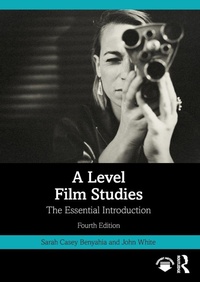
A Level Film Studies
The Essential Introduction
4th Edition
Published on 16. May 2025
Book
Paperback/Softback
408 pages
978-1-032-80193-3 (ISBN)
Description
Building confidence through a careful, step-by-step approach, this book is an essential companion for students undertaking A Level Film Studies.
This book begins by establishing a basic understanding of film analysis, introducing film construction, mise en scene, cinematography, editing, sound, and performance. Key theoretical approaches to narrative, genre, representation, spectatorship, and authorship are then introduced, along with specific national cinemas from around the world. Next, students consider the unique experiences of silent cinema, experimental films, and documentaries. Finally, the focus shifts to evaluating creative approaches to students' own filmmaking.
Thoroughly revised and updated to match exam specifications for both Eduqas and OCR, the fourth edition of this essential textbook features:
Case studies and activities relating to a number of films, including those new to the syllabus such as Get Out, Cleo from 5 to 7, and Belfast, each clearly signposted to the relevant board and specification
Fully integrated online resources, cross-referenced within the text, to help students and instructors dive deeper into case studies and exam prep
Even more chapter summaries and breakout boxes containing definitions of key terms, theories, and theorists throughout.
Designed to be comprehensive and easy-to-use, A Level Film Studies: The Essential Introduction covers everything students need to succeed in their exams as well as inspiring further study.
This book is supported by e-resources for students and instructors, including additional case studies, revision checklists, and key approaches to assessment.
This book begins by establishing a basic understanding of film analysis, introducing film construction, mise en scene, cinematography, editing, sound, and performance. Key theoretical approaches to narrative, genre, representation, spectatorship, and authorship are then introduced, along with specific national cinemas from around the world. Next, students consider the unique experiences of silent cinema, experimental films, and documentaries. Finally, the focus shifts to evaluating creative approaches to students' own filmmaking.
Thoroughly revised and updated to match exam specifications for both Eduqas and OCR, the fourth edition of this essential textbook features:
Case studies and activities relating to a number of films, including those new to the syllabus such as Get Out, Cleo from 5 to 7, and Belfast, each clearly signposted to the relevant board and specification
Fully integrated online resources, cross-referenced within the text, to help students and instructors dive deeper into case studies and exam prep
Even more chapter summaries and breakout boxes containing definitions of key terms, theories, and theorists throughout.
Designed to be comprehensive and easy-to-use, A Level Film Studies: The Essential Introduction covers everything students need to succeed in their exams as well as inspiring further study.
This book is supported by e-resources for students and instructors, including additional case studies, revision checklists, and key approaches to assessment.
More details
Series
Edition
4th edition
Language
English
Place of publication
London
United Kingdom
Publishing group
Taylor & Francis Ltd
Target group
College/higher education
AS/A2 and Further/Vocational Education
Illustrations
71 farbige Abbildungen, 37 s/w Photographien bzw. Rasterbilder, 71 Farbfotos bzw. farbige Rasterbilder, 37 s/w Abbildungen
71 Halftones, color; 37 Halftones, black and white; 71 Illustrations, color; 37 Illustrations, black and white
Dimensions
Height: 174 mm
Width: 246 mm
Thickness: 27 mm
Weight
822 gr
ISBN-13
978-1-032-80193-3 (9781032801933)
Copyright in bibliographic data and cover images is held by Nielsen Book Services Limited or by the publishers or by their respective licensors: all rights reserved.
Schweitzer Classification
Other editions
Additional editions
E-Book
05/2025
4th Edition
Routledge
€55.49
Available for download
E-Book
05/2025
4th Edition
Routledge
€55.49
Available for download
Book
05/2025
4th Edition
Routledge
€239.90
Shipment within 10-20 days
Previous edition
Book
02/2020
3rd Edition
Routledge
€47.50
Article exhausted; check for reprint
Persons
Sarah Casey Benyahia currently teaches Film Studies at A level and is an experienced senior examiner. She is the author of several books, including Crime (Routledge, 2011), Doing Film Studies with Claire Mortimer (Routledge, 2013), and Teaching Film and TV Documentary (2008). She has also contributed chapters to Death and Crises in the Hispanic World: Cultural Responses (2020), Narratives of Place in Film and Literature (2018), Stieg Larsson's Millennium Trilogy (2013), and The Routledge Encyclopedia of Films (Routledge, 2015).
John White is the author of British Cinema and a Divided Nation (2021), The Contemporary Western: An American Genre Post-9/11 (2019), European Art Cinema (Routledge, 2017), and Westerns (Routledge, 2011). He co-edited The Routledge Encyclopedia of Films (Routledge, 2015), Fifty Key American Films (Routledge, 2009), and Fifty Key British Films (Routledge, 2008).
John White is the author of British Cinema and a Divided Nation (2021), The Contemporary Western: An American Genre Post-9/11 (2019), European Art Cinema (Routledge, 2017), and Westerns (Routledge, 2011). He co-edited The Routledge Encyclopedia of Films (Routledge, 2015), Fifty Key American Films (Routledge, 2009), and Fifty Key British Films (Routledge, 2008).
Content
Introduction: This is film studies
Part I - Film form and analysis
Chapter 1 - Mise en scene
Chapter 2 - Cinematography
Chapter 3 - Editing
Chapter 4 - Sound
Chapter 5 - Performance
Part II - Theoretical approaches and critical debates
Chapter 6 - Narrative and genre
Chapter 7 - Representation and ideology
Chapter 8 - Spectatorship
Chapter 9 - Authorship
Chapter 10 - Historical, social, political, and cultural contexts
Part III - Hollywood and US cinema
Chapter 11 - Classical Hollywood, 1930-1960
Chapter 12 - New Hollywood, 1961-1990
Chapter 13 - American film post-2012
Part IV - National cinemas, European cinema, and global cinema
Chapter 14 - British film since 1995
Chapter 15 - European film
Chapter 16 - Global cinema
Part V - Further varieties of film experience
Chapter 17 - Silent cinema
Chapter 18 - Experimental film
Chapter 19 - Documentary film: theory and practice
Part VI - Understanding film through creative practice
Chapter 20 - Researching and constructing a short film
Index
Part I - Film form and analysis
Chapter 1 - Mise en scene
Chapter 2 - Cinematography
Chapter 3 - Editing
Chapter 4 - Sound
Chapter 5 - Performance
Part II - Theoretical approaches and critical debates
Chapter 6 - Narrative and genre
Chapter 7 - Representation and ideology
Chapter 8 - Spectatorship
Chapter 9 - Authorship
Chapter 10 - Historical, social, political, and cultural contexts
Part III - Hollywood and US cinema
Chapter 11 - Classical Hollywood, 1930-1960
Chapter 12 - New Hollywood, 1961-1990
Chapter 13 - American film post-2012
Part IV - National cinemas, European cinema, and global cinema
Chapter 14 - British film since 1995
Chapter 15 - European film
Chapter 16 - Global cinema
Part V - Further varieties of film experience
Chapter 17 - Silent cinema
Chapter 18 - Experimental film
Chapter 19 - Documentary film: theory and practice
Part VI - Understanding film through creative practice
Chapter 20 - Researching and constructing a short film
Index