

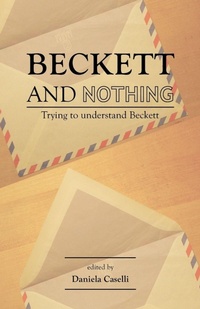
Beckett and Nothing
Trying to Understand Beckett
Published on 30. June 2012
Book
Paperback/Softback
292 pages
978-0-7190-8784-4 (ISBN)
Description
Beckett's reception was characterised in its early stages by a sustained attention to nothing as a philosophical concept. Theodor Adorno, however, was quick to argue that Beckett's plays resisted - unlike Sartre's - having their nothing transformed into something. This Beckettian nothing, moreover, is often invested with the aura of the genius, either for eulogical or dismissive purposes. This volume invites its readership to understand the complex ways in which the Beckett canon both suggests and resists turning nothing into something by looking at specific, sometimes almost invisible ways in which 'little nothings' pervade the Beckett canon.
The volume has two main functions: on the one hand, it looks at 'nothing' not only as a content but also a set of rhetorical strategies to reconsider afresh classic Beckett problems such as Irishness, silence, value, marginality, politics and the relationships between modernism and postmodernism and absence and presence. On the other, it focuses on 'nothing' in order to assess how the Beckett oeuvre can help us rethink contemporary preoccupations with materialism, neurology, sculpture, music and television.
Both advanced students and scholars of Beckett will find the volume of interest. It comprises jargon-free chapters that analyse Beckett's prose, drama, film, television, manuscripts and marginalia. It will prove of interest to advanced students and scholars in English, French, Comparative Literature, Drama, Visual Studies, Philosophy, Music, Cinema and TV studies.
An electronic edition of this book is freely available under a Creative Commons (CC BY-NC-ND) licence. -- .
The volume has two main functions: on the one hand, it looks at 'nothing' not only as a content but also a set of rhetorical strategies to reconsider afresh classic Beckett problems such as Irishness, silence, value, marginality, politics and the relationships between modernism and postmodernism and absence and presence. On the other, it focuses on 'nothing' in order to assess how the Beckett oeuvre can help us rethink contemporary preoccupations with materialism, neurology, sculpture, music and television.
Both advanced students and scholars of Beckett will find the volume of interest. It comprises jargon-free chapters that analyse Beckett's prose, drama, film, television, manuscripts and marginalia. It will prove of interest to advanced students and scholars in English, French, Comparative Literature, Drama, Visual Studies, Philosophy, Music, Cinema and TV studies.
An electronic edition of this book is freely available under a Creative Commons (CC BY-NC-ND) licence. -- .
More details
Language
English
Place of publication
Manchester
United Kingdom
Target group
College/higher education
Illustrations
Illustrations, black & white
Dimensions
Height: 216 mm
Width: 140 mm
Thickness: 17 mm
Weight
415 gr
ISBN-13
978-0-7190-8784-4 (9780719087844)
Copyright in bibliographic data and cover images is held by Nielsen Book Services Limited or by the publishers or by their respective licensors: all rights reserved.
Schweitzer Classification
Persons
Daniela Caselli is Senior Lecturer in Twentieth-Century Literature and Culture in the School of Arts, Histories, and Cultures at the University of Manchester -- .
Content
Foreword
Terry Eagleton, 'Nothing new'
Introduction
Daniela Caselli, 'Beckett and nothing: trying to understand Beckett'
1. John Pilling, 'On not being there: going on without in Beckett'
2. Peter Boxall, 'Nothing of value: reading Beckett's negativity'
3. Mladen Dolar, 'Nothing has changed'
4. Stephen Thomson, '"A tangle of tatters": ghosts and the busy nothing in Footfalls
5. Bill Prosser, 'Nothings in particular'
6. Shane Weller, 'Unwords'
7. Jonathan Bignell, 'Into the Void: Beckett's television plays and the idea of broadcasting'
8. Derval Tubridy, 'Beckett, Feldman, Salcedo... Neither'
9. Matthijs Engelberts, 'From Film to literature: theoretical debates and the critical erasure of Beckett's cinema'
10. Catherine Laws, 'Beckett and unheard sound'
11. Russell Smith, 'It's nothing: Beckett and anxiety'
12. Laura Salisbury, '"Something or nothing": Beckett and the matter of language'
Coda, Enoch Brater, 'The no-thing that knows no name and the Beckett envelope, blissfully reconsidered'
Bibliography
Index -- .
Terry Eagleton, 'Nothing new'
Introduction
Daniela Caselli, 'Beckett and nothing: trying to understand Beckett'
1. John Pilling, 'On not being there: going on without in Beckett'
2. Peter Boxall, 'Nothing of value: reading Beckett's negativity'
3. Mladen Dolar, 'Nothing has changed'
4. Stephen Thomson, '"A tangle of tatters": ghosts and the busy nothing in Footfalls
5. Bill Prosser, 'Nothings in particular'
6. Shane Weller, 'Unwords'
7. Jonathan Bignell, 'Into the Void: Beckett's television plays and the idea of broadcasting'
8. Derval Tubridy, 'Beckett, Feldman, Salcedo... Neither'
9. Matthijs Engelberts, 'From Film to literature: theoretical debates and the critical erasure of Beckett's cinema'
10. Catherine Laws, 'Beckett and unheard sound'
11. Russell Smith, 'It's nothing: Beckett and anxiety'
12. Laura Salisbury, '"Something or nothing": Beckett and the matter of language'
Coda, Enoch Brater, 'The no-thing that knows no name and the Beckett envelope, blissfully reconsidered'
Bibliography
Index -- .