

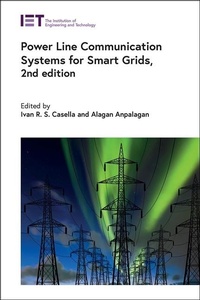
Power Line Communication Systems for Smart Grids
2nd Edition
Published on 7. January 2025
Book
Hardback
585 pages
978-1-83953-924-4 (ISBN)
Description
Power Line Communication Systems for Smart Grids presents the fundamentals and principles behind narrowband and broadband PLC technologies, covering the particularities of coupling PLC signals to the electrical grid and the main modulation and coding techniques used, to their standardisation and use in monitoring and control operations involved in energy management, charging of electric vehicles and distributed generation, taking into account the use of intermittent renewable energy sources.
This second edition offers substantial updates and new content. Chapters cover fundamentals of digital communications and error correction coding, orthogonal frequency division multiplexing and frequency domain equalization, channel models, noise mitigation, main narrowband and broadband PLC standards, PLC signals coupling to power grid, analysis of PLC modems over distribution transformers, use of PLC for monitoring and control of distributed generation, PLC in electric vehicle charging infrastructure, application of PLC in demand side management, power control for wind turbines based on PLC technology, non-linear filtering and multiple-input, multiple-output systems for narrowband PLC systems and hybrid communication systems analysis.
Researchers in electrical engineering involved with smart grids and PLC, engineers and practitioners working with power systems, as well as senior undergraduates, will find this expanded and updated new edition to be a valuable source of information on power line communication systems.
This second edition offers substantial updates and new content. Chapters cover fundamentals of digital communications and error correction coding, orthogonal frequency division multiplexing and frequency domain equalization, channel models, noise mitigation, main narrowband and broadband PLC standards, PLC signals coupling to power grid, analysis of PLC modems over distribution transformers, use of PLC for monitoring and control of distributed generation, PLC in electric vehicle charging infrastructure, application of PLC in demand side management, power control for wind turbines based on PLC technology, non-linear filtering and multiple-input, multiple-output systems for narrowband PLC systems and hybrid communication systems analysis.
Researchers in electrical engineering involved with smart grids and PLC, engineers and practitioners working with power systems, as well as senior undergraduates, will find this expanded and updated new edition to be a valuable source of information on power line communication systems.
More details
Series
Edition
2nd edition
Language
English
Place of publication
Stevenage
United Kingdom
Target group
Professional and scholarly
College/higher education
Product notice
sewn/stitched
Cloth over boards
Dimensions
Height: 234 mm
Width: 156 mm
Thickness: 32 mm
Weight
989 gr
ISBN-13
978-1-83953-924-4 (9781839539244)
Copyright in bibliographic data and cover images is held by Nielsen Book Services Limited or by the publishers or by their respective licensors: all rights reserved.
Schweitzer Classification
Other editions
Previous edition
Ivan R.S. Casella | Alagan Anpalagan
Power Line Communication Systems for Smart Grids
Book
01/2019
Institution of Engineering and Technology
€156.50
Shipment within 3-4 weeks
Persons
Ivan Roberto Santana Casella (S'01-M'04-SM'19) is a full professor at the Center for Engineering, Modeling and Applied Social Sciences (CECS) of the Federal University of ABC (UFABC), Brazil, and founder and director of the Information and Communication Laboratories (LIC I and LIC II). He holds a master's degree and doctorate in Electrical Engineering from the Polytechnic School of the University of Sao Paulo (USP), with a doctoral internship at the Wireless Communication Laboratory at the department of electrical and computer engineering (ECE) of the University of Toronto (UofT). He is a senior member of the IEEE (Institute of Electrical and Electronic Engineering), associate editor of the Electronics Letters of the IET (Institute of Engineering and Technology) and author of several articles in telecommunications and smart grid areas, which have resulted in some academic and scientific awards. He is also the author of several book chapters and books including Power Line Communication Systems for Smart Grids (2019) with IET and Smart Grids Renewable Energy, Power Electronics, Signal Processing and Communication Systems Applications (2024) with Springer. His main areas of interest are wireless communications, power line communications, smart grids, planar antennas design and energy harvesting.
Alagan Anpalagan (S'98-M'01-SM'04) is a full professor at the Department of Electrical, Computer and Biomedical Engineering (ECBE) of the Toronto Metropolitan University (TMU), Canada, and director of the Wireless Networks and Communications Research (WINCORE) Laboratory. He received the B.A.Sc., M.A.Sc. and Ph.D. degrees in Electrical Engineering from the University of Toronto (UofT). Alagan served as editor for the IEEE Communications Surveys & Tutorials and IEEE Communications Letters and co-edited the Handbook on Green Information and Communication Systems, Academic Press (2012), Routing in Opportunistic Networks, Springer (2013), Design and Deployment of Small Cell Networks, Cambridge University Press (2015). His main areas of research are radio resource management, green communication, energy harvesting, small cell and heterogeneous networks, cognitive and cooperative communication, smart grid and smart homes.
Alagan Anpalagan (S'98-M'01-SM'04) is a full professor at the Department of Electrical, Computer and Biomedical Engineering (ECBE) of the Toronto Metropolitan University (TMU), Canada, and director of the Wireless Networks and Communications Research (WINCORE) Laboratory. He received the B.A.Sc., M.A.Sc. and Ph.D. degrees in Electrical Engineering from the University of Toronto (UofT). Alagan served as editor for the IEEE Communications Surveys & Tutorials and IEEE Communications Letters and co-edited the Handbook on Green Information and Communication Systems, Academic Press (2012), Routing in Opportunistic Networks, Springer (2013), Design and Deployment of Small Cell Networks, Cambridge University Press (2015). His main areas of research are radio resource management, green communication, energy harvesting, small cell and heterogeneous networks, cognitive and cooperative communication, smart grid and smart homes.
Content
Chapter 1: Introduction
Chapter 2: Fundamentals of digital communications
Chapter 3: Basis of error correction coding
Chapter 4: Principles of orthogonal frequency division multiplexing and single-carrier frequency domain equalisation
Chapter 5: Modern power line communication technologies
Chapter 6: Power line communication channel models
Chapter 7: Noise mitigation
Chapter 8: Narrowband power line communication systems: PRIME and G3-PLC/IEEE 1901.2 performance
Chapter 9: Broadband power line communication systems: IEEE 1901 performance
Chapter 10: A guide to prototyping broadband and capacitive power line communication coupling circuits for low-voltage electric power grids
Chapter 11: Smart grids and the use of power line communications
Chapter 12: Performance evaluation of PRIME power line communication modems over distribution transformers: a case study
Chapter 13: Power line communication for monitoring and control of distributed energy resources in smart grids
Chapter 14: Power line communication devices for electric vehicles charging infrastructure: progress, challenges, opportunities and status
Chapter 15: Demand side management through power line communication: concepts and challenges
Chapter 16: Direct torque control for a wind doubly fed induction generator employing power line communication technology in smart grid environments
Chapter 17: The use of non-linear filtering to improve the performance of narrowband power line communication in smart grid applications
Chapter 18: Multiple-input multiple-output systems design for narrowband power line communication in smart distribution grids
Chapter 19: Analysis of hybrid communication systems for smart grids
Chapter 2: Fundamentals of digital communications
Chapter 3: Basis of error correction coding
Chapter 4: Principles of orthogonal frequency division multiplexing and single-carrier frequency domain equalisation
Chapter 5: Modern power line communication technologies
Chapter 6: Power line communication channel models
Chapter 7: Noise mitigation
Chapter 8: Narrowband power line communication systems: PRIME and G3-PLC/IEEE 1901.2 performance
Chapter 9: Broadband power line communication systems: IEEE 1901 performance
Chapter 10: A guide to prototyping broadband and capacitive power line communication coupling circuits for low-voltage electric power grids
Chapter 11: Smart grids and the use of power line communications
Chapter 12: Performance evaluation of PRIME power line communication modems over distribution transformers: a case study
Chapter 13: Power line communication for monitoring and control of distributed energy resources in smart grids
Chapter 14: Power line communication devices for electric vehicles charging infrastructure: progress, challenges, opportunities and status
Chapter 15: Demand side management through power line communication: concepts and challenges
Chapter 16: Direct torque control for a wind doubly fed induction generator employing power line communication technology in smart grid environments
Chapter 17: The use of non-linear filtering to improve the performance of narrowband power line communication in smart grid applications
Chapter 18: Multiple-input multiple-output systems design for narrowband power line communication in smart distribution grids
Chapter 19: Analysis of hybrid communication systems for smart grids