

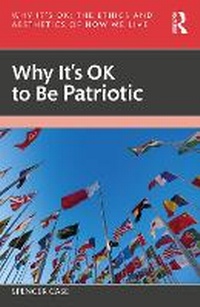
Why It's OK to Be Patriotic
1st Edition
Will be published approx. on 15. October 2026
Book
Paperback/Softback
224 pages
978-1-032-06148-1 (ISBN)
Description
The post-9/11 era saw patriotism transform from somber resolve into jingoistic excess, leaving many to wonder whether love of country inevitably corrupts into tribalism and violence. Critics from Leo Tolstoy to George Kateb have argued that patriotism is inherently dangerous, a relic of a less enlightened age. Yet abandoning patriotism entirely may be worse than the disease.
Why It's OK to Be Patriotic makes a philosophically rigorous case that patriotism, properly conceived, is neither irrational nor harmful-but essential to democratic life. Case argues that patriotism is best understood as love of country rather than mere loyalty, a love directed toward compatriots as participants in a shared political community. Drawing on Aristotle, contemporary philosophy, and hard-won experience, he defends patriotism as a virtue-a golden mean between tribal excess and cosmopolitan detachment-while articulating the patriotic duties of heart and mind required to maintain the civic commons. He tackles the toughest objections head-on: Does patriotism cause war? Does it rest on irrational bias? Can it be reconciled with universal moral principles?
The book culminates in a powerful meditation on America's current crisis. With political violence escalating and talk of "national divorce" gaining traction, Case argues that the only way out is through-not escape from politics, but the difficult practice of loving one's country by learning to love the people in it.
Key features:
Provides an account of patriotism in terms of love rather than loyalty, distinguishing patriotism from nationalism, jingoism, and tribalism.
Confronts arguments from critiques of patriotism from Emma Goldman, Leo Tolstoy, and Albert Einstein, as well as from more recent critics such as Simon Keller and George Kateb, showing that patriotism need not be irrational, harmful, or morally blind.
Offers concrete patriotic duties of heart-mind-including resistance to contempt, epistemic civic virtues, and practices for maintaining the civic commons-that can help repair America's fraying social fabric.
Draws on Aristotle, contemporary philosophy of love, and virtue ethics while remaining accessible to general readers concerned about their country's future.
Why It's OK to Be Patriotic makes a philosophically rigorous case that patriotism, properly conceived, is neither irrational nor harmful-but essential to democratic life. Case argues that patriotism is best understood as love of country rather than mere loyalty, a love directed toward compatriots as participants in a shared political community. Drawing on Aristotle, contemporary philosophy, and hard-won experience, he defends patriotism as a virtue-a golden mean between tribal excess and cosmopolitan detachment-while articulating the patriotic duties of heart and mind required to maintain the civic commons. He tackles the toughest objections head-on: Does patriotism cause war? Does it rest on irrational bias? Can it be reconciled with universal moral principles?
The book culminates in a powerful meditation on America's current crisis. With political violence escalating and talk of "national divorce" gaining traction, Case argues that the only way out is through-not escape from politics, but the difficult practice of loving one's country by learning to love the people in it.
Key features:
Provides an account of patriotism in terms of love rather than loyalty, distinguishing patriotism from nationalism, jingoism, and tribalism.
Confronts arguments from critiques of patriotism from Emma Goldman, Leo Tolstoy, and Albert Einstein, as well as from more recent critics such as Simon Keller and George Kateb, showing that patriotism need not be irrational, harmful, or morally blind.
Offers concrete patriotic duties of heart-mind-including resistance to contempt, epistemic civic virtues, and practices for maintaining the civic commons-that can help repair America's fraying social fabric.
Draws on Aristotle, contemporary philosophy of love, and virtue ethics while remaining accessible to general readers concerned about their country's future.
More details
Series
Language
English
Place of publication
London
United Kingdom
Publishing group
Taylor & Francis Ltd
Target group
General
Illustrations
1 s/w Abbildung, 1 s/w Photographie bzw. Rasterbild
1 Halftones, black and white; 1 Illustrations, black and white
Dimensions
Height: 198 mm
Width: 129 mm
ISBN-13
978-1-032-06148-1 (9781032061481)
Copyright in bibliographic data and cover images is held by Nielsen Book Services Limited or by the publishers or by their respective licensors: all rights reserved.
Schweitzer Classification
Other editions
Additional editions

Spencer Case
Why It's OK to Be Patriotic
Book
approx. 10/2026
1st Edition
Why It's OK
€191.50
Not yet published
Person
Spencer Case, writer and host of Micro-Digressions: A Philosophy Podcast, received his PhD in philosophy from the University of Colorado Boulder in 2018. He is coauthor, along with Matt Lutz, of Is Morality Real? A Debate (Routledge 2023) and author of more than ten peer-reviewed philosophy articles .
Content
Prologue; Introduction: Why Patriotism?; Chapter 1: Countries, Nations, and Other Preliminaries; Chapter 2: Love of Country; Chapter 3: The Harm Objection; Chapter 4: The Irrationality Objection; Chapter 5: The Psychological Goods of National Identity; Chapter 6: Heart-Mind Duties; Chapter 7: Patriotism as a Virtue; Conclusion: What will become of us?; Notes; Bibliography; Index.