

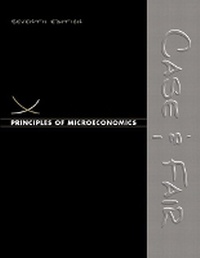
Principles of Microeconomics
7th Edition
Published on 15. January 2004
Book
Hardback
480 pages
978-0-13-144283-2 (ISBN)
Description
For the 1-semester freshman/sophomore course in Principles of Microeconomics.
These two highly-respected economists and educators have revised this best-selling Microeconomics book to include more current topics and events while maintaining its hallmark feature of teaching economics through stories, graphs, and equations; relevant to students with various learning styles (verbal, visual, and numerical).
These two highly-respected economists and educators have revised this best-selling Microeconomics book to include more current topics and events while maintaining its hallmark feature of teaching economics through stories, graphs, and equations; relevant to students with various learning styles (verbal, visual, and numerical).
More details
Edition
7th edition
Language
English
Place of publication
United States
Publishing group
Pearson Education (US)
Target group
Professional and scholarly
Dimensions
Height: 277 mm
Width: 217 mm
Thickness: 15 mm
Weight
991 gr
ISBN-13
978-0-13-144283-2 (9780131442832)
Copyright in bibliographic data and cover images is held by Nielsen Book Services Limited or by the publishers or by their respective licensors: all rights reserved.
Schweitzer Classification
Other editions
New editions
Book
03/2008
8th Edition
Pearson
€56.94
Article exhausted; check for reprint
Previous edition
Karl E. Case | Ray C. Fair
Principles of Microeconomics and ActiveEcon CD Package
Book
07/2001
6th Edition
Pearson
€53.35
Article exhausted; check for reprint
Content
I. INTRODUCTION TO ECONOMICS.
1. The Scope and Method of Economics.
2. The Economic Problem: Scarcity and Choice.
3. Demand, Supply, and Market Equilibrium.
4. Demand and Supply Applications and Elasticity.
II. FOUNDATIONS OF MICROECONOMICS: CONSUMERS AND FIRMS.
5. Household Behavior and Consumer Choice.
6. The Production Process: The Behavior of Profit-Maximizing Firms.
7. Short-Run Costs and Output Decisions.
8. Long-Run Costs and Output Decisions.
9. Input Demand: The Labor and Land Markets.
10. Input Demand: The Capital Market and the Investment Decision.
11. General Equilibrium and the Efficiency of Perfect Competition.
III. MARKET IMPERFECTIONS AND THE ROLE OF GOVERNMENT.
12. Monopoly and Antitrust Policy.
13. Monopolistic Competition and Oligopoly.
14. Externalities, Public Goods, Imperfect Information, and Social Choice.
15. Income Distribution and Poverty.
16. Public Finance: The Economics of Taxation.
IV. THE WORLD ECONOMY.
17. International Trade, Comparative Advantage, and Protectionism.
18. Globalization.
19. Economic Growth in Developing and Transitional Economies.
1. The Scope and Method of Economics.
2. The Economic Problem: Scarcity and Choice.
3. Demand, Supply, and Market Equilibrium.
4. Demand and Supply Applications and Elasticity.
II. FOUNDATIONS OF MICROECONOMICS: CONSUMERS AND FIRMS.
5. Household Behavior and Consumer Choice.
6. The Production Process: The Behavior of Profit-Maximizing Firms.
7. Short-Run Costs and Output Decisions.
8. Long-Run Costs and Output Decisions.
9. Input Demand: The Labor and Land Markets.
10. Input Demand: The Capital Market and the Investment Decision.
11. General Equilibrium and the Efficiency of Perfect Competition.
III. MARKET IMPERFECTIONS AND THE ROLE OF GOVERNMENT.
12. Monopoly and Antitrust Policy.
13. Monopolistic Competition and Oligopoly.
14. Externalities, Public Goods, Imperfect Information, and Social Choice.
15. Income Distribution and Poverty.
16. Public Finance: The Economics of Taxation.
IV. THE WORLD ECONOMY.
17. International Trade, Comparative Advantage, and Protectionism.
18. Globalization.
19. Economic Growth in Developing and Transitional Economies.