

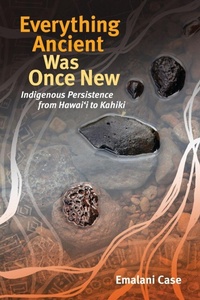
Everything Ancient Was Once New
Indigenous Persistence from Hawai'i to Kahiki
Published on 28. February 2021
Book
Paperback/Softback
168 pages
978-0-8248-8681-3 (ISBN)
Description
In Everything Ancient Was Once New, Emalani Case explores Indigenous persistence through the concept of Kahiki, a term that is at once both an ancestral homeland for Kanaka Maoli (Hawaiians) and the knowledge that there is life to be found beyond Hawai?i's shores. It is therefore both a symbol of ancestral connection and the potential that comes with remembering and acting upon that connection.
Tracing physical, historical, intellectual, and spiritual journeys to and from Kahiki, Emalani frames it as a place of refuge and sanctuary, a place where ancient knowledge can constantly be made anew. It is in Kahiki, she argues, and in the sanctuary it creates, that today's Kanaka Maoli can find safety and reprieve from the continued onslaught of settler colonial violence, while also confronting some of the often uncomfortable and challenging realities of being Indigenous in Hawai?i, in the Pacific, and in the world.
Each chapter of the book engages with Kahiki as a shifting term, employed by Kanaka Maoli to explain their lives and experiences to themselves at different points in history. In doing so, Everything Ancient Was Once New proposes and argues for reactivated and reinvigorated engagements with Kahiki, each supporting ongoing work aimed at decolonizing physical and ideological spaces, and reconnecting Kanaka Maoli to other peoples and places in the Pacific region and beyond in ways that are both purposeful and meaningful. In the book, Kahiki is therefore traced through pivotal moments in history and critical moments in contemporary times, explaining that while not always mentioned by name, the idea of Kahiki was, and is, always full of potential.
In writing that is both personal and theoretical, Emalani weaves the past and the present together, reflecting on ancient concepts and their continued relevance in movements to protect lands, waters, and oceans; to fight for social justice; to reexamine our responsibilities and obligations to each other across the Pacific region; and to open space for continued dialogue on what it means to be Indigenous both when at home and when away. Combining personal narrative and reflection with research and critical analysis, Everything Ancient Was Once New journeys to and from Kahiki, the sanctuary for reflection, deep learning, and continued dreaming with the past, in the present, and far into the future.
Tracing physical, historical, intellectual, and spiritual journeys to and from Kahiki, Emalani frames it as a place of refuge and sanctuary, a place where ancient knowledge can constantly be made anew. It is in Kahiki, she argues, and in the sanctuary it creates, that today's Kanaka Maoli can find safety and reprieve from the continued onslaught of settler colonial violence, while also confronting some of the often uncomfortable and challenging realities of being Indigenous in Hawai?i, in the Pacific, and in the world.
Each chapter of the book engages with Kahiki as a shifting term, employed by Kanaka Maoli to explain their lives and experiences to themselves at different points in history. In doing so, Everything Ancient Was Once New proposes and argues for reactivated and reinvigorated engagements with Kahiki, each supporting ongoing work aimed at decolonizing physical and ideological spaces, and reconnecting Kanaka Maoli to other peoples and places in the Pacific region and beyond in ways that are both purposeful and meaningful. In the book, Kahiki is therefore traced through pivotal moments in history and critical moments in contemporary times, explaining that while not always mentioned by name, the idea of Kahiki was, and is, always full of potential.
In writing that is both personal and theoretical, Emalani weaves the past and the present together, reflecting on ancient concepts and their continued relevance in movements to protect lands, waters, and oceans; to fight for social justice; to reexamine our responsibilities and obligations to each other across the Pacific region; and to open space for continued dialogue on what it means to be Indigenous both when at home and when away. Combining personal narrative and reflection with research and critical analysis, Everything Ancient Was Once New journeys to and from Kahiki, the sanctuary for reflection, deep learning, and continued dreaming with the past, in the present, and far into the future.
More details
Series
Language
English
Place of publication
Honolulu, HI
United States
Target group
Professional and scholarly
Product notice
Paperback (trade)
Unsewn / adhesive bound
Dimensions
Height: 225 mm
Width: 148 mm
Thickness: 12 mm
Weight
252 gr
ISBN-13
978-0-8248-8681-3 (9780824886813)
Copyright in bibliographic data and cover images is held by Nielsen Book Services Limited or by the publishers or by their respective licensors: all rights reserved.
Schweitzer Classification
Persons
Emalani Case is a Kanaka Maoli lecturer in Pacific studies at Te Herenga Waka-Victoria University of Wellington, New Zealand.
Noelani Goodyear-Ka'opua is associate professor of political science at the University of Hawai'i at Manoa, where she teaches Hawaiian and Indigenous politics.
Noelani Goodyear-Ka'opua is associate professor of political science at the University of Hawai'i at Manoa, where she teaches Hawaiian and Indigenous politics.