

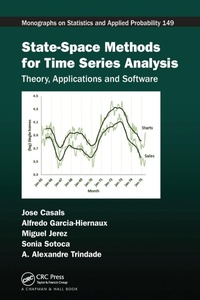
State-Space Methods for Time Series Analysis
Theory, Applications and Software
1st Edition
Published on 30. June 2020
Book
Paperback/Softback
270 pages
978-0-367-57058-3 (ISBN)
Description
The state-space approach provides a formal framework where any result or procedure developed for a basic model can be seamlessly applied to a standard formulation written in state-space form. Moreover, it can accommodate with a reasonable effort nonstandard situations, such as observation errors, aggregation constraints, or missing in-sample values.
Exploring the advantages of this approach, State-Space Methods for Time Series Analysis: Theory, Applications and Software presents many computational procedures that can be applied to a previously specified linear model in state-space form.
After discussing the formulation of the state-space model, the book illustrates the flexibility of the state-space representation and covers the main state estimation algorithms: filtering and smoothing. It then shows how to compute the Gaussian likelihood for unknown coefficients in the state-space matrices of a given model before introducing subspace methods and their application. It also discusses signal extraction, describes two algorithms to obtain the VARMAX matrices corresponding to any linear state-space model, and addresses several issues relating to the aggregation and disaggregation of time series. The book concludes with a cross-sectional extension to the classical state-space formulation in order to accommodate longitudinal or panel data. Missing data is a common occurrence here, and the book explains imputation procedures necessary to treat missingness in both exogenous and endogenous variables.
Web Resource
The authors' E4 MATLAB (R) toolbox offers all the computational procedures, administrative and analytical functions, and related materials for time series analysis. This flexible, powerful, and free software tool enables readers to replicate the practical examples in the text and apply the procedures to their own work.
Exploring the advantages of this approach, State-Space Methods for Time Series Analysis: Theory, Applications and Software presents many computational procedures that can be applied to a previously specified linear model in state-space form.
After discussing the formulation of the state-space model, the book illustrates the flexibility of the state-space representation and covers the main state estimation algorithms: filtering and smoothing. It then shows how to compute the Gaussian likelihood for unknown coefficients in the state-space matrices of a given model before introducing subspace methods and their application. It also discusses signal extraction, describes two algorithms to obtain the VARMAX matrices corresponding to any linear state-space model, and addresses several issues relating to the aggregation and disaggregation of time series. The book concludes with a cross-sectional extension to the classical state-space formulation in order to accommodate longitudinal or panel data. Missing data is a common occurrence here, and the book explains imputation procedures necessary to treat missingness in both exogenous and endogenous variables.
Web Resource
The authors' E4 MATLAB (R) toolbox offers all the computational procedures, administrative and analytical functions, and related materials for time series analysis. This flexible, powerful, and free software tool enables readers to replicate the practical examples in the text and apply the procedures to their own work.
Reviews / Votes
"The way the authors of describe their book, it is the fruit of a long-lasting love affair with state space models, which started in the 1980s, inspired by the work of Box and Jenkins. Judging from the density of equations and symbols, it must be the theory of the subject that attracts them most. ... This book is not for the fainthearted. It explains a lotabout state space models. To use them, you have to accept the philosophy of detailed modelling of time series. In summary, if you are a specialist, or want to become one, you will like this book."- Paul Eilers, ISCB News, May 2017
"This book synthesizes and presents the computational advantages of the state-space approach over the traditional time domain approaches to linear time series analysis. The explicit connection between the mainstream ARIMA time series models and the state-space representation, one of the main features of the book, is achieved by presenting many examples and procedures to combine, decompose, aggregate, and disaggregate an economic time series into the state-space form. More specifically, it provides a bridge for going back and forth between state-space models and the broad class of VARMAX models...Overall, this is a useful book on sate-space methods for time series analysis and covers substantial amount of material lucidly with a focus on computational aspects and software. It is an excellent reference book for self-study and can also be used as a companion for teaching time series analysis along with a standard time series text."
-Mohsen Pourahmadi, Texas A&M University, in the Journal of Time Series Analysis, June 2017
More details
Series
Language
English
Place of publication
Boca Raton
United Kingdom
Publishing group
Taylor & Francis Ltd
Target group
College/higher education
Dimensions
Height: 234 mm
Width: 156 mm
Thickness: 16 mm
Weight
456 gr
ISBN-13
978-0-367-57058-3 (9780367570583)
Copyright in bibliographic data and cover images is held by Nielsen Book Services Limited or by the publishers or by their respective licensors: all rights reserved.
Schweitzer Classification
Other editions
Additional editions
Jose Casals | Alfredo Garcia-Hiernaux | Miguel Jerez
State-Space Methods for Time Series Analysis
Theory, Applications and Software
E-Book
09/2018
1st Edition
Chapman & Hall/CRC
€72.49
Available for download
Jose Casals | Alfredo Garcia-Hiernaux | Miguel Jerez
State-Space Methods for Time Series Analysis
Theory, Applications and Software
E-Book
09/2018
Chapman & Hall/CRC
€72.49
Available for download
Jose Casals | Alfredo Garcia-Hiernaux | Miguel Jerez
State-Space Methods for Time Series Analysis
Theory, Applications and Software
Book
03/2016
1st Edition
Chapman & Hall/CRC
€146.00
Article not available for order
Persons
Jose Casals is head of global risk management at Bankia. He is also an associate professor of econometrics at Universidad Complutense de Madrid.
Alfredo Garcia-Hiernaux is an associate professor of econometrics at Universidad Complutense de Madrid and a freelance consultant.
Miguel Jerez is an associate professor of econometrics at Universidad Complutense de Madrid and a freelance consultant. He was previously executive vice-president at Caja de Madrid for six years.
Sonia Sotoca is an associate professor of econometrics at Universidad Complutense de Madrid.
Drs. Casals, Garcia-Hiernaux, Jerez, and Sotoca are all engaged in a long-term research project to apply state-space techniques to standard econometric problems. Their common research interests include state-space methods and time series econometrics.
A. Alexandre (Alex) Trindade is a professor of statistics in the Department of Mathematics and Statistics at Texas Tech University and an adjunct professor in the Graduate School of Biomedical Sciences at Texas Tech University Health Sciences Center. His research spans a broad swath of theoretical and computational statistics.
Alfredo Garcia-Hiernaux is an associate professor of econometrics at Universidad Complutense de Madrid and a freelance consultant.
Miguel Jerez is an associate professor of econometrics at Universidad Complutense de Madrid and a freelance consultant. He was previously executive vice-president at Caja de Madrid for six years.
Sonia Sotoca is an associate professor of econometrics at Universidad Complutense de Madrid.
Drs. Casals, Garcia-Hiernaux, Jerez, and Sotoca are all engaged in a long-term research project to apply state-space techniques to standard econometric problems. Their common research interests include state-space methods and time series econometrics.
A. Alexandre (Alex) Trindade is a professor of statistics in the Department of Mathematics and Statistics at Texas Tech University and an adjunct professor in the Graduate School of Biomedical Sciences at Texas Tech University Health Sciences Center. His research spans a broad swath of theoretical and computational statistics.
Content
Introduction
Linear state-space models
The multiple error model
Single error models
Model transformations
Model decomposition
Model combination
Change of variables in the output
Uses of these transformations
Filtering and smoothing
The conditional moments of a state-space model
The Kalman filter
Decomposition of the smoothed moments
Smoothing for a general state-space model
Smoothing for fixed-coefficients and single-error models
Uncertainty of the smoothed estimates in a fixed-coefficients SEM
Examples
Likelihood computation for fixed-coefficients models
Maximum likelihood estimation
The likelihood for a non-stationary model
The likelihood for a model with inputs
Examples
The likelihood of models with varying parameters
Regression with time-varying parameters
Periodic models
The likelihood of models with GARCH errors
Examples
Subspace methods
Theoretical foundations
System order estimation
Constrained estimation
Multiplicative seasonal models
Examples
Signal extraction
Input and error-related components
Estimation of the deterministic components
Decomposition of the stochastic component
Structure of the method
Examples
The VARMAX representation of a state-space model
Notation and previous results
Obtaining the VARMAX form of a state-space model
Practical applications and examples
Aggregation and disaggregation of time series
The effect of aggregation on a state-space model
Observability in the aggregated model
Specification of the high-frequency model
Empirical example
The cross-sectional extension: longitudinal and panel data
Model formulation
The Kalman filter
The linear mixed model in state-space form
Maximum likelihood estimation
Missing data modifications
Real data examples
AppendicesAppendix A: Some results in numerical algebra and linear systems
Appendix B: Asymptotic properties of maximum likelihood estimates
Appendix C: Software (E4)
Appendix D: Downloading E4 and the examples in this book
Bibliography
Linear state-space models
The multiple error model
Single error models
Model transformations
Model decomposition
Model combination
Change of variables in the output
Uses of these transformations
Filtering and smoothing
The conditional moments of a state-space model
The Kalman filter
Decomposition of the smoothed moments
Smoothing for a general state-space model
Smoothing for fixed-coefficients and single-error models
Uncertainty of the smoothed estimates in a fixed-coefficients SEM
Examples
Likelihood computation for fixed-coefficients models
Maximum likelihood estimation
The likelihood for a non-stationary model
The likelihood for a model with inputs
Examples
The likelihood of models with varying parameters
Regression with time-varying parameters
Periodic models
The likelihood of models with GARCH errors
Examples
Subspace methods
Theoretical foundations
System order estimation
Constrained estimation
Multiplicative seasonal models
Examples
Signal extraction
Input and error-related components
Estimation of the deterministic components
Decomposition of the stochastic component
Structure of the method
Examples
The VARMAX representation of a state-space model
Notation and previous results
Obtaining the VARMAX form of a state-space model
Practical applications and examples
Aggregation and disaggregation of time series
The effect of aggregation on a state-space model
Observability in the aggregated model
Specification of the high-frequency model
Empirical example
The cross-sectional extension: longitudinal and panel data
Model formulation
The Kalman filter
The linear mixed model in state-space form
Maximum likelihood estimation
Missing data modifications
Real data examples
AppendicesAppendix A: Some results in numerical algebra and linear systems
Appendix B: Asymptotic properties of maximum likelihood estimates
Appendix C: Software (E4)
Appendix D: Downloading E4 and the examples in this book
Bibliography