

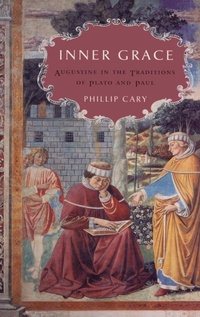
Inner Grace
Augustine in the Traditions of Plato and Paul
Published on 10. April 2008
Book
Hardback
208 pages
978-0-19-533648-1 (ISBN)
Description
Augustine's epochal doctrine of grace is often portrayed as a break from his earlier Platonism, but in Inner Grace, Phillip Cary argues it should be seen instead as the way Augustines Platonism developed as he read the apostle Paul. Augustines concept of grace as an inner gift that moves, turns and strengthens the will from within requires a Platonist conception of the soul's inner relation to the Good. What he adds to this conception is that grace is needed not only for the mind to see God but also for the will to turn away from lower goods and love God as its eternal Good, and even for it to choose faith in Christ, the temporal road by which the soul journeys to God. Thus over the course of Augustine's career the scope of the soul's need for grace expands outward from intellect to love and then to faith. At every stage, Augustine insists that divine grace does not compromise or coerce the human will but frees, helps and strengthens it, precisely because grace is not an external force but an inner gift of delight. But as his polemic against the Pelagians develops, increasingly more is attributed to grace and less to the power of free will. At the end of his career this results in an explicit doctrine of predestination, according to which it is ultimately God who chooses who shall be saved. Behind predestination therefore is divine election, which Augustine understands as God choosing some rather than others for salvation. This contrasts with the Biblical doctrine of election, Cary argues, in which some are chosen for the blessing of others: e.g., Israel for the nations and Christ for the world. In this Biblical doctrine, grace and blessing are external rather than inner gifts, because they always come to us from others outside us.
Reviews / Votes
Inner Grace is a fresh analysis of Augustinian grace issuing a compelling challenge to dominant perceptions. * Sophie Hampshire, Expository Times * well-written, perceptive and thought-provoking book... a stimulating new approach * Josef Loessl, The Journal of Theological Studies *More details
Language
English
Place of publication
New York
United States
Target group
College/higher education
Dimensions
Height: 240 mm
Width: 161 mm
Thickness: 16 mm
Weight
479 gr
ISBN-13
978-0-19-533648-1 (9780195336481)
Copyright in bibliographic data and cover images is held by Nielsen Book Services Limited or by the publishers or by their respective licensors: all rights reserved.
Schweitzer Classification
Other editions
Additional editions
E-Book
03/2008
1st Edition
OUP eBook
€41.49
Available for download
E-Book
03/2008
1st Edition
OUP eBook
€41.49
Available for download
Person
Phillip Cary is Professor of Philosophy at Eastern University in St. Davids, PA, where he is also Scholar-in-Residence at the Templeton Honors College. He is author of Augustines Invention of the Inner Self (Oxford University Press, 2000) as well as lecture series on Augustine, on Luther and on Philosophy of Religion published by The Teaching Company.
Content
INTRODUCTION; CONCLUSION; APPENDIX: PHASES OF AUGUSTINE'S ANTI-PELAGIAN WRITINGS