

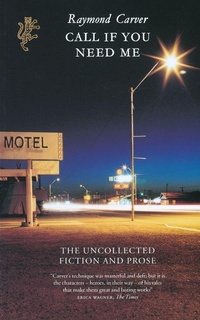
Call If You Need Me
Published on 21. June 2001
Book
Paperback/Softback
320 pages
978-1-86046-846-9 (ISBN)
Description
When he died in August 1988, Raymond Carver had just published what were thought to be his last stories in the collection entitled Elephant and his own collection of stories, Where I'm Calling from. Five previously unpublished stories have recently been discovered, and this new volume brings together all of his uncollected fiction, including a fragment of an unfinished novel, five early stories, and all of his non-fiction prose.
Three of these late-found stories are fine examples of Carver's late, open style, while two date from his middle period. The non-fiction prose includes all of his essays, together with occasional commentary on his own fiction and poetry, writings on the American short story, and reviews of work by his contemporaries, among them Donald Barthelme, Richard Brautigan, Jim Harrison, Thomas McGuane and Richard Ford. Also included is Carver's latest essay "Friendship", about a London reunion with Richard Ford and Tobias Wolff.
Call If You Need Me takes us into Carver's workshop, and alongside All of Us: The Collected Poems and Where I'm Calling from: The Selected Stories completes the picture of one of the most original writers in the English language of his generation.
Three of these late-found stories are fine examples of Carver's late, open style, while two date from his middle period. The non-fiction prose includes all of his essays, together with occasional commentary on his own fiction and poetry, writings on the American short story, and reviews of work by his contemporaries, among them Donald Barthelme, Richard Brautigan, Jim Harrison, Thomas McGuane and Richard Ford. Also included is Carver's latest essay "Friendship", about a London reunion with Richard Ford and Tobias Wolff.
Call If You Need Me takes us into Carver's workshop, and alongside All of Us: The Collected Poems and Where I'm Calling from: The Selected Stories completes the picture of one of the most original writers in the English language of his generation.
Reviews / Votes
Raymond Carver has done what many of the most gifted writers fail to do, he has invented a country of his own -- Michael Wood * New York Times * The prose is a prayer book of simple words, unsentimental. Carver's gleam -- Tom Adair * Scotsman * Carver the writer is still the hero of this story, as this 'last of the last' abundantly proves -- Bharart Tandon * Times Literary Supplement * In Call If You Need Me, generosity and fidelity to his characters shine from every page... In his style, Carver may have affinities with Hemingway, but his portrayal of relationships between men and women is deeper and more nuanced than anything the old bullfighter ever committed to print -- Toby Mundy * New Statesman *More details
Language
English
Place of publication
London
United Kingdom
Publishing group
Vintage Publishing
Dimensions
Height: 216 mm
Width: 135 mm
Thickness: 19 mm
Weight
437 gr
ISBN-13
978-1-86046-846-9 (9781860468469)
Copyright in bibliographic data and cover images is held by Nielsen Book Services Limited or by the publishers or by their respective licensors: all rights reserved.
Schweitzer Classification
Other editions
Additional editions
Previous edition

Raymond Carver | William L. Stull
Call If You Need ME
The Uncollected Writings with Five Previously Unpublished Titles
Book
07/2000
The Harvill Press
€33.61
Article exhausted; check for reprint
Person
Raymond Carver was born in Clatskanie, Oregon, in 1938. His father was a saw-mill worker and his mother was a waitress and clerk. He married early and for years writing had to come second to earning a living for his young family. Despite small-press publication, it was not until Will You Please Be Quiet Please? appeared in 1976 that his work began to reach a wider audience. This was the year in which he gave up alcohol, which had contributed to the collapse of his marriage. In 1977 he met the writer Tess Gallagher, with whom he shared the last eleven years of his life. During this prolific period he wrote three collections of stories, What We Talk About When We Talk About Love, Cathedral and Elephant. Fires, a collection of essays, poems and stories, appeared in 1985, followed by three further collections of poetry. In 1988 he completed the poetry collection A New Path to the Waterfall.