

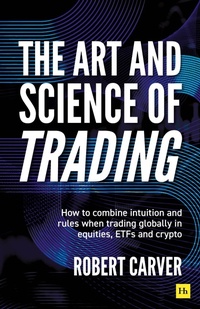
The Art and Science of Trading
How to combine intuition and rules when trading globally in equities, ETFs and crypto
Will be published approx. on 1. December 2026
Book
Hardback
256 pages
978-1-80409-479-2 (ISBN)
Description
Is trading an art or a science?
The Art and Science of Trading reveals why the world's best traders - whether intuitive artists or systematic scientists - all follow the same proven rules.
Some traders are artists, using purely intuitive methods to decide when to trade. Others are more like scientists, trading systematically with no room for human judgment. Among the very best traders in the world, you will find both discretionary artists and systematic scientists.
So, what distinguishes good traders from bad ones? Good traders all follow certain rules.
These rules are virtually the same for all outstanding traders, regardless of their preference for intuition or algorithms. The key rules are scientific - they are underpinned by the mathematics and financial theory which systematic traders are well versed in, and successful artistic traders also follow instinctively.
In contrast, bad traders do not follow these rules. They use a dangerous mixture of gut feeling and half-baked pseudo-scientific methods. Most of them will lose money, unless they are especially lucky.
This book is about combining art and science. Part of a successful trading strategy can be purely artistic - down to your intuition. It could also be entirely scientific. But however you trade, you must always follow certain key, scientifically grounded rules.
Master these principles, and you will have a better chance of succeeding as a trader.
The Art and Science of Trading reveals why the world's best traders - whether intuitive artists or systematic scientists - all follow the same proven rules.
Some traders are artists, using purely intuitive methods to decide when to trade. Others are more like scientists, trading systematically with no room for human judgment. Among the very best traders in the world, you will find both discretionary artists and systematic scientists.
So, what distinguishes good traders from bad ones? Good traders all follow certain rules.
These rules are virtually the same for all outstanding traders, regardless of their preference for intuition or algorithms. The key rules are scientific - they are underpinned by the mathematics and financial theory which systematic traders are well versed in, and successful artistic traders also follow instinctively.
In contrast, bad traders do not follow these rules. They use a dangerous mixture of gut feeling and half-baked pseudo-scientific methods. Most of them will lose money, unless they are especially lucky.
This book is about combining art and science. Part of a successful trading strategy can be purely artistic - down to your intuition. It could also be entirely scientific. But however you trade, you must always follow certain key, scientifically grounded rules.
Master these principles, and you will have a better chance of succeeding as a trader.
More details
Language
English
Place of publication
Petersfield
United Kingdom
Dimensions
Height: 244 mm
Width: 170 mm
ISBN-13
978-1-80409-479-2 (9781804094792)
Copyright in bibliographic data and cover images is held by Nielsen Book Services Limited or by the publishers or by their respective licensors: all rights reserved.
Schweitzer Classification
Other editions
Additional editions
Robert Carver
The Art and Science of Trading
How to combine intuition and rules when trading globally in equities, ETFs and crypto
E-Book
approx. 12/2026
Harriman House Publishing
€36.99
Not yet available
Person
Robert Carver is an independent trader and bestselling author, with nearly thirty years of trading experience. He is currently a visiting lecturer at Queen Mary, University of London, and a research advisor for Stylus Digital; a hedge fund trading cryptocurrencies. Rob is also engaged as a consultant on an undisclosed basis by several other institutional trading firms.
Rob's career in finance began at Barclays investment bank where he traded exotic derivative products. Subsequently, he worked as a portfolio manager for AHL - one of the worlds largest hedge funds - before, during, and after the global financial meltdown of 2008. He was responsible for the creation of AHL's fundamental global macro strategy, and subsequently managed the funds multi billion dollar fixed income portfolio.
Rob has Bachelors and Masters degrees in Economics, and is the author of four previous books published by Harriman House including Advanced Futures Trading Strategies, Leveraged Trading, Systematic Trading, and The Art and Science of Trading. He trades his own portfolio using the techniques you can find in his books.
Rob's career in finance began at Barclays investment bank where he traded exotic derivative products. Subsequently, he worked as a portfolio manager for AHL - one of the worlds largest hedge funds - before, during, and after the global financial meltdown of 2008. He was responsible for the creation of AHL's fundamental global macro strategy, and subsequently managed the funds multi billion dollar fixed income portfolio.
Rob has Bachelors and Masters degrees in Economics, and is the author of four previous books published by Harriman House including Advanced Futures Trading Strategies, Leveraged Trading, Systematic Trading, and The Art and Science of Trading. He trades his own portfolio using the techniques you can find in his books.