

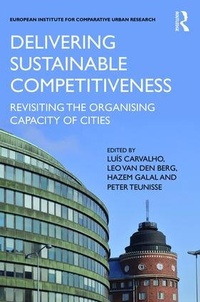
Delivering Sustainable Competitiveness
Revisiting the organising capacity of cities
1st Edition
Published on 21. June 2016
Book
Hardback
246 pages
978-1-4724-8267-9 (ISBN)
Description
Global trends such as climate change, digitalisation, enhanced concepts of democracy and the consequences of the 2008 financial crisis are changing the playing field of cities across the world. Urban development objectives are shifting away from being purely concerned with wealth creation and competitiveness, to increasingly combining social and environmental dimensions. In this context, how can cities influence and sustain their competitive position over time? Which new types of urban strategies are emerging, and which organising capacities are proving the most important?
This book provides insight into the complex issue of delivering sustainable competitiveness by analysing a number of innovative urban development strategies in context. Questions and topics addressed include: how can new legacies of city events be secured; how can clean technology industries be nurtured through urban regeneration initiatives; and how can the impact of urban safety strategies be enhanced? These and other pivotal questions are explored through close attention to the enabling factors linking ideas with results, such as distributed leadership, collaboration, communication and experimentation. Combining case studies from Europe, Africa, South America and Southeast Asia, the book provides a truly international perspective on the potentials and limitations of a new generation of urban development and competitiveness strategies.
This book provides insight into the complex issue of delivering sustainable competitiveness by analysing a number of innovative urban development strategies in context. Questions and topics addressed include: how can new legacies of city events be secured; how can clean technology industries be nurtured through urban regeneration initiatives; and how can the impact of urban safety strategies be enhanced? These and other pivotal questions are explored through close attention to the enabling factors linking ideas with results, such as distributed leadership, collaboration, communication and experimentation. Combining case studies from Europe, Africa, South America and Southeast Asia, the book provides a truly international perspective on the potentials and limitations of a new generation of urban development and competitiveness strategies.
More details
Series
Language
English
Place of publication
London
United Kingdom
Publishing group
Taylor & Francis Ltd
Target group
Professional and scholarly
Illustrations
18 s/w Abbildungen, 18 s/w Zeichnungen, 27 s/w Tabellen
27 Tables, black and white; 18 Line drawings, black and white; 18 Illustrations, black and white
Dimensions
Height: 246 mm
Width: 174 mm
Weight
640 gr
ISBN-13
978-1-4724-8267-9 (9781472482679)
Copyright in bibliographic data and cover images is held by Nielsen Book Services Limited or by the publishers or by their respective licensors: all rights reserved.
Schweitzer Classification
Other editions
Additional editions
Luis Carvalho | Leo van den Berg | Hazem Galal
Delivering Sustainable Competitiveness
Revisiting the organising capacity of cities
Book
09/2020
1st Edition
Routledge
€65.50
Shipment within 15-20 days
Luis Carvalho | Leo van den Berg | Hazem Galal
Delivering Sustainable Competitiveness
Revisiting the organising capacity of cities
E-Book
07/2016
Routledge
€59.49
Available for download
Luis Carvalho | Leo van den Berg | Hazem Galal
Delivering Sustainable Competitiveness
Revisiting the organising capacity of cities
E-Book
07/2016
Routledge
€59.49
Available for download
Persons
Luis Carvalho is Senior Researcher at the European Institute for Comparative Urban Research (EURICUR) and at the Centre of Studies in Geography and Spatial Planning (CEGOT), based at the University of Porto. His research addresses local economic development dynamics, innovation and economic geography issues. He has been closely involved in a number of international comparative studies in several European, Asian and Latin American cities and in the coordination of academic and executive education in his fields of expertise. Current research focuses on the geography of smart city innovation and sociotechnical transitions in cities.
Leo van den Berg is Emeritus Professor at the Erasmus University Rotterdam and has been active in the field of urban management and regional economics for more than 40 years. He has been Director of the European Institute for Comparative Research (EURICUR) for more than 25 years and has conducted urban research in more than 130 cities in all parts of the world. Since 1995 he has been an active member of the Global Urban Competitiveness Project (GUCP). He is the (co-)author of 27 books and has contributed to more than 100 articles, book chapters and other publications.
Hazem Galal is a PwC Partner and the global Leader for PwC's Cities and Local Government Sector. With 25 years of consulting experience, he has expertise in strategy formulation and implementation for cities and local government entities. He has supported several city projects in the United States, Middle East, Latin America, Asia, Africa and Europe. Galal is a frequent speaker at numerous global conferences and panels on cities organised by the World Cities Summit, World Bank, World Islamic Economic Forum, Asian Development Bank, United Nations and other international bodies as well as local and national governments around the world. He has also been hosted as a city expert on several occasions by leading media channels such as the BBC, CNBC, Russia Today and Channel News Asia.
Peter Teunisse works at the Public Sector practice within PwC Advisory, the Netherlands and is Senior Director for Cities and Local Government. Since 1990 he has led several consultancy projects for the Dutch government, as well as for local and regional authorities. Since 2004 he has been a core-team member of the international PwC network for Cities, Regions and Local Government. He has published various articles and books about the organisation of Dutch cities and is one of the lead authors of the international PwC publications on the future of cities.
Leo van den Berg is Emeritus Professor at the Erasmus University Rotterdam and has been active in the field of urban management and regional economics for more than 40 years. He has been Director of the European Institute for Comparative Research (EURICUR) for more than 25 years and has conducted urban research in more than 130 cities in all parts of the world. Since 1995 he has been an active member of the Global Urban Competitiveness Project (GUCP). He is the (co-)author of 27 books and has contributed to more than 100 articles, book chapters and other publications.
Hazem Galal is a PwC Partner and the global Leader for PwC's Cities and Local Government Sector. With 25 years of consulting experience, he has expertise in strategy formulation and implementation for cities and local government entities. He has supported several city projects in the United States, Middle East, Latin America, Asia, Africa and Europe. Galal is a frequent speaker at numerous global conferences and panels on cities organised by the World Cities Summit, World Bank, World Islamic Economic Forum, Asian Development Bank, United Nations and other international bodies as well as local and national governments around the world. He has also been hosted as a city expert on several occasions by leading media channels such as the BBC, CNBC, Russia Today and Channel News Asia.
Peter Teunisse works at the Public Sector practice within PwC Advisory, the Netherlands and is Senior Director for Cities and Local Government. Since 1990 he has led several consultancy projects for the Dutch government, as well as for local and regional authorities. Since 2004 he has been a core-team member of the international PwC network for Cities, Regions and Local Government. He has published various articles and books about the organisation of Dutch cities and is one of the lead authors of the international PwC publications on the future of cities.
Content
Chapter 1 Organising Capacity for Sustainable Urban Competitiveness
(Luis Carvalho, Leo van den Berg, Hazem Galal and Peter Teunisse)
Chapter 2 Digital Strategy (Manchester)
(Luis Carvalho and Erwin van Tuijl)
Chapter 3 Dublinked (Dublin)
(Luis Carvalho and Alexander Otgaar
Chapter 4 Integrated Housing Development Programme (Addis Ababa)
(Alberto Gianoli and Alexander Otgaar)
Chapter 5 Kasongan Pottery Cluster (Yogyakarta)
(Jan Fransen and Erwin van Tuijl
Chapter 6 Mobile World Capital (Barcelona)
(Alexander Otgaar and Luis Carvalho
Chapter 7 Pacifying Police Units (Rio de Janeiro)
(Hazem Galal
Chapter 8 Park Railway North (Antwerp)
(Jan van der Meer and Alexander Otgaar)
Chapter 9 Phoenix Project (Dortmund)
(Erwin van Tuijl and Leo van den Berg)
Chapter 10 RDM Campus (Rotterdam)
(Erwin van Tuijl and Alexander Otgaar)
Chapter 11 Water Management Strategy (Singapore)
(Sarah Lide
Chapter 12 World Design Capital (Helsinki)
Alexander Otgaar and Luis Carvalho
Chapter 13 Strategies, Dilemmas and Capabilities for Urban Managers
Luis Carvalho, Leo van den Berg, Hazem Galal and Peter Teunisse
(Luis Carvalho, Leo van den Berg, Hazem Galal and Peter Teunisse)
Chapter 2 Digital Strategy (Manchester)
(Luis Carvalho and Erwin van Tuijl)
Chapter 3 Dublinked (Dublin)
(Luis Carvalho and Alexander Otgaar
Chapter 4 Integrated Housing Development Programme (Addis Ababa)
(Alberto Gianoli and Alexander Otgaar)
Chapter 5 Kasongan Pottery Cluster (Yogyakarta)
(Jan Fransen and Erwin van Tuijl
Chapter 6 Mobile World Capital (Barcelona)
(Alexander Otgaar and Luis Carvalho
Chapter 7 Pacifying Police Units (Rio de Janeiro)
(Hazem Galal
Chapter 8 Park Railway North (Antwerp)
(Jan van der Meer and Alexander Otgaar)
Chapter 9 Phoenix Project (Dortmund)
(Erwin van Tuijl and Leo van den Berg)
Chapter 10 RDM Campus (Rotterdam)
(Erwin van Tuijl and Alexander Otgaar)
Chapter 11 Water Management Strategy (Singapore)
(Sarah Lide
Chapter 12 World Design Capital (Helsinki)
Alexander Otgaar and Luis Carvalho
Chapter 13 Strategies, Dilemmas and Capabilities for Urban Managers
Luis Carvalho, Leo van den Berg, Hazem Galal and Peter Teunisse