

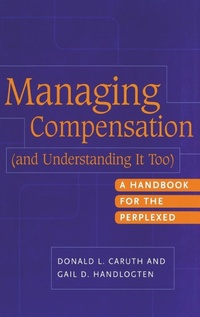
Managing Compensation (and Understanding It Too)
A Handbook for the Perplexed
Published on 28. February 2001
Book
Hardback
280 pages
978-1-56720-380-6 (ISBN)
Description
This text is a lively, well-written, and carefully illustrated guide to the mysteries and mystique of how people are compensated for their efforts in all types of organizations. With clear discussions of what works, what doesn't, and why, this intensely practical handbook it covers such topics as job evaluation; job pricing; employee benefit programs; pay for performance; and the compensation of executives, sales personnel, and international employees. Executives and managers with no special training in pay determination and management will find it an easily accessible handbook that not only makes clear how compensation systems are conceived and developed but most importantly, how they are implemented and administrated. Its logical presentation and full coverage makes the book valuable as a text for upper-level college students as well as a solid instructional resource for teachers.
The authors open with an overview of compensation and its role in organizations and then move to the legal environment in which compensation is embedded and the laws that govern it. They describe current and traditional views of motivation and elucidate the importance of job analysis and its end products--job description and job specification. The role of compensation surveys and their use in assigning monetary rates to jobs are discussed. A topic of special interest to executives in New Economy organizations will be the purpose and importance of benefits, particularly indirect monetary compensation, stock options, and other pay for performance incentives. Caruth and Handlogten address the challange of compensating teams and pay special attention to the, often unique, problem of compensating uppermost management, sales people, and employees abroad. The text concludes with practical suggestions for the on-going maintenance and management of compensation systems and how to adapt them to changing organizational circumstances.
The authors open with an overview of compensation and its role in organizations and then move to the legal environment in which compensation is embedded and the laws that govern it. They describe current and traditional views of motivation and elucidate the importance of job analysis and its end products--job description and job specification. The role of compensation surveys and their use in assigning monetary rates to jobs are discussed. A topic of special interest to executives in New Economy organizations will be the purpose and importance of benefits, particularly indirect monetary compensation, stock options, and other pay for performance incentives. Caruth and Handlogten address the challange of compensating teams and pay special attention to the, often unique, problem of compensating uppermost management, sales people, and employees abroad. The text concludes with practical suggestions for the on-going maintenance and management of compensation systems and how to adapt them to changing organizational circumstances.
More details
Language
English
Place of publication
United States
Publishing group
Bloomsbury Publishing Plc
Target group
College/higher education
Professional and scholarly
Dimensions
Height: 240 mm
Width: 161 mm
Thickness: 20 mm
Weight
587 gr
ISBN-13
978-1-56720-380-6 (9781567203806)
Copyright in bibliographic data and cover images is held by Nielsen Book Services Limited or by the publishers or by their respective licensors: all rights reserved.
Schweitzer Classification
Other editions
Additional editions
Donald L. Caruth | Gail D. Handlogten
Managing Compensation (and Understanding It Too)
A Handbook for the Perplexed
E-Book
02/2001
1st Edition
Praeger Publishers Inc
€82.49
Available for download
Persons
DONALD L. CARUTH holds a doctorate degree in management and has consulted on human resource matters, particularly pay and other forms of compensation, for more than 30 years. He is also Professor of Management at Amberton University, author of numerous books and articles, and co-author of Staffing the Contemporary Organization (Quorum, 1997).
GAIL D. HANDLOGTEN is a human resource management consultant. With an advanced degree in human resources and training, she is a certified mediator and arbitrator and author or coauthor of more than 30 articles and books.
GAIL D. HANDLOGTEN is a human resource management consultant. With an advanced degree in human resources and training, she is a certified mediator and arbitrator and author or coauthor of more than 30 articles and books.
Content
Preface An Overview of Compensation Management The Legal Framework Motivation and Compensation Job Analysis Job Evaluation: Non-Quantitative Techniques Job Evaluation: Quantitative Techniques Compensation Surveys Job Pricing Indirect Monetary Compensation: The Role of Benefits Incentives: Pay for Performance Performance Appraisal Systems Compensation of Special Groups Compensation Administration Selected Bibliography Compensation Websites Index