

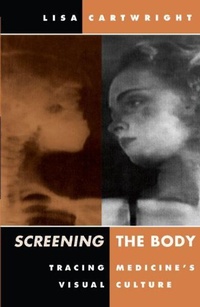
Screening the Body
Tracing Medicine's Visual Culture
Published on 9. March 1995
Book
Paperback/Softback
224 pages
978-0-8166-2290-0 (ISBN)
Description
Moving images are used as diagnostic tools and locational devices every day in hospitals, clinics, and laboratories. But how and when did they come to be established and accepted sources of knowledge about the body in medical culture? How are the specialized techniques and codes of these imaging techniques determined, and whose bodies are studied, diagnosed, and treated with the help of optical recording devices?
Screening the Body traces the fascinating history of scientific film during the late nineteenth and early twentieth centuries to show that early experiments with cinema are important precedents of contemporary medical techniques such as ultrasound and PET scanning. Lisa Cartwright brings to light eccentric projects in the history of science and medicine, such as Thomas Edison's sensational attempt to image the brain with X rays before a public audience, and the efforts of doctors to use the motion picture camera to capture movements of the body, from the virtually imperceptible flow of blood to epileptic seizures.
Drawing on feminist film theory, cultural studies, the history of film, and the writings of Foucault, Cartwright illustrates how this scientific cinema was part of a broader tendency in society toward the technological surveillance, management, and physical transformation of the individual body and the social body. She unveils an area of film culture that has rarely been discussed but that will leave readers with a new way of seeing the everyday practice of diagnostic imaging that we all inevitably encounter in clinics and hospitals.
Screening the Body traces the fascinating history of scientific film during the late nineteenth and early twentieth centuries to show that early experiments with cinema are important precedents of contemporary medical techniques such as ultrasound and PET scanning. Lisa Cartwright brings to light eccentric projects in the history of science and medicine, such as Thomas Edison's sensational attempt to image the brain with X rays before a public audience, and the efforts of doctors to use the motion picture camera to capture movements of the body, from the virtually imperceptible flow of blood to epileptic seizures.
Drawing on feminist film theory, cultural studies, the history of film, and the writings of Foucault, Cartwright illustrates how this scientific cinema was part of a broader tendency in society toward the technological surveillance, management, and physical transformation of the individual body and the social body. She unveils an area of film culture that has rarely been discussed but that will leave readers with a new way of seeing the everyday practice of diagnostic imaging that we all inevitably encounter in clinics and hospitals.
More details
Language
English
Place of publication
Minnesota
United States
Target group
College/higher education
Professional and scholarly
Dimensions
Height: 229 mm
Width: 151 mm
Thickness: 12 mm
Weight
304 gr
ISBN-13
978-0-8166-2290-0 (9780816622900)
Copyright in bibliographic data and cover images is held by Nielsen Book Services Limited or by the publishers or by their respective licensors: all rights reserved.
Schweitzer Classification
Person
Lisa Cartwright is an assistant professor of English and visual and cultural studies at the University of Rochester. With Paula A. Treichler, she is coeditor of Imaging Technologies, Inscribing Science, a forthcoming anthology on gender and the visual and inscriptive culture of medicine and science.