

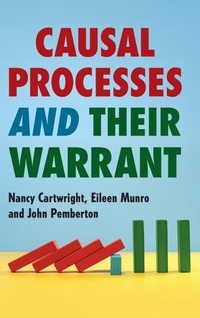
Causal Processes and their Warrant
Published on 14. May 2026
Book
Hardback
322 pages
978-1-009-40832-5 (ISBN)
Description
In this book, Nancy Cartwright, Eileen Munro and John Pemberton introduce a new method for assessing whether plans for how to affect change produced their intended outcome, or whether they are likely to do so in the future. The method offers the prospect of a step-change improvement in the accuracy of policy assessments, based on a new pluralistic theory of causation. This theory, which goes beyond existing ones, synthesises seven tried and tested familiar component accounts so as to license identification and systematisation of a wide range of evidence types. The authors outline well-grounded improvements to methods for policy development and assessment by the systematic use of real-world examples, including notably that of child welfare. Their book will be valuable for the burgeoning audience concerned with the critical issue of how to develop and implement policies that work across domains from welfare to education and economics to medicine.
Reviews / Votes
'This is a detailed and thought-provoking account of how to evidence single-case causal claims. It is clear and engaging-I would recommend it to all evaluators and researchers interested in evaluation methodology.' Jon Williamson, University of ManchesterMore details
Language
English
Place of publication
Cambridge
United Kingdom
Illustrations
Worked examples or Exercises
Dimensions
Height: 235 mm
Width: 157 mm
Thickness: 22 mm
Weight
619 gr
ISBN-13
978-1-009-40832-5 (9781009408325)
Copyright in bibliographic data and cover images is held by Nielsen Book Services Limited or by the publishers or by their respective licensors: all rights reserved.
Schweitzer Classification
Other editions
Additional editions
Nancy Cartwright | Eileen Munro | John Pemberton
Causal Processes and their Warrant
Book
05/2026
Cambridge University Press
€36.00
Shipment within 15-20 days
Persons
Nancy Cartwright is Professor of Philosophy, Durham University and Distinguished Professor, University of California at San Diego. Her books include How the Laws of Physics Lie (1983), The Dappled World (Cambridge 1999), Hunting Causes and Using Them (Cambridge 2007), Evidence-based Policy: Doing it Better (2012), and The Tangle of Science (2023). Eileen Munro is Emeritus Professor of Social Policy, London School of Economics. She is a philosopher and is a qualified social worker. Her academic work has combined these two strands focusing on research methods and causal processes in social work practice and in organisational functioning. John Pemberton is an Honorary Fellow in the Philosophy Department at Durham University. He works on the ontology of change, and on causation, processes, mechanisms, powers and laws of nature.
Content
Acknowledgments; Overview; Introduction; Technical note: production and difference-making; Technical note: evidential pluralism and singular causation; Part I. A Theory of Singular Causation: 1. Towards a thick theory of singular causal processes; 1.1 Formal relations; 1.2 Processes and mediators; 1.3 INUS conditions; 1.4 Activities; Technical note: causation, continuity and activities; 1.5 Tendency principles; Technical note: science for a fragile world (Robert Northcott); 1.6 Situation-Specific Causal Equation Models (SCEMs); 1.7 Underlying systems; 1.8 What we have done in part 1; Part II. What's Warrant for Singular Causal Processes and Why: 2. What happens in part 2; 2.1 Evidence-role maps: marshalling the evidence; Technical note: process triggers; Technical note: what you can gain from learning that the events in the boxes occur; 2.2 What evidence should you collect?; 2.3 What should you do with all this information now you have assembled and organised it?; 2.4 What we have done in Part 2; Part III. Case Study of the Implementation of Signs of Safety in M, a UK Agency Providing a Child Protection Service: 3.1 Introduction; 3.2 Background on child protection services and signs of safety; 3.3 What happened in M; 3.4 Did all this Help?; 3.5 Constructing evidence-role maps; 3.6 Reflections; 3.7 What we have done in Part 3; Bibliography; Index.