

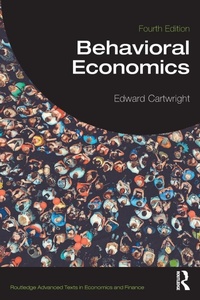
Behavioral Economics
4th Edition
Published on 22. January 2024
Book
Paperback/Softback
578 pages
978-1-032-41410-2 (ISBN)
Description
Over the last few decades behavioral economics has revolutionized the discipline. It has done so by putting the human back into economics, by recognizing that people sometimes make mistakes, care about others and are generally not as cold and calculating as economists have traditionally assumed. The results have been exciting and fascinating, and have fundamentally changed the way we look at economic behavior.
This textbook introduces all the key results and insights of behavioral economics to a student audience. Ideas such as mental accounting, prospect theory, present bias, inequality aversion and learning are explained in detail. These ideas are also applied in diverse settings, such as auctions, stock market crashes, charitable donations and health care, to show why behavioral economics is crucial to understanding the world around us. Consideration is also given to what makes people happy, and how we can potentially nudge people to be happier.
This new edition contains expanded and updated coverage of several topics and applications, including fraud and cybercrime, cryptocurrency, public health messaging, and the COVID-19 pandemic. The companion website is also updated with a range of new questions and worked examples. This book remains the ideal introduction to behavioral economics for advanced undergraduate and graduate students.
This textbook introduces all the key results and insights of behavioral economics to a student audience. Ideas such as mental accounting, prospect theory, present bias, inequality aversion and learning are explained in detail. These ideas are also applied in diverse settings, such as auctions, stock market crashes, charitable donations and health care, to show why behavioral economics is crucial to understanding the world around us. Consideration is also given to what makes people happy, and how we can potentially nudge people to be happier.
This new edition contains expanded and updated coverage of several topics and applications, including fraud and cybercrime, cryptocurrency, public health messaging, and the COVID-19 pandemic. The companion website is also updated with a range of new questions and worked examples. This book remains the ideal introduction to behavioral economics for advanced undergraduate and graduate students.
More details
Series
Edition
4th edition
Language
English
Place of publication
London
United Kingdom
Publishing group
Taylor & Francis Ltd
Target group
College/higher education
Postgraduate and Undergraduate
Illustrations
220 s/w Abbildungen, 220 s/w Zeichnungen, 113 s/w Tabellen
113 Tables, black and white; 220 Line drawings, black and white; 220 Illustrations, black and white
Dimensions
Height: 234 mm
Width: 156 mm
Thickness: 33 mm
Weight
916 gr
ISBN-13
978-1-032-41410-2 (9781032414102)
Copyright in bibliographic data and cover images is held by Nielsen Book Services Limited or by the publishers or by their respective licensors: all rights reserved.
Schweitzer Classification
Other editions
Additional editions
Edward Cartwright
Behavioral Economics
Book
01/2024
4th Edition
Routledge
€249.50
Shipment within 10-20 days
Edward Cartwright
Behavioral Economics
E-Book
01/2024
4th Edition
Taylor & Francis
€81.99
Available for download
Edward Cartwright
Behavioral Economics
E-Book
01/2024
4th Edition
Taylor & Francis
€81.99
Available for download
Previous edition
Edward Cartwright
Behavioral Economics
Book
01/2018
3rd Edition
Routledge
€90.55
Article exhausted; check for reprint
Person
Edward Cartwright is Professor of Economics at De Montfort University, UK.
Content
Part I: Introduction 1. An introduction to behavioral economics Part II: Economic behavior 2. Simple heuristics for complex choices 3. Choice with risk 4. Choosing when to act 5. Learning from new information 6. Interacting with others 7. Social preferences Part III: Origins of behavior 8. Evolution and culture 9. Neuroeconomics Part IV: Welfare and policy 10. Happiness and utility 11. Policy and behavior