

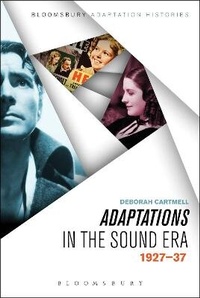
Adaptations in the Sound Era
1927-37
Published on 30. July 2015
Book
Paperback/Softback
176 pages
978-1-62356-878-8 (ISBN)
Description
There is no disputing that the coming of sound heralded a new era for adaptations. We take it for granted today that a film is enhanced by sound but it was not a view unanimously held in the early period of sound cinema. While there was a substantial degree of skepticism in the late 1920s and early 30s about the advantages of sound, what we would call technophobia today, the inclusion of speech in screen versions of literary and theatrical works, undeniably revised what it was to be an adaptation: words.
Focusing on promotional materials, Adaptations in the Sound Era tracks early attempts to promote sound through the elevation of words in adaptations in the early sound period. The popular appeal of these films clearly stands in opposition to academic regard for them and the book reflects on the presence and marketing of 'words' in a variety of adaptations, from the introduction of sound in the late 1920s to the mid 1930s. This book contextualizes a range of adaptations in relation to debates about 'picturizations' of books in the early sound era, including reactions to the talking adaptation by writers such as, Irwin Panofsky, Aldous Huxley and Graham Greene. Film adaptations of Shakespeare, Dickens, gothic fiction and biopics are also discussed in relation to their use and promotion of sound or, more precisely, words.
Focusing on promotional materials, Adaptations in the Sound Era tracks early attempts to promote sound through the elevation of words in adaptations in the early sound period. The popular appeal of these films clearly stands in opposition to academic regard for them and the book reflects on the presence and marketing of 'words' in a variety of adaptations, from the introduction of sound in the late 1920s to the mid 1930s. This book contextualizes a range of adaptations in relation to debates about 'picturizations' of books in the early sound era, including reactions to the talking adaptation by writers such as, Irwin Panofsky, Aldous Huxley and Graham Greene. Film adaptations of Shakespeare, Dickens, gothic fiction and biopics are also discussed in relation to their use and promotion of sound or, more precisely, words.
Reviews / Votes
Adaptation studies thrive amongst the complex and fertile interactions of writing, theatre and film. Disciplinary boundaries, professional territorialism and critical conventions often impede our access to the truth about those cultural relationships. Deborah Cartmell's new book provokes us to dismantle barriers, disown vested interests and think again about the written and spoken word and their screen manifestations. Using the transition from silent to sound movies as a test-case, Cartmell demonstrates, with erudition, acumen and penetrating theoretical insight, that screen adaptations need to be explained by their economic, political, social and cultural entanglements, and not as separable 'works' of literature, drama or film. * Graham Holderness, Professor of English, University of Hertfordshire, UK * Deborah Cartmell makes an important and foundational contribution to the growing scholarship that brings a film historical approach to adaptation studies. Organised around the introduction of sound to cinema and considering a range of film adaptations-from Shakespeare to children's literature-Cartmell focuses her study on the marketing and promotional material of the films and considers them in relation to film critics' ambivalence about the new technology and literary critics' anxiety about mass-produced culture. Adaptations in the Sound Era clearly articulates the importance of this decade for establishing the expectations for and debates about fidelity that have dominated adaptation studies ever since, making it a must-have for anyone who studies film adaptation in any period. * Shelley Cobb, Associate Professor of Film and English, University of Southampton, UK *More details
Series
Language
English
Place of publication
New York
United States
Publishing group
Bloomsbury Publishing Plc
Target group
Professional and scholarly
Illustrations
14 bw illus
Dimensions
Height: 226 mm
Width: 148 mm
Thickness: 14 mm
Weight
260 gr
ISBN-13
978-1-62356-878-8 (9781623568788)
Copyright in bibliographic data and cover images is held by Nielsen Book Services Limited or by the publishers or by their respective licensors: all rights reserved.
Schweitzer Classification
Other editions
Additional editions
E-Book
07/2015
1st Edition
Bloomsbury Academic USA
€33.99
Available for download
E-Book
07/2015
1st Edition
Bloomsbury Academic USA
€33.99
Available for download
Person
Deborah Cartmell is Professor of English and Director of the Centre for Adaptations at De Montfort University, UK, founder and co-editor of the international journals Shakespeare and Adaptation, founder and former Chair of the Association of Adaptation Studies.
Content
Chapter 1: Introduction: Early Reactions to Sound Adaptations
Chapter 2: The Taming of the Shrew (1929) and the First Adaptation of Shakespeare
Chapter 3: Sound Shakespeares in the 1930s
Chapter 4: Sound Dickens in the 1930s
Chapter 5: Sound and Early 1930s Biopics: Disraeli (1929), The Private Life of Henry VIII (1933), Cleopatra (1934), The Barretts of Wimpole Street (1934)
Chapter 6: Sound and the Gothic Survival of 1931
Chapter 7: Conclusion: The Sound Adaptation Genre
References: Key Critical Works and a List of Adaptations
Chapter 2: The Taming of the Shrew (1929) and the First Adaptation of Shakespeare
Chapter 3: Sound Shakespeares in the 1930s
Chapter 4: Sound Dickens in the 1930s
Chapter 5: Sound and Early 1930s Biopics: Disraeli (1929), The Private Life of Henry VIII (1933), Cleopatra (1934), The Barretts of Wimpole Street (1934)
Chapter 6: Sound and the Gothic Survival of 1931
Chapter 7: Conclusion: The Sound Adaptation Genre
References: Key Critical Works and a List of Adaptations