

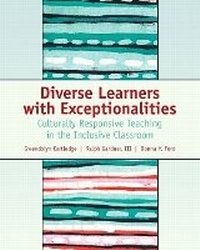
Diverse Learners with Exceptionalities
Culturally Responsive Teaching in the Inclusive Classroom
Published on 15. February 2008
Book
Paperback/Softback
400 pages
978-0-13-114995-3 (ISBN)
Unfortunately, price unknown
Article is exhausted; no reprint
Description
This text focuses on the special needs of culturally and racially diverse learners with exceptionalities. The culturally and linguistically diverse learner is profiled in terms of disproportionate positions within our society and schools. A case is made for why intense attention is needed for this population, the points of greatest need for this population and why certain types of instruction are more appropriate for those students with the most significant educational needs. The text discusses the nature of culture and cultural/linguistic diversity in the United States, the exceptional learner-those with both disabilities and gifts, assessment/testing issues, family issues, ways to prevent academic and social problems through early intervention, and methods for teaching both social and academic behaviors. Additionally, the text provides community and study skill content that are especially important for CLDE learners.
Highlights of this First Edition:
An exclusive and in-depth focus of culturally and linguistically diverse learners with exceptionalities - helps educators meet the challenge of increasing the achievement of CLDE youth to meet national standards.
Introductory guiding questions - give the reader an overview of the chapter and prepares the reader for the content of the chapter.
Teacher Tips - help to recapture the main points of the preceding text and give the reader very specific steps for applying the suggested procedures and strategies.
Introductory Vignettes - authenticate the content of each chapter by demonstrating the unique conditions of CLD students with exceptionalities. Many of the vignettes are revisited at later points in the chapter to provide examples of how the concepts in the chapter related to CLDE learners.
Applications - give explicit examples of how the information can be used in the classroom. They take the guesswork out of taking theory to practice.
Related Learning Activities - found at the end of each chapter. They are largely applied so that the reader will try out the suggested strategies with actual CLDE populations.
Highlights of this First Edition:
An exclusive and in-depth focus of culturally and linguistically diverse learners with exceptionalities - helps educators meet the challenge of increasing the achievement of CLDE youth to meet national standards.
Introductory guiding questions - give the reader an overview of the chapter and prepares the reader for the content of the chapter.
Teacher Tips - help to recapture the main points of the preceding text and give the reader very specific steps for applying the suggested procedures and strategies.
Introductory Vignettes - authenticate the content of each chapter by demonstrating the unique conditions of CLD students with exceptionalities. Many of the vignettes are revisited at later points in the chapter to provide examples of how the concepts in the chapter related to CLDE learners.
Applications - give explicit examples of how the information can be used in the classroom. They take the guesswork out of taking theory to practice.
Related Learning Activities - found at the end of each chapter. They are largely applied so that the reader will try out the suggested strategies with actual CLDE populations.
More details
Language
English
Place of publication
United States
Publishing group
Pearson Education (US)
Target group
Professional and scholarly
Dimensions
Height: 254 mm
Width: 203 mm
Weight
771 gr
ISBN-13
978-0-13-114995-3 (9780131149953)
Copyright in bibliographic data and cover images is held by Nielsen Book Services Limited or by the publishers or by their respective licensors: all rights reserved.
Schweitzer Classification
Content
PART I FOUNDATION OF DIVERSITY IN SPECIAL EDUCATION
Chapter 1 Understanding Diversity
Chapter 2 Understanding the Culturally and Linguistically Diverse Exceptional Learner
PART II CREATING CULTURALLY RESPONSIVE, EQUITABLE, AND INCLUSIVE CLASSROOMS
Chapter 3 The Culturally Responsive Inclusive Classroom
Chapter 4 Disciplined Culturally and Linguistically Diverse Exceptional Learners
Chapter 5 Socially Skilled, Culturally and Linguistically Diverse Exceptional Learners
Chapter 6 Culturally Responsive Collaborations with Families
Chapter 7 Culturally Responsive Assessment with CLDE Learners
Chapter 8 Culturally Responsive Community-Based Interventions
PART III CULTURALLY RESPONSIVE INSTRUCTION
Chapter 9 Understanding Effective Instruction for Culturally and Linguistically Diverse Learners
Chapter 10 Implementing Effective Instruction in Inclusive Classrooms for Culturally and Linguistically Diverse Learners
Chapter 11 Creating Self-Directed Culturally and Linguistically Diverse Exceptional Learners
Chapter 12 Early Interventions for Culturally and Linguistically Diverse Exceptional Learners
Chapter 13 Effective Post Secondary Transitions for Culturally and Linguistically Diverse Learners with Exceptionalities
Chapter 14 Gifted and Talented Culturally and Linguistically Diverse Exceptional Learners
Chapter 1 Understanding Diversity
Chapter 2 Understanding the Culturally and Linguistically Diverse Exceptional Learner
PART II CREATING CULTURALLY RESPONSIVE, EQUITABLE, AND INCLUSIVE CLASSROOMS
Chapter 3 The Culturally Responsive Inclusive Classroom
Chapter 4 Disciplined Culturally and Linguistically Diverse Exceptional Learners
Chapter 5 Socially Skilled, Culturally and Linguistically Diverse Exceptional Learners
Chapter 6 Culturally Responsive Collaborations with Families
Chapter 7 Culturally Responsive Assessment with CLDE Learners
Chapter 8 Culturally Responsive Community-Based Interventions
PART III CULTURALLY RESPONSIVE INSTRUCTION
Chapter 9 Understanding Effective Instruction for Culturally and Linguistically Diverse Learners
Chapter 10 Implementing Effective Instruction in Inclusive Classrooms for Culturally and Linguistically Diverse Learners
Chapter 11 Creating Self-Directed Culturally and Linguistically Diverse Exceptional Learners
Chapter 12 Early Interventions for Culturally and Linguistically Diverse Exceptional Learners
Chapter 13 Effective Post Secondary Transitions for Culturally and Linguistically Diverse Learners with Exceptionalities
Chapter 14 Gifted and Talented Culturally and Linguistically Diverse Exceptional Learners