

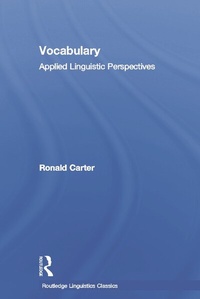
Vocabulary
Applied Linguistic Perspectives
1st Edition
Published on 28. February 2012
Book
Hardback
320 pages
978-0-415-69933-4 (ISBN)
Description
How do we teach and learn vocabulary? How do words work in literary texts? In this book, Ronald Carter provides the necessary basis for the further study of modern English vocabulary with particular reference to linguistic descriptive frameworks and educational contexts. Vocabulary: Applied Linguistic Perspectives includes an introductory account of linguistic approaches to the analysis of the modern lexicon in English and discusses key topics such as vocabulary and language teaching, dictionaries and lexicography and the literary, stylistic study of vocabulary.
This Routledge Linguistics Classic includes a substantial new introductory chapter situating the book in the current digital age, covering changes and developments in related fields from lexicography and corpus linguistics to vocabulary testing and assessment as well as additional new references.
Vocabulary: Applied Linguistic Perspectives has been widely praised since first publication for the breadth, depth and clarity of its approach and is a key text for postgraduate students and researchers studying vocabulary within the fields of English Language, Applied Linguistics and Education.
This Routledge Linguistics Classic includes a substantial new introductory chapter situating the book in the current digital age, covering changes and developments in related fields from lexicography and corpus linguistics to vocabulary testing and assessment as well as additional new references.
Vocabulary: Applied Linguistic Perspectives has been widely praised since first publication for the breadth, depth and clarity of its approach and is a key text for postgraduate students and researchers studying vocabulary within the fields of English Language, Applied Linguistics and Education.
Reviews / Votes
"[A] remarkable piece of linguistic work, embracing the basics while addressing topics or areas of particular interest or technicality. It will not only be a good text for beginners of linguistics... but will also appeal to more advanced readers." - LINGUIST List 'Indeed, the book is what the name of the series indicates, one of the linguistic classics... The book... is in and of itself a remarkable piece of linguistic work, embracing the basics while addressing topics or areas of particular interest or technicality. It will not only be a good text for beginners of linguistics who are interested in vocabulary as an object of study, but will also appeal to more advanced readers who are well aware of the interdisciplinary nature of various linguistic disciplines and are therefore looking to see how lexical study can link them all up and produce analyses that may at once be both challenging and inspiring.' - Linguist ListMore details
Series
Language
English
Place of publication
London
United Kingdom
Publishing group
Taylor & Francis Ltd
Target group
College/higher education
Dimensions
Height: 234 mm
Width: 156 mm
Weight
750 gr
ISBN-13
978-0-415-69933-4 (9780415699334)
Copyright in bibliographic data and cover images is held by Nielsen Book Services Limited or by the publishers or by their respective licensors: all rights reserved.
Schweitzer Classification
Other editions
Additional editions
E-Book
03/2012
1st Edition
Routledge
€55.49
Available for download
E-Book
03/2012
1st Edition
Routledge
€55.49
Available for download
Book
02/2012
1st Edition
Routledge
€63.80
Shipment within 15-20 days
Person
Ronald Carter is Professor of Modern English Language at the University of Nottingham, UK and has written and edited more than 30 books, including most recently Language and Creativity (2004, Routledge). He is the author and editor of twelve books with Routledge, and has edited and co-edited five Routledge series.
Content
Part I Foundations
1. What's in a word
2. The notion of core vocabulary
3. Words and patterns
4. Lexis and discourse
Part II Reviews
5. Lexis and literary stylistics
6. Lexis and lexicography
7. Learning and teaching vocabulary
Part III Case studies
8. Case study: Lexis, tones and ironies
9. Case study: Style, lexis and the dictionary
1. What's in a word
2. The notion of core vocabulary
3. Words and patterns
4. Lexis and discourse
Part II Reviews
5. Lexis and literary stylistics
6. Lexis and lexicography
7. Learning and teaching vocabulary
Part III Case studies
8. Case study: Lexis, tones and ironies
9. Case study: Style, lexis and the dictionary