

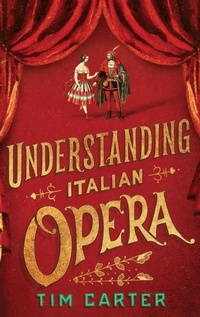
Understanding Italian Opera
Published on 26. November 2015
Book
Hardback
288 pages
978-0-19-024794-2 (ISBN)
Description
Ever since its invention in Florence around 1600, opera has exerted a peculiar fascination for creative artists and audiences alike. A "Western" genre with a global reach, it is often regarded as the pinnacle of high art, where music and drama come together in unique ways, supported by stellar singers and spectacular staging. Yet it is also patently absurd-why should anyone sing on the stage?-and shrouded in mystique. In this engaging and entertaining guide, renowned music scholar Tim Carter unravels its many layers to offer a thorough introduction to Italian opera from the seventeenth to the early-twentieth century.
Eschewing the technical music detail that all too often dominates writing on opera, Carter begins instead where the composers themselves did: with the text. Walking readers through the relationship between music and words that lies at the heart of any opera, Carter then offers explorations of five of the most enduring, emblematic, and often performed Italian operas: Monteverdi's The Coronation of Poppaea; Handel's Julius Caesar in Egypt; Mozart's The Marriage of Figaro; Verdi's Rigoletto; and Pucini's La Boheme. Shedding light on the creative collusions and collisions involved in bringing opera to the stage, the various, and varying, demands of its text and music, and the nature of its musical drama, Carter shows how Italian opera has developed over the course of music history. Complete with synopses, cast lists, and suggested further reading for each opera discussed, Understanding Italian Opera is a must-read for anyone with an interest in and love for opera.
Eschewing the technical music detail that all too often dominates writing on opera, Carter begins instead where the composers themselves did: with the text. Walking readers through the relationship between music and words that lies at the heart of any opera, Carter then offers explorations of five of the most enduring, emblematic, and often performed Italian operas: Monteverdi's The Coronation of Poppaea; Handel's Julius Caesar in Egypt; Mozart's The Marriage of Figaro; Verdi's Rigoletto; and Pucini's La Boheme. Shedding light on the creative collusions and collisions involved in bringing opera to the stage, the various, and varying, demands of its text and music, and the nature of its musical drama, Carter shows how Italian opera has developed over the course of music history. Complete with synopses, cast lists, and suggested further reading for each opera discussed, Understanding Italian Opera is a must-read for anyone with an interest in and love for opera.
Reviews / Votes
Required reading. * C. A. Traupman-Carr, CHOICE * [Carter's] book provides a splendid corrective that makes it recommended reading for anyone seeking a more complete 'understanding' of one of the most successful genres in Western culture. * Kenneth Chalmers, Opera *More details
Language
English
Place of publication
New York
United States
Target group
College/higher education
Dimensions
Height: 240 mm
Width: 161 mm
Thickness: 21 mm
Weight
642 gr
ISBN-13
978-0-19-024794-2 (9780190247942)
Copyright in bibliographic data and cover images is held by Nielsen Book Services Limited or by the publishers or by their respective licensors: all rights reserved.
Schweitzer Classification
Other editions
Additional editions
Tim Carter
Understanding Italian Opera
E-Book
09/2015
1st Edition
OUP eBook
€20.99
Available for download
Tim Carter
Understanding Italian Opera
E-Book
09/2015
1st Edition
OUP eBook
€20.99
Available for download
Person
Tim Carter is David G. Frey Distinguished Professor of Music at the University of North Carolina, Chapel Hill. He has published widely on music in late Renaissance and early Baroque Italy, Mozart's operas, and American musical theater in the 1930s and '40s. Previously on faculty at Royal Holloway, University of London, he frequently gives pre-performance lectures, and conducts adult-education workshops on opera in both the US and the UK.
Content
Preface ; 1: What is Opera? ; Some definitions ; In praise of librettists ; Italian versification ; Poetic structures and musical consequences ; Two examples from Mozart ; An "exotic and irrational entertainment"? ; 2: Giovanni Francesco Busenello and Claudio Monteverdi, ; L'incoronazione di Poppea (Venice, 1643) ; Monteverdi in Venice ; The first operas ; "But here the matter is represented differently" ; "Speaking" and "singing" ; Seductive Poppea ; Seneca's death ; Ottavia in exile ; Ecstasies of love ; 3: Nicola Francesco Haym and George Frideric Handel, ; Giulio Cesare in Egitto (London, 1724) ; Arcadian reforms ; Adapting Bussani ; Recitatives and arias ; Some alternatives ; "Fly, my heart, to the sweet enchantment" ; Taming Cleopatra ; Cesare returns ; All's well... ; 4: Lorenzo da Ponte and Wolfgang Amadeus Mozart, ; Le nozze di Figaro (Vienna, 1786) ; ... these Italian gentlemen are very civil to your face ; Translating Beaumarchais ; Aria forms ; A duet, a trio, and a sextet ; Finales ; Readings and messages ; 5: Francesco Maria Piave and Giuseppe Verdi, ; Rigoletto (Venice, 1851) ; "Le Roi s'amuse" ; Cantabiles and cabalettas ; Duets ; Arias and monologues ; A quartet ... a storm ... and a death ; 6: Giuseppe Giacosa, Luigi Illica, and Giacomo Puccini, ; La Boheme (Turin, 1896) ; Bohemian rhapsodies ; A publisher, two librettists, and a rival ; A missing act ; Verse and music ; Formless forms? ; Operatic realisms ; Mimi dies ; 7: Afterthoughts