

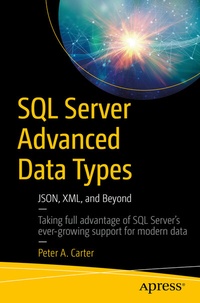
SQL Server Advanced Data Types
JSON, XML, and Beyond
Published on 24. August 2018
Book
Paperback/Softback
XV, 392 pages
978-1-4842-3900-1 (ISBN)
Description
Microsoft has been steadily adding support for advanced data types into their database engine, and many developers and database administrators are not fully aware of what these new types can provide in the way of optimization and speeding development time. This book introduces readers to the growing amount of support within SQL Server for operations and data transformations that until now required third-party software and all the associated licensing and development costs. Readers benefit through a better understanding of what can be done inside the database engine with no additional costs or development time invested in outside software.
More details
Edition
First Edition
Language
English
Place of publication
Berkeley
United States
Target group
Professional and scholarly
Illustrations
103 s/w Abbildungen
XV, 392 p. 103 illus.
Dimensions
Height: 235 mm
Width: 155 mm
Thickness: 23 mm
Weight
616 gr
ISBN-13
978-1-4842-3900-1 (9781484239001)
DOI
10.1007/978-1-4842-3901-8
Schweitzer Classification
Other editions
Additional editions
E-Book
08/2018
APress
€62.99
Available for download
Person
Peter Carter
is a SQL Server expert with over a decade of experience in developing, administering, and architecting SQL Server platforms and data-tier applications. He was awarded an MCC by Microsoft in 2011. He has MCTS, MCITP, MCSA, and MCSE certifications in SQL Server from version 2005 onward. Peter has written a number of books across a variety of SQL Server topics, including security, high availability, and automation.
Content
1. SQL Server Data Types.- 2. Understanding XML.- 3. Constructing XML with T-SQL.- 4. Querying and Shredding XML.- 5. XML Indexes.- 6. Understanding JSON.- 7. Constructing JSON from T-SQL.- 8. Shredding JSON Data.- 9. Working with the JSON Data Type.- 10. Understanding Spatial Data.- 11. Working with Spatial Data.- 12. Working with Hierarchical Data with HierarchyID.