

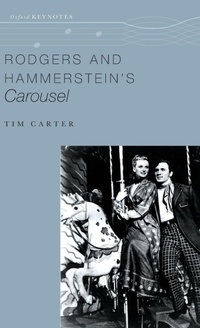
Rodgers and Hammerstein's Carousel
Published on 9. November 2017
Book
Hardback
164 pages
978-0-19-069343-5 (ISBN)
Description
Carousel (1945), with music by Richard Rodgers and the book and lyrics by Oscar Hammerstein II, was their second collaboration following the surprising success of Oklahoma! (1943). They worked again with Theresa Helburn and Lawrence Langner of the Theatre Guild (producers), Rouben Mamoulian (director), and Agnes de Mille (choreographer). But with Oklahoma! still running to sell-out houses, they needed to do something quite different.
Based on a play, Liliom (1909), by the Hungarian playwright Ferenc Molnar, Carousel took Broadway musical theater in far darker directions because of its subject matter-the protagonist, Billy Bigelow, is wholly an anti-hero-and also given its extensive music that some claimed came close to opera. The action is shifted from a gritty working-class suburb of Budapest to the New England coast (Maine), but the themes remain the same as two social misfits try to survive harsh economic times. Billy Bigelow is unemployed, prone to domestic violence, and dies in the course of committing a robbery; Julie Jordan sticks by him through thick and thin; and the show seeks some manner of redemption for both of them as Billy is given a day back on earth to do some good for his wife and their daughter. Troubling though these matters are nowadays, they fit squarely in the context of a country moving through the end of World War II to an uncertain future.
Not for nothing had composers such as Giacomo Puccini and Kurt Weill already tried to persuade Molnar to release his play. It also led Rodgers and Hammerstein to new heights: songs such as "If I Loved You," Billy's "Soliloquy," and "You'll Never Walk Alone" transformed the American musical. In this book, we discover how and why they came about, and exactly what Carousel was trying to achieve.
Based on a play, Liliom (1909), by the Hungarian playwright Ferenc Molnar, Carousel took Broadway musical theater in far darker directions because of its subject matter-the protagonist, Billy Bigelow, is wholly an anti-hero-and also given its extensive music that some claimed came close to opera. The action is shifted from a gritty working-class suburb of Budapest to the New England coast (Maine), but the themes remain the same as two social misfits try to survive harsh economic times. Billy Bigelow is unemployed, prone to domestic violence, and dies in the course of committing a robbery; Julie Jordan sticks by him through thick and thin; and the show seeks some manner of redemption for both of them as Billy is given a day back on earth to do some good for his wife and their daughter. Troubling though these matters are nowadays, they fit squarely in the context of a country moving through the end of World War II to an uncertain future.
Not for nothing had composers such as Giacomo Puccini and Kurt Weill already tried to persuade Molnar to release his play. It also led Rodgers and Hammerstein to new heights: songs such as "If I Loved You," Billy's "Soliloquy," and "You'll Never Walk Alone" transformed the American musical. In this book, we discover how and why they came about, and exactly what Carousel was trying to achieve.
Reviews / Votes
Through his careful analysis and compelling reading of new sources, Carter makes a compelling case for scholars and performers to reconsider a work that might otherwise be dismissed, and provides a fascinating historical narrative in the process. * Arianne Johnson Quinn, Society for American Music Bulletin *More details
Series
Language
English
Place of publication
New York
United States
Target group
Professional and scholarly
Illustrations
16 line art; 8 halftone
Dimensions
Height: 222 mm
Width: 145 mm
Thickness: 13 mm
Weight
343 gr
ISBN-13
978-0-19-069343-5 (9780190693435)
Copyright in bibliographic data and cover images is held by Nielsen Book Services Limited or by the publishers or by their respective licensors: all rights reserved.
Schweitzer Classification
Other editions
Additional editions
Tim Carter
Rodgers and Hammerstein's Carousel
Book
11/2017
Oxford University Press Inc
€27.80
Shipment within 15-20 days
Tim Carter
Rodgers and Hammerstein's Carousel
E-Book
09/2017
1st Edition
OUP eBook
€11.99
Available for download
Tim Carter
Rodgers and Hammerstein's Carousel
E-Book
09/2017
1st Edition
OUP eBook
€11.99
Available for download
Person
Tim Carter is the author of books on opera and musical theater ranging from Monteverdi through Mozart to Rodgers and Hammerstein. Prior to moving to the University of North Carolina at Chapel Hill in 2001, he was head of the Music Department at Royal Holloway, University of London.
Content
Contents
Acknowledgments
Sources and permissions
List of illustrations, tables, and music examples
1: Carousel in Context
2: Molnar's Liliom: From Budapest to Broadway (and Beyond)
Three film versions
The Theatre Guild, American musical theater, and a would-be Carousel
Molnar sees Oklahoma!
3: Creating Carousel
Some dilemmas
Hammerstein's draft scenario
Casting, rehearsals, and tryouts
4: A Duet, a Soliloquy, and a Ballet
The "Bench scene"
"Soliloquy"
"Louise's Ballet"
5: The Problems of an Ending
Up or down?
A post-war message
6: From Stage to Screen (and Back)
The search for "American opera"
Carousel on film
Restoring Carousel
Appendix: Hammerstein's Scenario for Carousel
Further Reading, Listening, and Viewing
Notes
Index
Acknowledgments
Sources and permissions
List of illustrations, tables, and music examples
1: Carousel in Context
2: Molnar's Liliom: From Budapest to Broadway (and Beyond)
Three film versions
The Theatre Guild, American musical theater, and a would-be Carousel
Molnar sees Oklahoma!
3: Creating Carousel
Some dilemmas
Hammerstein's draft scenario
Casting, rehearsals, and tryouts
4: A Duet, a Soliloquy, and a Ballet
The "Bench scene"
"Soliloquy"
"Louise's Ballet"
5: The Problems of an Ending
Up or down?
A post-war message
6: From Stage to Screen (and Back)
The search for "American opera"
Carousel on film
Restoring Carousel
Appendix: Hammerstein's Scenario for Carousel
Further Reading, Listening, and Viewing
Notes
Index