

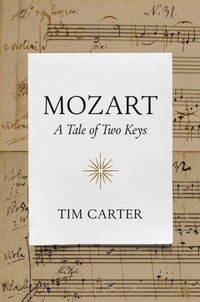
Mozart
A Tale of Two Keys
Published on 21. October 2025
Book
Hardback
192 pages
978-0-19-780633-3 (ISBN)
Description
How can we best understand the rules of Mozart's musical games? His first symphony, written in E flat major when he was just nine years old, sits at the opposite end of the tonal spectrum of his final concerto in A major. Through his diligent attention to -- and the creative reconsideration of -- tuning and temperament, instrumentation, musical intertextualities, and key-specific idioms, Mozart demonstrated the breadth of his musical ingenuity. By incorporating distinctive musical techniques within and across keys, the composer pushed the boundaries of meaning in late eighteenth-century music in ways that still resonate today.
In Mozart: A Tale of Two Keys, Tim Carter explores this unique approach to musical creativity, uncovering new insights that reveal the inventiveness and humor inherent in Mozart's works. With particular emphasis on the intention behind his technique, Carter argues that the composer used sound in unexpected, playful, and striking ways, revealing the intense joy and limitless possibility inherent in the art and craft of making music.
In Mozart: A Tale of Two Keys, Tim Carter explores this unique approach to musical creativity, uncovering new insights that reveal the inventiveness and humor inherent in Mozart's works. With particular emphasis on the intention behind his technique, Carter argues that the composer used sound in unexpected, playful, and striking ways, revealing the intense joy and limitless possibility inherent in the art and craft of making music.
More details
Language
English
Place of publication
New York
United States
Product notice
sewn/stitched
Cloth over boards
Illustrations
7 b/w figures, 97 b/w music examples, 9 b/w tables
Dimensions
Height: 256 mm
Width: 188 mm
Thickness: 18 mm
Weight
531 gr
ISBN-13
978-0-19-780633-3 (9780197806333)
Copyright in bibliographic data and cover images is held by Nielsen Book Services Limited or by the publishers or by their respective licensors: all rights reserved.
Schweitzer Classification
Other editions
Person
Tim Carter is a musicologist who has taught at the Universities of Leicester and Lancaster, Royal Holloway and Bedford New College, and the University of North Carolina at Chapel Hill. He has been awarded numerous fellowships, including at the Harvard Center for Italian Renaissance Studies, Villa I Tatti, the Newberry Library, and the National Humanities Center. Carter is an honorary member of the American Musicological Society, the Royal Musical Association, and the Society for Seventeenth-Century Music.
Content
List of Music Examples, Figures, and Tables
Acknowledgments
Editorial (etc.) Principles
1: Theme and Variations
2: The "Meaning" of Keys: Eighteenth-Century Views
3: E-flat Major: The Flat Seventh and Other Space-Opening Motions
4: A Major: 5 or 3 and Other Problems
5: Rosina and Her Sisters
6: "A Major" Seduction
7: Farewell to Nancy Storace (in Three Flats)
8: Instrumental Complications
Works Cited
Index of Mozart's Works
General Index
Acknowledgments
Editorial (etc.) Principles
1: Theme and Variations
2: The "Meaning" of Keys: Eighteenth-Century Views
3: E-flat Major: The Flat Seventh and Other Space-Opening Motions
4: A Major: 5 or 3 and Other Problems
5: Rosina and Her Sisters
6: "A Major" Seduction
7: Farewell to Nancy Storace (in Three Flats)
8: Instrumental Complications
Works Cited
Index of Mozart's Works
General Index