

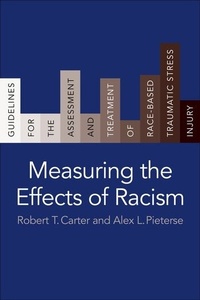
Measuring the Effects of Racism
Guidelines for the Assessment and Treatment of Race-Based Traumatic Stress Injury
Will be published approx. on 21. July 2020
Book
Hardback
432 pages
978-0-231-19306-1 (ISBN)
Description
A large body of research has established a causal relationship between experiences of racial discrimination and adverse effects on mental and physical health. In Measuring the Effects of Racism, Robert T. Carter and Alex L. Pieterse offer a manual for mental health professionals on how to understand, assess, and treat the effects of racism as a psychological injury.
Carter and Pieterse provide guidance on how to recognize the psychological effects of racism and racial discrimination. They propose an approach to understanding racism that connects particular experiences and incidents with a person's individual psychological and emotional response. They detail how to evaluate the specific effects of race-based encounters that produce psychological distress and possibly impairment or trauma. Carter and Pieterse outline therapeutic interventions for use with individuals and groups who have experienced racial trauma, and they draw attention to the importance of racial awareness for practitioners. The book features a racial-trauma assessment toolkit, including a race-based traumatic-stress symptoms scale and interview schedule. Useful for both scholars and practitioners, including social workers, educators, and counselors, Measuring the Effects of Racism offers a new framework of race-based traumatic stress that helps legitimize psychological reactions to experiences of racism.
Carter and Pieterse provide guidance on how to recognize the psychological effects of racism and racial discrimination. They propose an approach to understanding racism that connects particular experiences and incidents with a person's individual psychological and emotional response. They detail how to evaluate the specific effects of race-based encounters that produce psychological distress and possibly impairment or trauma. Carter and Pieterse outline therapeutic interventions for use with individuals and groups who have experienced racial trauma, and they draw attention to the importance of racial awareness for practitioners. The book features a racial-trauma assessment toolkit, including a race-based traumatic-stress symptoms scale and interview schedule. Useful for both scholars and practitioners, including social workers, educators, and counselors, Measuring the Effects of Racism offers a new framework of race-based traumatic stress that helps legitimize psychological reactions to experiences of racism.
Reviews / Votes
[A] well-researched book. -- H. Steven Moffic, MD , Jessica Isom, MD, MPH , Rahn K. Bailey, MD * Psychiatric Times * It is impossible to cover immense strengths of this book in this four-page review. The authors validate many points that address a huge gap currently prominent in society and provide evidence of ways to measure the effects and impact of racism, encourage training to prepare mental health workers, and clinical ideas for working with people of color who are impacted by racism. I believe this text takes a huge step in the process of helping clients who come to mental health workers measure the effects of racism and guide future work to effectively increase the well-being of people of color who have experienced racism. This text is appropriate for all mental health workers and health-care professionals who work with individuals, families, and student groups. -- Edward N. Randle Tarleton State University, Fort Worth, Texas, USA * Social Work with Groups * Carter and Pieterse increase our understanding of and the treatability of traumatic stress that results from racism. The proposals proffered in Measuring the Effects of Racism will lead to better treatment methods of race-based trauma and increase the evidence base for advocacy and agendas for social justice. -- Hugo Kamya, Simmons University Drawing on decades of experience, Robert Carter and Alex Pieterse have given us a tour de force exploration of new research on race-based traumatic stress (RBTS). Introducing an invaluable new theoretical model and assessment, they have provided an indispensable resource for researchers, practitioners, and trainees interested in systematically addressing the ill effects of racism in our society. -- Helen A. Neville, coauthor of <i>Counseling the Culturally Diverse</i> Measuring the Effects of Racism is the definitive guide to understanding the scope of the psychological impact of racism. Providing a clear and comprehensive conceptual framework and assessment strategy, Carter and Pieterse have written a book that will be of great benefit to educators, researchers, practitioners, and policy makers. -- Matthew Miller, associate editor of <i>Journal of Counseling Psychology</i>More details
Language
English
Place of publication
New York
United States
Target group
Professional and scholarly
Product notice
Trade binding
Illustrations
1 b&w figure
Dimensions
Height: 229 mm
Width: 152 mm
ISBN-13
978-0-231-19306-1 (9780231193061)
Copyright in bibliographic data and cover images is held by Nielsen Book Services Limited or by the publishers or by their respective licensors: all rights reserved.
Schweitzer Classification
Other editions
Additional editions
Robert T. Carter | Alex L. Pieterse
Measuring the Effects of Racism
Guidelines for the Assessment and Treatment of Race-Based Traumatic Stress Injury
E-Book
08/2020
1st Edition
Columbia University Press
€36.99
Available for download
Robert T. Carter | Alex L. Pieterse
Measuring the Effects of Racism
Guidelines for the Assessment and Treatment of Race-Based Traumatic Stress Injury
Book
07/2020
Columbia University Press
€37.14
Shipment within 10-20 days
Persons
Robert T. Carter is professor emeritus of psychology and education at Teachers College, Columbia University. His books include Confronting Racism: Integrating Mental Health Research Into Legal Strategies and Reforms (2019).
Alex L. Pieterse is associate professor and director of doctoral training in the program of counseling psychology at the State University of New York at Albany. He also serves as a racial diversity consultant and practices as a licensed psychologist.
Alex L. Pieterse is associate professor and director of doctoral training in the program of counseling psychology at the State University of New York at Albany. He also serves as a racial diversity consultant and practices as a licensed psychologist.
Content
Acknowledgments
Introduction
Part I. What We Know About Racism and Stress
1. Terms and Concepts Defined
2. Understanding Reactions to Stress: Trauma, Traumatic Stress, and Posttraumatic Stress Disorder
3. Redefining Racism: Documenting Racism's Effects
4. Variations in Responses to Racial Discrimination
Part II. What We Need to Know About Racial Trauma
5. Race-Based Traumatic Stress as Racial Trauma
6. Measuring Race-Based Traumatic Stress
7. Empirical Research Evidence Associated with the Race-Based Traumatic Stress Symptom Scale
8. The Short Form and the Interview Schedule of the Race-Based Traumatic Stress Symptom Scale
Part III. What to Do with What We Know: Practice Applications
9. Clinical Applications of the Race-Based Traumatic Stress Model
10. A Guide to Forensic Assessment: Clinical Applications
11. Training Mental Health Professionals to Treat Racial Trauma
12. Emerging Issues in Practice and Research
Appendix A: RBTSSS-Short Form (RBTSSS-SF)
Appendix B: Carter-Vinson Race-Based Traumatic Stress Interview Schedule
Notes
References
Index
Introduction
Part I. What We Know About Racism and Stress
1. Terms and Concepts Defined
2. Understanding Reactions to Stress: Trauma, Traumatic Stress, and Posttraumatic Stress Disorder
3. Redefining Racism: Documenting Racism's Effects
4. Variations in Responses to Racial Discrimination
Part II. What We Need to Know About Racial Trauma
5. Race-Based Traumatic Stress as Racial Trauma
6. Measuring Race-Based Traumatic Stress
7. Empirical Research Evidence Associated with the Race-Based Traumatic Stress Symptom Scale
8. The Short Form and the Interview Schedule of the Race-Based Traumatic Stress Symptom Scale
Part III. What to Do with What We Know: Practice Applications
9. Clinical Applications of the Race-Based Traumatic Stress Model
10. A Guide to Forensic Assessment: Clinical Applications
11. Training Mental Health Professionals to Treat Racial Trauma
12. Emerging Issues in Practice and Research
Appendix A: RBTSSS-Short Form (RBTSSS-SF)
Appendix B: Carter-Vinson Race-Based Traumatic Stress Interview Schedule
Notes
References
Index