

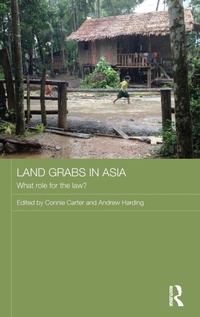
Land Grabs in Asia
What Role for the Law?
1st Edition
Published on 14. May 2015
Book
Hardback
212 pages
978-1-138-90401-9 (ISBN)
Description
Although there is no universally accepted definition of the term "land grabbing", ordinary people whose livelihoods are adversely affected by land grabbing know exactly what it is. It involves the physical capture and control of land and homes, including the usurpation of the power to decide how and when these will be used and for what purposes - with little or no prior consultation or compensation to the displaced communities.
This thought-provoking book defines land grabbing, and examines aspects of the land grabs phenomenon in seven Asian countries, researched and written by country-specific legal scholars. The book provides unique perspectives on how and why land grabbing is practised in China, India, Pakistan, Cambodia, Malaysia, Myanmar and Indonesia, and explores the surprising role that law plays in facilitating and legitimizing land grabs in each country. In contrast to most of the literature which law focuses on foreign investors' rights under international law, here the focus is on domestic laws and legal infrastructures. Finding that Asian States need to move beyond existing regimes that govern land to a regime that encourages more equitable land rights allocation and protection of stakeholders' rights, the book urges further research in the nexus between the use of law to facilitate development.
Land Grabs in Asia is the first book to explore land grabbing in multiple jurisdictions in Asia. As such, it will appeal to students and scholars of law and development, law and society, and international relations, as well as being essential reading for development policy-makers and government ministers.
This thought-provoking book defines land grabbing, and examines aspects of the land grabs phenomenon in seven Asian countries, researched and written by country-specific legal scholars. The book provides unique perspectives on how and why land grabbing is practised in China, India, Pakistan, Cambodia, Malaysia, Myanmar and Indonesia, and explores the surprising role that law plays in facilitating and legitimizing land grabs in each country. In contrast to most of the literature which law focuses on foreign investors' rights under international law, here the focus is on domestic laws and legal infrastructures. Finding that Asian States need to move beyond existing regimes that govern land to a regime that encourages more equitable land rights allocation and protection of stakeholders' rights, the book urges further research in the nexus between the use of law to facilitate development.
Land Grabs in Asia is the first book to explore land grabbing in multiple jurisdictions in Asia. As such, it will appeal to students and scholars of law and development, law and society, and international relations, as well as being essential reading for development policy-makers and government ministers.
More details
Series
Language
English
Place of publication
London
United Kingdom
Publishing group
Taylor & Francis Ltd
Target group
College/higher education
Illustrations
1 s/w Tabelle
1 Tables, black and white
Dimensions
Height: 240 mm
Width: 161 mm
Thickness: 16 mm
Weight
490 gr
ISBN-13
978-1-138-90401-9 (9781138904019)
Copyright in bibliographic data and cover images is held by Nielsen Book Services Limited or by the publishers or by their respective licensors: all rights reserved.
Schweitzer Classification
Other editions
Additional editions
Book
06/2017
1st Edition
Routledge
€73.20
Shipment within 10-20 days
E-Book
05/2015
1st Edition
Routledge
€67.49
Available for download
E-Book
05/2015
1st Edition
Routledge
€67.49
Available for download
Persons
Connie Carter is Professor of Law & International Business in the Faculty of Management at Royal Roads University, Victoria, Canada. She is also a Barrister of Lincoln's Inn, currently non-practising. Her research focuses on law and development, foreign direct investment and corporate social responsibility in China and South East Asia.
Andrew Harding is a Professor in the Faculty of Law, National University of Singapore, where he is also Director of the Centre for Asia Legal Studies and Director of the Asia Law Institute. He is a leading scholar in the fields of Asian legal studies and comparative constitutional law, on which has published widely.
Andrew Harding is a Professor in the Faculty of Law, National University of Singapore, where he is also Director of the Centre for Asia Legal Studies and Director of the Asia Law Institute. He is a leading scholar in the fields of Asian legal studies and comparative constitutional law, on which has published widely.
Content
1. Consent not coercion: Rethinking the taking of land for 'development' 2. International law response to land grabbing in Asia 3. How land grabs are made 'constitutional' in China 4. Il-legality with Chinese characteristics: How administrative litigation addresses land grabs in China 5. The legal design of land grabs: Possession and the State in post-conflict Cambodia 6. Indonesia's Land Acquisition Law: towards effective prevention of land grabbing? 7. Winners and losers: Land grabbing for foreign investment in the new Myanmar 8. Peninsular Malaysia's 'customary lands': How does legal paternalism facilitate land grabs? 9. Land grabs in Sabah, Malaysia: Customary rights as legal entitlement for indigenous peoples: Real or illusory? 10. Perspectives on land grabbing in Vietnam 11. Transnational State responsibility for human rights violation resulting from global land grabs