

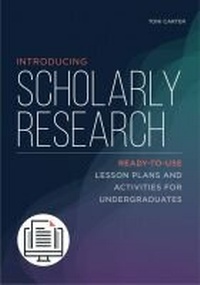
Introducing Scholarly Research
Ready-to-Use Lesson Plans and Activities for Undergraduates
Published on 13. September 2021
Book
Paperback/Softback
136 pages
978-0-8389-3782-2 (ISBN)
Description
From this book, instruction librarians will gain strategies and practical tools for introducing undergraduates to scholarly research topics such as research ethics, the role of research in higher education, quantitative and qualitative methods, and research in the areas of STEM, Humanities, and Social Sciences.
The world of scholarly research is uncharted territory for undergrads, but with the right approach you can quickly get them up to speed. With 33 time-saving lesson plans, Carter's invaluable resource will assist you in moving your instruction beyond basic skills to include how to use a library database and the reasons scholars use them to explaining why peer review is important. Inside, you'll find
modular lessons designed for 50-minute timeslots that include individual and group activities with 25 worksheets, quick in-session assessment, conversation starters, and learning outcomes;
a variety of mix-and-match tools and activities that can be easily adapted for one-shots;
concepts that are grounded in the ACRL Framework for Information Literacy for Higher Education;
topics that include the infrastructure that supports the scholarly research process;
warm-ups using the lingo of favorite hobbies to launch a discussion of scholarship terminology;
an exercise that brainstorms the factors leading to authority, then asks students to apply them to a well-known campus professor;
an activity using visualization to examine the characteristics of a scholar to check biases and explore diversity;
factors to consider when choosing a scholarly journal for publishing research;
QUAN and QUAL worksheets to teach the two type of research; and
discussion on the categories, disciplines, and crossovers within liberal arts.
The world of scholarly research is uncharted territory for undergrads, but with the right approach you can quickly get them up to speed. With 33 time-saving lesson plans, Carter's invaluable resource will assist you in moving your instruction beyond basic skills to include how to use a library database and the reasons scholars use them to explaining why peer review is important. Inside, you'll find
modular lessons designed for 50-minute timeslots that include individual and group activities with 25 worksheets, quick in-session assessment, conversation starters, and learning outcomes;
a variety of mix-and-match tools and activities that can be easily adapted for one-shots;
concepts that are grounded in the ACRL Framework for Information Literacy for Higher Education;
topics that include the infrastructure that supports the scholarly research process;
warm-ups using the lingo of favorite hobbies to launch a discussion of scholarship terminology;
an exercise that brainstorms the factors leading to authority, then asks students to apply them to a well-known campus professor;
an activity using visualization to examine the characteristics of a scholar to check biases and explore diversity;
factors to consider when choosing a scholarly journal for publishing research;
QUAN and QUAL worksheets to teach the two type of research; and
discussion on the categories, disciplines, and crossovers within liberal arts.
More details
Language
English
Place of publication
Chicago, IL
United States
Publishing group
American Library Association
Target group
Professional and scholarly
Dimensions
Height: 229 mm
Width: 152 mm
Thickness: 10 mm
Weight
333 gr
ISBN-13
978-0-8389-3782-2 (9780838937822)
Copyright in bibliographic data and cover images is held by Nielsen Book Services Limited or by the publishers or by their respective licensors: all rights reserved.
Schweitzer Classification