

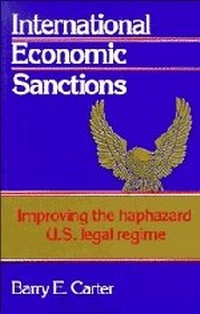
International Economic Sanctions
Improving the Haphazard U.S. Legal Regime
Published on 28. October 1988
Book
Hardback
304 pages
978-0-521-34258-2 (ISBN)
Description
This is a comprehensive analysis of the myriad US laws for imposing economic sanctions for foreign policy reasons. Against a broad range of target countries, the United States has resorted increasingly to a variety of economic pressures as a major tool in its foreign policy. Examples include South Africa, Panama, Libya, Nicaragua, the Soviet Union, Poland and Iran. The book is written in a lucid style designed for both non-lawyer and lawyer. It begins with a brief history and examination of the effectiveness of economic sanctions, drawing upon the existing literature. It then breaks ground by carefully analysing the wide range of US laws that authorize controls on government programmes (such as foreign aid), US exports, imports, private financial transactions, and assistance by international financial institutions. The study offers discussion of the 1988 omnibus trade bill and includes a useful chapter examining the widely differing laws of major US allies, notably the United Kingdom, Germany, Japan and the European Community.
More details
Language
English
Place of publication
Cambridge
United Kingdom
Target group
College/higher education
Dimensions
Height: 228 mm
Width: 152 mm
Thickness: 27 mm
Weight
568 gr
ISBN-13
978-0-521-34258-2 (9780521342582)
Copyright in bibliographic data and cover images is held by Nielsen Book Services Limited or by the publishers or by their respective licensors: all rights reserved.
Schweitzer Classification
Other editions
New editions
Book
06/2008
Cambridge University Press
€49.30
Shipment within 15-20 days
Additional editions
Book
06/2008
Cambridge University Press
€49.30
Shipment within 15-20 days
Content
1. Introduction Scope of the book; 2. Overview of the history and effectiveness of sanctions; 3. Non-emergency laws: an overview and bilateral government programs; 4. Exports from the United States; 5. Imports to the United States; 6. Private financial transactions; 7. International financial institutions; 8. Miscellaneous laws for non-emergencies; 9. Present laws for a declared national emergency; 10. Possible powers of the President beyond the statutes; 11. Looking to the allies; 12. Planning for the future.