

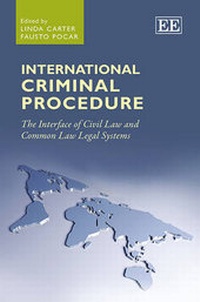
International Criminal Procedure
The Interface of Civil Law and Common Law Legal Systems
Published on 28. February 2013
Book
Hardback
272 pages
978-0-85793-957-9 (ISBN)
Description
The emergence of international criminal courts, beginning with the International Criminal Tribunal for the former Yugoslavia and including the International Criminal Court, has also brought an evolving international criminal procedure. In this book, the authors examine selected issues that reflect a blending of, or choice between, civil law and common law models of procedure. The topics include background on civil law and common law legal systems; plea bargaining; witness proofing; written and oral evidence; self-representation and the use of assigned, standby, and amicus counsel; the role of victims; and the right to appeal.International Criminal Procedure will appeal to academics, students, researchers, lawyers and judges working in the field of international criminal law.
Contributors include:G. Acquaviva, L. Carter, H. Garry, S. Horovitz, C.C. Jalloh, M. Maystre, F. Pocar, J.I. Turner
Contributors include:G. Acquaviva, L. Carter, H. Garry, S. Horovitz, C.C. Jalloh, M. Maystre, F. Pocar, J.I. Turner
Reviews / Votes
'Professor Carter, Judge Pocar and the individual authors of ICP have made an important contribution to international justice by blending many of the challenges of crafting the right international criminal procedures into a single, useful volume.' -- Dan Saxon, The Cambridge Law Journal 'International Criminal Procedure, edited by two insiders to international criminal proceedings, Professor Linda Carter and Professor Fausto Pocar, a judge at the ICTY and a former President of this Tribunal, is a coherently organized, well-researched, very informative and not the least elegantly-written contribution to a young and rapidly developing legal sub-discipline. The book provides its reader with a highly accessible and up-to date introduction into key elements of international criminal procedure as well as with critical commentary and rich inspiration for improvements of current practices.' -- Claus Kress LL.M. (Cantab.), University of Cologne, Germany and Institute for International Peace and Security Law 'This book addresses compelling issues that have come before international criminal tribunals. They include the self-representation of accused persons, plea bargaining and victim participation. It usefully approaches all of the issues and problems from a comparative law perspective. This excellent and accessible work is essential reading for practitioners, faculty and students of international criminal law.' -- Richard Goldstone, Retired Justice of the Constitutional Court of South Africa and former Chief Prosecutor of the International Criminal Tribunals for the former Yugoslavia and for RwandaMore details
Language
English
Place of publication
Cheltenham
United Kingdom
Target group
College/higher education
Dimensions
Height: 234 mm
Width: 156 mm
ISBN-13
978-0-85793-957-9 (9780857939579)
Copyright in bibliographic data and cover images is held by Nielsen Book Services Limited or by the publishers or by their respective licensors: all rights reserved.
Schweitzer Classification
Persons
Edited by Linda E. Carter, Distinguished Professor of Law Emerita, McGeorge School of Law, University of the Pacific, US and Fausto Pocar, Professor Emeritus of International Law, University of Milan, Italy and Judge, ICTY, ICTR and ICJ
Content
Contents:
Preface
1. The Challenge of Shaping Procedures in International Criminal Courts
Fausto Pocar and Linda Carter
2. Plea Bargaining
Jenia Iontcheva Turner
3. Witness Proofing
Hannah Garry
4. Written and Oral Evidence
Guido Acquaviva
5. Self-representation and the Use of Assigned, Standby and Amicus Counsel
Charles Chernor Jalloh
6. The Role of Victims
Sigall Horovitz
7. Right to Appeal
Magali Maystre
Index
Preface
1. The Challenge of Shaping Procedures in International Criminal Courts
Fausto Pocar and Linda Carter
2. Plea Bargaining
Jenia Iontcheva Turner
3. Witness Proofing
Hannah Garry
4. Written and Oral Evidence
Guido Acquaviva
5. Self-representation and the Use of Assigned, Standby and Amicus Counsel
Charles Chernor Jalloh
6. The Role of Victims
Sigall Horovitz
7. Right to Appeal
Magali Maystre
Index