

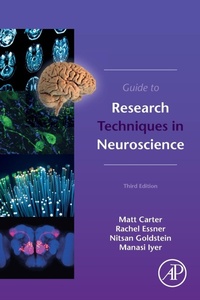
Guide to Research Techniques in Neuroscience
3rd Edition
Published on 29. March 2022
Book
Paperback/Softback
414 pages
978-0-12-818646-6 (ISBN)
Description
Modern neuroscience research is inherently multidisciplinary, with a wide variety of cutting edge new techniques to explore multiple levels of investigation. This Third Edition of Guide to Research Techniques in Neuroscience provides a comprehensive overview of classical and cutting edge methods including their utility, limitations, and how data are presented in the literature. This book can be used as an introduction to neuroscience techniques for anyone new to the field or as a reference for any neuroscientist while reading papers or attending talks.
More details
Edition
3rd edition
Language
English
Place of publication
San Diego
United States
Publishing group
Elsevier Science Publishing Co Inc
Target group
Professional and scholarly
Dimensions
Height: 221 mm
Width: 155 mm
Thickness: 30 mm
Weight
673 gr
ISBN-13
978-0-12-818646-6 (9780128186466)
Copyright in bibliographic data and cover images is held by Nielsen Book Services Limited or by the publishers or by their respective licensors: all rights reserved.
Schweitzer Classification
Other editions
Additional editions
Matt Carter | Rachel Essner | Nitsan Goldstein
Guide to Research Techniques in Neuroscience
E-Book
03/2022
3rd Edition
Academic Press
€64.95
Available for download
Previous edition
Matt Carter | Jennifer C. Shieh
Guide to Research Techniques in Neuroscience
Book
03/2015
2nd Edition
Academic Press
€70.00
Shipment within 15-20 days
Persons
Matt Carter is an Associate Professor of Biology at Williams College where he teaches courses in neuroscience and physiology. His research program focuses on how the brain regulates food intake and sleep and is funded by grants from the National Institutes of Health and National Science Foundation. In addition to primary scientific publications, he is also the author of Designing Science Presentations (Academic Press). He is a recipient of the Walter Gores Award for Excellence in Teaching from Stanford University and the Nelson Bushnell Prize for Excellence in Teaching and Writing from Williams College. Rachel Essner is a Neuroscience PhD candidate at Harvard University and a National Science Foundation Graduate Research Fellow. She received a BA in Biology from Williams College in 2016, where she was awarded the Erastus C. Benedict prize in Biology. Her current research focuses on how the brain processes and regulates sensory signals from within the body. Nitsan Goldstein is a Neuroscience PhD candidate at the University of Pennsylvania. Her research focuses on gut-brain communication and how the brain regulates innate behaviors. Nitsan received her BA in Biology and Psychology from Williams College in 2015. She is the winner of the 2021 Regeneron Prize for Creative Innovation and is a National Science Foundation Graduate Research Fellow. Manasi Iyer is a Neurosciences PhD candidate and a Graduate Fellow in Science and Engineering at Stanford University, where she is studying the cellular mechanisms that underlie developmental myelin formation in the central nervous system. She received her BA in Biology from Williams College in 2014, where she was awarded the Erastus C. Benedict Prize in Biology. When she is not in lab, Manasi spends her time teaching undergraduate courses such as Foundational Topics in Neuroscience and working with NeuWrite West as an editor and blog manager. She is also passionate about early child education.
Content
1. Whole Brain Imaging
2. Animal Behavior
3. Stereotaxic Surgeries
4. Electrophysiology
5. Microscopy
6. Visualizing Nervous System Structure
7. Visualizing and Measuring Neural Dynamics
8. Manipulating Neural Activity
9. Identifying Genes and Proteins of Interest
10. Molecular Cloning and Recombinant DNA Technology
11. Gene Delivery Strategies
12. Making and using transgenic organisms
13. Cell culture techniques
14. Biochemical assays and intracellular signaling
2. Animal Behavior
3. Stereotaxic Surgeries
4. Electrophysiology
5. Microscopy
6. Visualizing Nervous System Structure
7. Visualizing and Measuring Neural Dynamics
8. Manipulating Neural Activity
9. Identifying Genes and Proteins of Interest
10. Molecular Cloning and Recombinant DNA Technology
11. Gene Delivery Strategies
12. Making and using transgenic organisms
13. Cell culture techniques
14. Biochemical assays and intracellular signaling