

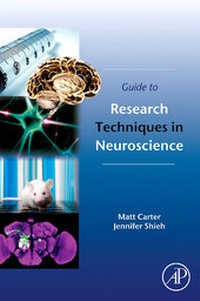
Guide to Research Techniques in Neuroscience
Published on 22. October 2009
Book
Paperback/Softback
408 pages
978-0-12-374849-2 (ISBN)
Description
Neuroscience is by definition a multidisciplinary field: some scientists study genes and proteins at the molecular level while others study neural circuitry. A single topic such as the auditory system can be studied using techniques from genetics, imaging, biochemistry, or electrophysiology. A young scientist must learn how to read the primary literature and then develop their own experiments. This book offers that scientist an overview of mainstream research techniques, provides guidelines on how to choose one technique over another, offers tips on analyzing data, and provides a list of references for additional detailed study. This book can also assist an experienced scientist understand published studies conducted outside their own subfield.
More details
Language
English
Place of publication
San Diego
United States
Publishing group
Elsevier Science Publishing Co Inc
Target group
College/higher education
Graduate students in neuroscience, post-doctoral students, fellows, and scientists with non-neuroscience backgrounds(e.g. mathematics, physics, engineering, computer science)
Dimensions
Height: 229 mm
Width: 152 mm
Weight
660 gr
ISBN-13
978-0-12-374849-2 (9780123748492)
Copyright in bibliographic data and cover images is held by Nielsen Book Services Limited or by the publishers or by their respective licensors: all rights reserved.
Schweitzer Classification
Other editions
New editions
Matt Carter | Jennifer C. Shieh
Guide to Research Techniques in Neuroscience
Book
03/2015
2nd Edition
Academic Press
€70.00
Shipment within 15-20 days
Additional editions
Matt Carter | Jennifer C. Shieh
Guide to Research Techniques in Neuroscience
E-Book
09/2009
1st Edition
Academic Press
€47.95
Available for download
Persons
Matt Carter is an Associate Professor of Biology at Williams College where he teaches courses in neuroscience and physiology. His research program focuses on how the brain regulates food intake and sleep and is funded by grants from the National Institutes of Health and National Science Foundation. In addition to primary scientific publications, he is also the author of Designing Science Presentations (Academic Press). He is a recipient of the Walter Gores Award for Excellence in Teaching from Stanford University and the Nelson Bushnell Prize for Excellence in Teaching and Writing from Williams College. Jennifer C. Shieh, PhD, is currently Program Director and SBIR (Small Business Innovation Research) Coordinator at the National Heart, Lung, and Blood Institute at the NIH. She co-authored the first edition of this book (Elsevier, 2009), and was awarded the Hans-Lukas Teuber Award for Outstanding Research and Academics in Brain and Cognitive Sciences, and the MIT Department of Brain and Cognitive Sciences Award for Outstanding Scholarship and BCS Contributions.
Content
Foreword: Professor William Newsome, Stanford UniversityWhole Brain ImagingStereotaxic Surgeries and PharmacologyBehavioral AssaysElectrophysiologyMicroscopyHistologyVisualizing Neural ActivityIdentifying Genes and Proteins of InterestMolecular Cloning and Recombinant DNA TechnologyManipulating Genes and GenomesCell Culture and Gene Delivery StrategiesIntracellular SignalingIndex