

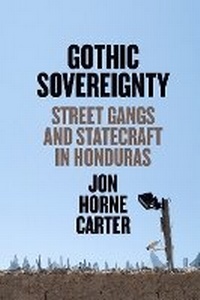
Gothic Sovereignty
Street Gangs and Statecraft in Honduras
Published on 1. February 2022
Book
Hardback
368 pages
978-1-4773-2415-8 (ISBN)
Description
Gang-related violence has forced thousands of Hondurans to flee their country, leaving behind everything as refugees and undocumented migrants abroad. To uncover how this happened, Jon Carter looks back to the mid-2000s, when neighborhood gangs were scrambling to survive state violence and mass incarceration, locating there a critique of neoliberal globalization and state corruption that foreshadows Honduras's current crises.
Carter begins with the story of a thirteen-year-old gang member accused in the murder of an undercover DEA agent, asking how the nation's seductive criminal underworld has transformed the lives of young people. He then widens the lens to describe a history of imperialism and corruption that shaped this underworld-from Cold War counterinsurgency to the "War on Drugs" to the near-impunity of white-collar crime-as he follows local gangs who embrace new trades in the illicit economy. Carter describes the gangs' transformation from neighborhood groups to sprawling criminal societies, even in the National Penitentiary, where they have become political as much as criminal communities. Gothic Sovereignty reveals not only how the revolutionary potential of gangs was lost when they merged with powerful cartels but also how close analysis of criminal communities enables profound reflection on the economic, legal, and existential discontents of globalization in late liberal nation-states.
Carter begins with the story of a thirteen-year-old gang member accused in the murder of an undercover DEA agent, asking how the nation's seductive criminal underworld has transformed the lives of young people. He then widens the lens to describe a history of imperialism and corruption that shaped this underworld-from Cold War counterinsurgency to the "War on Drugs" to the near-impunity of white-collar crime-as he follows local gangs who embrace new trades in the illicit economy. Carter describes the gangs' transformation from neighborhood groups to sprawling criminal societies, even in the National Penitentiary, where they have become political as much as criminal communities. Gothic Sovereignty reveals not only how the revolutionary potential of gangs was lost when they merged with powerful cartels but also how close analysis of criminal communities enables profound reflection on the economic, legal, and existential discontents of globalization in late liberal nation-states.
Reviews / Votes
This is a diabolically original book about urban worlds, carcerality, US militarized imperialism, elites vampirizing young people's energy and hopelessness, and the rippling creativity of those young people and their communities. Jon Carter writes with great artistry, rage, and compassion about Hondurans seeking to walk away from lives made barely livable by the baroque grotesqueries of the illicit webs of extraction woven about them. By terms heartbreaking and heart-pounding, Gothic Sovereignty is theoretically nimble and ethnographically rich. Deeply respectful of lived complexities, it offers profane visions and counterintuitive methods for understanding the unfolding worlds in which we are all enmeshed.- Diane M. Nelson, Duke University, author of Who Counts? The Mathematics of Death and Life after GenocideJon Carter engages with hypervisible gang violence in Honduras by moving slowly and with deliberate understatement, using a grounded theory approach to build a subtle string of observations into powerful considerations of violence, debilitating injury, and death. He avoids the familiar analytics of "deviance" and "pathology" that can become realities of their own, too often foreclosing the possibility of social change. By delving into a "prehistory" of gang formation in Honduras, Carter takes on the institutional violence that opens the way for political transformation and future making. This book will be widely read and will resonate beyond anthropology.- Laurence Ralph, Princeton University, author of The Torture Letters: Reckoning with Police Violence
[An] ethnography noir of the drug economy in Honduras...Carter introduces us to dizzying conspiracies and a lurid cast of characters that make the Hollywood treatment of the subject matter, like Netflix's Narcos, seem tame...Readers who approach this book with an interest in understanding the cultural forms and aesthetics surrounding gang life in Central America will certainly learn a great deal. Others will come to this book with more of an interest in the complex vectors of the drugs and arms underworld, and they will be rewarded by an alternative political mapping of this world.- American Ethnologist
Gothic Sovereignty offers a nuanced anthropological analysis of pervasive gang violence in Honduras, which transcends narrow sociological approaches to organized crime and state corruption in Central America...Gothic Sovereignty will appeal to students of the anthropology of crime, aesthetics, and Latin American political history...Recommended.- CHOICE
[Gothic Sovereignty] builds on a critical framework centered on the writing of Walter Benjamin, offering a nuanced critic's reading of the experience of gang activity in that country. Carter presents a deep analysis of various aspects of gang activity...These are important interventions in the debate on gangs in Latin America. Acknowledging the critical aesthetics of sovereignty in Honduras and how gangs reflect a challenge to that is an insightful contribution to understanding the implications of gang activity for state power and the ways that violence and governance are practiced that goes beyond much of the existing scholarship.- Latin American Politics and Society
Gothic Sovereignty is a fascinating read about street gangs and the state in Honduras...Carter is to be lauded for completing an important study that was difficult to finish...Carter's study warrants analysis by both specialists and the public...If you are interested in political and legal anthropology or the study of organised crime in Central America, I highly recommend [Gothic Sovereignty].- Anthropological Forum
What is most remarkable about this book, however, is how little violence it actually holds. Carter does an extraordinary job of writing about violent acts and violent actors without reproducing that violence . . . Gothic Sovereignty is an exemplary anthropology, as it is at once method, theory, argument, narrative, positioned reflexivity, and a bit of memoir. The text is theoretically rich, expecting a sophisticated facility with social theory from the reader.- Journal of Latin American and Caribbean Anthropology
Throughout [Gothic Sovereignty], Carter's writing moves fluidly between the safe haven of high theory and the thick fever of barrio life with a momentum that reads like a novel. His ethnographic fieldwork is immersive, making use of 'dissident' surrealist Georges Bataille's theories of waste and purposelessness, here applied as a methodology to allow Carter's research to come to him. In other words, he lets chance determine the course of the work.- Religious Studies Review
More details
Language
English
Place of publication
Austin, TX
United States
Target group
Professional and scholarly
Illustrations
19 b&w photos, 1 b&w map
Dimensions
Height: 229 mm
Width: 152 mm
Thickness: 30 mm
Weight
626 gr
ISBN-13
978-1-4773-2415-8 (9781477324158)
Copyright in bibliographic data and cover images is held by Nielsen Book Services Limited or by the publishers or by their respective licensors: all rights reserved.
Schweitzer Classification
Person
Jon Horne Carter is an associate professor of anthropology at Appalachian State University.
Content
Preface
A Note on Translations and Anonymization
Introduction
Part I. Angels
Chapter 1. Flash
Chapter 2. Baroque
Chapter 3. Allegory
Chapter 4. Image
Chapter 5. Danger
Part II. Devils
Chapter 6. Underworld
Chapter 7. Dragons
Chapter 8. Crime
Chapter 9. Storm
Chapter 10. Rubbish
Chapter 11. Evil
Chapter 12. Corruption
Chapter 13. Lumpen
Part III: Justice
Chapter 14. Community
Chapter 15. Sovereignty
Chapter 16. Apocalypse
Chapter 17. Trust
Chapter 18. Futures
Afterword
Acknowledgments
Notes
Index
A Note on Translations and Anonymization
Introduction
Part I. Angels
Chapter 1. Flash
Chapter 2. Baroque
Chapter 3. Allegory
Chapter 4. Image
Chapter 5. Danger
Part II. Devils
Chapter 6. Underworld
Chapter 7. Dragons
Chapter 8. Crime
Chapter 9. Storm
Chapter 10. Rubbish
Chapter 11. Evil
Chapter 12. Corruption
Chapter 13. Lumpen
Part III: Justice
Chapter 14. Community
Chapter 15. Sovereignty
Chapter 16. Apocalypse
Chapter 17. Trust
Chapter 18. Futures
Afterword
Acknowledgments
Notes
Index