

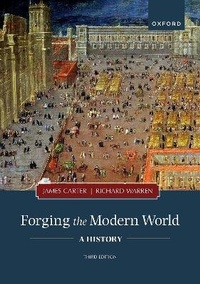
Forging the Modern World
A History
3rd Edition
Published on 29. July 2022
Book
Paperback/Softback
448 pages
978-0-19-758023-3 (ISBN)
Description
In Forging the Modern World: A History, Third Edition, authors James Carter and Richard Warren offer an accessible explanation of key transformations in global economic, political, and ideological relationships since the fourteenth century. The book is distinct from most world history texts in three important ways. First, it explores the ways in which historians use and produce information. Each chapter delves deeply into one or two specific issues of historical inquiry related to the chapter theme, showing how new primary sources, methodologies, or intellectual trends have changed how we engage with the past. Second, it clearly explains the political, economic, and ideological concepts that students need to understand in order to compare events and trends across time and space. Finally, the chapters are organized around global historical themes, which are explored through an array of conceptual and comparative lenses. While the book chapters proceed chronologically, each chapter is written with some chronological overlap linking it to preceding and subsequent chapters. This strategy emphasizes the interconnectedness between the events and themes of one chapter and those of surrounding chapters.
Reviews / Votes
This textbook doesn't try to be a comprehensive history of everything that happened in the last 500+ years; instead it focuses on a single narrative encapsulated by the title, Forging the Modern World. The authors are also transparent about their process of historical reasoning, and I use that transparency with my students to demystify historical thinking skills like honing arguments and using sources as evidence. It's a great book, the best for this particular class by far. I've designed my entire course-which I've now taught five times face to face and twice online-around this textbook." - Eric Limbach, Ohio State University Forging the Modern World's major strength is its accessibility for students. The narrative is concise and readable yet still does a wonderful job of including major scholarship and relevant interpretation. I know my students are reading this book-for the first time in years, students are making comments or asking questions in class that refer to material in the text. This allows for classroom discussions and opportunities for me to expand on topics that students would have glazed over in previous texts. * Suzanne Shoaf Smith, Cape Fear Community College *More details
Edition
3rd Revised edition
Language
English
Place of publication
New York
United States
Edition type
Revised edition
Illustrations
72
Dimensions
Height: 235 mm
Width: 165 mm
ISBN-13
978-0-19-758023-3 (9780197580233)
Copyright in bibliographic data and cover images is held by Nielsen Book Services Limited or by the publishers or by their respective licensors: all rights reserved.
Schweitzer Classification
Persons
Content
- List of Maps
- Acknowledgments
- Changes to the Third Edition
- About the Authors
- INTRODUCTION Forging the Modern World
- What's in a Title?
- Sources and Methods
- Practicing History with This Book
- Agency and Contingency
- CHAPTER 1 A World Connected 1347-1520
- Political and Economic Order in Afro-Eurasia
- The Great Disruptions of the Fourteenth Century
- Historians Explore The Second Global Pandemic
- New Structures and New Relationships
- Africa
- Conclusion
- Exploring the Sources
- A Few Good Books
- CHAPTER 2 The New Global Interface 1486-1637
- Encounter and Cataclysm in the Western Hemisphere
- Historians Explore The Conquest Era
- From Conquest to Colonialism
- A World Connected
- Conclusion
- Exploring the Sources
- A Few Good Books
- CHAPTER 3 The Paradoxes of Early Modern Empire 1501-1661
- The Words and Deeds of Empire Building
- Tangled Loyalties and the European Wars of Religion
- Collapse and Restoration of Empire in China
- Historians Explore The Ming-Qing Transition
- Conclusion
- Exploring the Sources
- A Few Good Books
- CHAPTER 4 Production and Consumption in the First Global Economy 1571-1721
- Agricultural Production
- Global Trade Networks
- Historians Explore Early Modern Textiles and Material Culture
- States and Economic Activity
- Conclusion
- Exploring the Sources
- A Few Good Books
- CHAPTER 5 Global War and Imperial Reform 1655-1766
- Consolidating the Center: Modernizing Monarchies
- The Question of Control in the Atlantic Seaborne Empires
- Historians Explore Slavery, Resistance, and Survival
- World War Zero
- Conclusion
- Exploring the Sources
- A Few Good Books
- CHAPTER 6 A New Order for the Ages 1762-1839
- The Reform Impulse
- Revolution and Reaction
- Historians Explore Haiti and the Age of Revolution
- New Challenges of Political Organization
- Conclusion
- Exploring the Sources
- A Few Good Books
- CHAPTER 7 The Engines of Industrialization 1787-1868
- What Is Revolutionary about Industrialization?
- Historians Explore Industrialization in Comparative Perspective
- Life during the Industrial Revolution
- The Transformation of Global Power Relations
- Conclusion
- Exploring the Sources
- A Few Good Books
- CHAPTER 8 Modernity Organized 1840-1893
- Reform versus Revolution
- Nation and Citizen in the Western Hemisphere
- Global Hierarchies Defined and Defied
- Historians Explore Archaeology, Museums, and the Hierarchy of Nations
- Conclusion
- Exploring the Sources
- A Few Good Books
- CHAPTER 9 Globalization and Its Discontents 1869-1915
- The New Imperialism and Neocolonialism
- Historians Explore Solidarity and Resistance to Imperialism in Africa
- Sovereignty and Conflict in East Asia
- The Price of Progress in the Western Hemisphere
- Migration and Work, Empire and Nation
- Conclusion
- Exploring the Sources
- A Few Good Books
- CHAPTER 10 Total War and Mass Society 1911-1933
- Total War: World War I and the Russian Revolution
- First Challenges of the Post-War World
- Political Paths through the 1920s
- Historians Explore Literature as Sources
- The Global Economy from the 1920s to the Great Depression
- Conclusion
- Exploring the Sources
- A Few Good Books
- CHAPTER 11 The Ongoing Crisis of Global Order 1930-1957
- The Political and Economic Experiments of the 1930s
- The International Order Collapses
- Historians Explore Mass Media, Propaganda, and the Modern State
- Empire in the Shadow of Global War
- Conclusion
- Exploring the Sources
- A Few Good Books
- CHAPTER 12 Hot Wars, Cold Wars, and Liberation Movements 1954-1991
- Economic Development: Three Worlds?
- Historians Explore Identities and Protest Movements
- The Late Cold War Era and Shifting Power Dynamics
- Conclusion
- Exploring the Sources
- A Few Good Books
- CHAPTER 13 The Many Worlds of the Twenty-First Century 1987-2021
- The End of History and Its Quick Return
- Economic Integration
- Historians Explore Viral Images, Deep Fakes, and Historical Reasoning
- The Realities of the Biological New Regime
- Conclusion
- Exploring the Sources
- A Few Good Books
- Epilogue
- Credits
- Index
- Acknowledgments
- Changes to the Third Edition
- About the Authors
- INTRODUCTION Forging the Modern World
- What's in a Title?
- Sources and Methods
- Practicing History with This Book
- Agency and Contingency
- CHAPTER 1 A World Connected 1347-1520
- Political and Economic Order in Afro-Eurasia
- The Great Disruptions of the Fourteenth Century
- Historians Explore The Second Global Pandemic
- New Structures and New Relationships
- Africa
- Conclusion
- Exploring the Sources
- A Few Good Books
- CHAPTER 2 The New Global Interface 1486-1637
- Encounter and Cataclysm in the Western Hemisphere
- Historians Explore The Conquest Era
- From Conquest to Colonialism
- A World Connected
- Conclusion
- Exploring the Sources
- A Few Good Books
- CHAPTER 3 The Paradoxes of Early Modern Empire 1501-1661
- The Words and Deeds of Empire Building
- Tangled Loyalties and the European Wars of Religion
- Collapse and Restoration of Empire in China
- Historians Explore The Ming-Qing Transition
- Conclusion
- Exploring the Sources
- A Few Good Books
- CHAPTER 4 Production and Consumption in the First Global Economy 1571-1721
- Agricultural Production
- Global Trade Networks
- Historians Explore Early Modern Textiles and Material Culture
- States and Economic Activity
- Conclusion
- Exploring the Sources
- A Few Good Books
- CHAPTER 5 Global War and Imperial Reform 1655-1766
- Consolidating the Center: Modernizing Monarchies
- The Question of Control in the Atlantic Seaborne Empires
- Historians Explore Slavery, Resistance, and Survival
- World War Zero
- Conclusion
- Exploring the Sources
- A Few Good Books
- CHAPTER 6 A New Order for the Ages 1762-1839
- The Reform Impulse
- Revolution and Reaction
- Historians Explore Haiti and the Age of Revolution
- New Challenges of Political Organization
- Conclusion
- Exploring the Sources
- A Few Good Books
- CHAPTER 7 The Engines of Industrialization 1787-1868
- What Is Revolutionary about Industrialization?
- Historians Explore Industrialization in Comparative Perspective
- Life during the Industrial Revolution
- The Transformation of Global Power Relations
- Conclusion
- Exploring the Sources
- A Few Good Books
- CHAPTER 8 Modernity Organized 1840-1893
- Reform versus Revolution
- Nation and Citizen in the Western Hemisphere
- Global Hierarchies Defined and Defied
- Historians Explore Archaeology, Museums, and the Hierarchy of Nations
- Conclusion
- Exploring the Sources
- A Few Good Books
- CHAPTER 9 Globalization and Its Discontents 1869-1915
- The New Imperialism and Neocolonialism
- Historians Explore Solidarity and Resistance to Imperialism in Africa
- Sovereignty and Conflict in East Asia
- The Price of Progress in the Western Hemisphere
- Migration and Work, Empire and Nation
- Conclusion
- Exploring the Sources
- A Few Good Books
- CHAPTER 10 Total War and Mass Society 1911-1933
- Total War: World War I and the Russian Revolution
- First Challenges of the Post-War World
- Political Paths through the 1920s
- Historians Explore Literature as Sources
- The Global Economy from the 1920s to the Great Depression
- Conclusion
- Exploring the Sources
- A Few Good Books
- CHAPTER 11 The Ongoing Crisis of Global Order 1930-1957
- The Political and Economic Experiments of the 1930s
- The International Order Collapses
- Historians Explore Mass Media, Propaganda, and the Modern State
- Empire in the Shadow of Global War
- Conclusion
- Exploring the Sources
- A Few Good Books
- CHAPTER 12 Hot Wars, Cold Wars, and Liberation Movements 1954-1991
- Economic Development: Three Worlds?
- Historians Explore Identities and Protest Movements
- The Late Cold War Era and Shifting Power Dynamics
- Conclusion
- Exploring the Sources
- A Few Good Books
- CHAPTER 13 The Many Worlds of the Twenty-First Century 1987-2021
- The End of History and Its Quick Return
- Economic Integration
- Historians Explore Viral Images, Deep Fakes, and Historical Reasoning
- The Realities of the Biological New Regime
- Conclusion
- Exploring the Sources
- A Few Good Books
- Epilogue
- Credits
- Index