

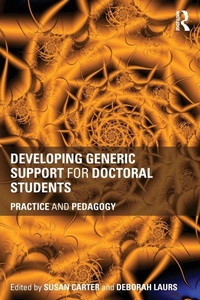
Developing Generic Support for Doctoral Students
Practice and pedagogy
1st Edition
Published on 21. March 2014
Book
Paperback/Softback
208 pages
978-0-415-66233-8 (ISBN)
Description
This multidisciplinary, multi-voiced book looks at the practice and pedagogy of generic, across-campus support for doctoral students. With a global imperative for increased doctoral completions, universities around the world are providing more generic support. This book represents collegial cross-fertilisation focussed on generic pedagogy, provided by contributors who are practitioners working and researching at the pan-disciplinary level which complements supervision.
In the UK, funding for two weeks annual training in transferable skills for each doctoral scholarship recipient has caused an explosion of such teaching, which is now flourishing elsewhere too; for example, endorsed by the Carnegie Initiative on the Doctorate in the USA and developed extensively in Australia. Generic doctoral support is expanding, yet is a relatively new kind of teaching, practised extensively only in the last decade and with its own ethical, practical and pedagogical complexities. These raise a number of questions:
How is generic support funded and situated within institutions?
Should some sessions be compulsory for doctoral students?
Where do the boundaries lie between what can be taught generically or left to supervisors as discipline-specific?
To what extent is generic work pastoral?
What are its main benefits? Its challenges? Its objectives?
Over the last two decades supervision has been investigated and theorised as a teaching practice, a discussion this book extends to generic doctoral support.
This edited book has contributions from a wide range of authors and includes short inset narratives from academic authorities, accumulatively enabling discussion of practice and the establishment of a benchmark for this growing topic.
In the UK, funding for two weeks annual training in transferable skills for each doctoral scholarship recipient has caused an explosion of such teaching, which is now flourishing elsewhere too; for example, endorsed by the Carnegie Initiative on the Doctorate in the USA and developed extensively in Australia. Generic doctoral support is expanding, yet is a relatively new kind of teaching, practised extensively only in the last decade and with its own ethical, practical and pedagogical complexities. These raise a number of questions:
How is generic support funded and situated within institutions?
Should some sessions be compulsory for doctoral students?
Where do the boundaries lie between what can be taught generically or left to supervisors as discipline-specific?
To what extent is generic work pastoral?
What are its main benefits? Its challenges? Its objectives?
Over the last two decades supervision has been investigated and theorised as a teaching practice, a discussion this book extends to generic doctoral support.
This edited book has contributions from a wide range of authors and includes short inset narratives from academic authorities, accumulatively enabling discussion of practice and the establishment of a benchmark for this growing topic.
Reviews / Votes
"...The book identifies the key issues related to the development of doctoral training programmes in the UK and Australasia over the last two decades, including initial development, objectives and challenges. The complementary nature of the work undertaken by research supervisor and generic doctoral training learning advisor is considered. From its position in the 'borderlands between disciplines' a generic training programme's contributions to equity and access, language acquisition, critical thinking, pastoral care and career preparation are all discussed and debated. Ultimately however, reliable measurement of the contribution of such programmes to the doctoral experience still remains elusive." - Pam Herman, a former Research Graduate School Manager at an Australian UniversityMore details
Language
English
Place of publication
London
United Kingdom
Publishing group
Taylor & Francis Ltd
Target group
College/higher education
Professional and scholarly
Academic, Postgraduate, Professional, and Professional Practice & Development
Illustrations
5 s/w Photographien bzw. Rasterbilder, 5 s/w Zeichnungen, 10 s/w Abbildungen, 4 s/w Tabellen
4 Tables, black and white; 5 Line drawings, black and white; 5 Halftones, black and white; 10 Illustrations, black and white
Dimensions
Height: 234 mm
Width: 156 mm
Thickness: 12 mm
Weight
327 gr
ISBN-13
978-0-415-66233-8 (9780415662338)
Copyright in bibliographic data and cover images is held by Nielsen Book Services Limited or by the publishers or by their respective licensors: all rights reserved.
Schweitzer Classification
Other editions
Additional editions
Book
03/2014
1st Edition
Routledge
€272.00
Shipment within 15-20 days
E-Book
03/2014
1st Edition
Routledge
€61.99
Available for download
E-Book
03/2014
1st Edition
Routledge
€61.99
Available for download
Persons
Susan Carter coordinated a generic doctoral programme from 2004-2012 and now works with supervisors as an academic developer within the recently established Centre for Learning and Research in Higher Education at the University of Auckland, New Zealand
Deborah Laurs is a senior learning advisor at Victoria University of Wellington, New Zealand, where she runs research skills seminars and thesis-writing workshops,?as well as providing one-to-one support to students from all disciplines and at all stages of their doctoral journey. ?
Deborah Laurs is a senior learning advisor at Victoria University of Wellington, New Zealand, where she runs research skills seminars and thesis-writing workshops,?as well as providing one-to-one support to students from all disciplines and at all stages of their doctoral journey. ?
Content
Acknowledgements Contributors Introduction Part 1 1. Context 2. Putting Together a Doctoral Skills Programme Part 2 3. Responding to Cross-Campus Student Requirements 4. Acknowledging Values, Identity and Equity 5. Generic Support for English as an Additional Language (EAL) students 6. Writing: Intrinsic to Research 7. Writing: Process, Product and Identity Development Part 3 8 Part-Time and Digital Support 9. Preparation for Careers 10 Evaluation of Generic Doctoral Support Conclusion Index Works Cited