

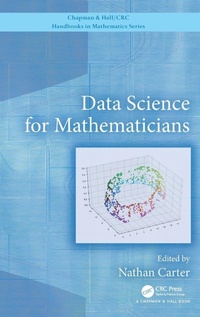
Data Science for Mathematicians
1st Edition
Published on 16. September 2020
Book
Hardback
528 pages
978-0-367-02705-6 (ISBN)
Description
Mathematicians have skills that, if deepened in the right ways, would enable them to use data to answer questions important to them and others, and report those answers in compelling ways. Data science combines parts of mathematics, statistics, computer science. Gaining such power and the ability to teach has reinvigorated the careers of mathematicians. This handbook will assist mathematicians to better understand the opportunities presented by data science. As it applies to the curriculum, research, and career opportunities, data science is a fast-growing field. Contributors from both academics and industry present their views on these opportunities and how to advantage them.
More details
Series
Language
English
Place of publication
Oxford
United Kingdom
Publishing group
Taylor & Francis Ltd
Target group
Professional and scholarly
Academic
Illustrations
39 s/w Tabellen, 151 s/w Abbildungen
39 Tables, black and white; 151 Illustrations, black and white
Dimensions
Height: 240 mm
Width: 161 mm
Thickness: 34 mm
Weight
977 gr
ISBN-13
978-0-367-02705-6 (9780367027056)
Copyright in bibliographic data and cover images is held by Nielsen Book Services Limited or by the publishers or by their respective licensors: all rights reserved.
Schweitzer Classification
Other editions
Additional editions
Nathan Carter
Data Science for Mathematicians
Book
08/2024
1st Edition
Chapman & Hall/CRC
€178.20
Shipment within 15-20 days
Nathan Carter
Data Science for Mathematicians
E-Book
09/2020
1st Edition
Chapman & Hall/CRC
€172.99
Available for download
Nathan Carter
Data Science for Mathematicians
E-Book
09/2020
1st Edition
Chapman & Hall/CRC
€172.99
Available for download
Person
Nathan Carter is a professor at Bentley University.
Content
Contents
Chapter 1 Introduction 1
Chapter 2 Programming with Data
Chapter 3 Linear Algebra
Chapter 4 Basic Statistics
Chapter 5 Clustering
Chapter 6 Operations Research
Chapter 7 Dimensionality Reduction
Chapter 8 Machine Learning
Chapter 9 Deep Learning
Chapter 10 Topological Data Analysis
Bibliography
Chapter 1 Introduction 1
Chapter 2 Programming with Data
Chapter 3 Linear Algebra
Chapter 4 Basic Statistics
Chapter 5 Clustering
Chapter 6 Operations Research
Chapter 7 Dimensionality Reduction
Chapter 8 Machine Learning
Chapter 9 Deep Learning
Chapter 10 Topological Data Analysis
Bibliography