

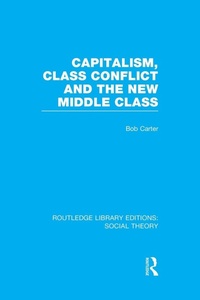
Capitalism, Class Conflict and the New Middle Class
1st Edition
Published on 9. December 2015
Book
Paperback/Softback
268 pages
978-1-138-96534-8 (ISBN)
Description
Non-manual workers are fast becoming the largest occupational category in Western capitalist countries. This is the first book to present a detailed socialist analysis of this much discussed change in the class structure of contemporary capitalism.
Focusing on the class position of managerial and supervisory workers, Robert Carter takes as his starting-point the inadequacy of both orthodox Marxist and Weberian models of class relations. Rather, he concurs with recent structuralist theorists of class who maintain that there exists between capital and labour in the process of producing a new middle class. He parts company from the work of these theorists, however, in his insistence that the organisation and consciousness of the new middle class have also to be examined because of the practical consequences these have on class relations.
The book therefore examines the historical rise of the middle class, both in the private and the state sector, together with the tendency of the class to respond to its changing relations with capital and labour by unionising. It is sharply critical of the dominant models of the causes and nature of white-collar unionism - both industrial relations and Weberian ones - and indeed rejects these models in favour of a perspective which views the extent and nature of middle-class unionism within the dynamics of class relations.
Focusing on the class position of managerial and supervisory workers, Robert Carter takes as his starting-point the inadequacy of both orthodox Marxist and Weberian models of class relations. Rather, he concurs with recent structuralist theorists of class who maintain that there exists between capital and labour in the process of producing a new middle class. He parts company from the work of these theorists, however, in his insistence that the organisation and consciousness of the new middle class have also to be examined because of the practical consequences these have on class relations.
The book therefore examines the historical rise of the middle class, both in the private and the state sector, together with the tendency of the class to respond to its changing relations with capital and labour by unionising. It is sharply critical of the dominant models of the causes and nature of white-collar unionism - both industrial relations and Weberian ones - and indeed rejects these models in favour of a perspective which views the extent and nature of middle-class unionism within the dynamics of class relations.
More details
Series
Language
English
Place of publication
London
United Kingdom
Publishing group
Taylor & Francis Ltd
Target group
College/higher education
Dimensions
Height: 234 mm
Width: 156 mm
Thickness: 15 mm
Weight
412 gr
ISBN-13
978-1-138-96534-8 (9781138965348)
Copyright in bibliographic data and cover images is held by Nielsen Book Services Limited or by the publishers or by their respective licensors: all rights reserved.
Schweitzer Classification
Other editions
Additional editions

E-Book
08/2014
1st Edition
Routledge
€64.49
Available for download

E-Book
08/2014
1st Edition
Routledge
€64.49
Available for download
Book
08/2014
1st Edition
Routledge
€206.60
Shipment within 10-20 days
Person
Content
1. Sociology, Marxism and the Class Structure of Capitalist Societies 2. Marx, Marxism and the New Middle Class 3. Monopoly Capitalism and the Rise of the New Middle Class 4. The State and the New Middle Class 5. The Theory of Middle-Class Trade Unionism 6. The Practice of Middle-Class Unionism 7. Conclusion: The Politics of the New Middle Class