

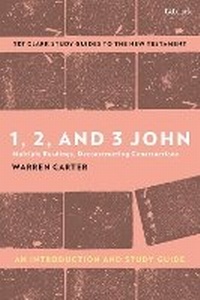
1, 2, and 3 John: An Introduction and Study Guide
Multiple Readings, Deconstructing Constructions
Published on 8. August 2024
Book
Paperback/Softback
144 pages
978-0-567-70421-4 (ISBN)
Description
This insightful study engages the debates and interpretations of the brief and somewhat elusive writings known in the Christian canon as 1, 2, and 3 John. Chapter 1 identifies six unknowns about the origins of the three writings: authors, relationship to John's Gospel, order, date and location of the writings, and their audiences. Chapters 2 and 3 delineate the debate concerning the relationship of these writings to a purported "Johannine tradition" and "Johannine community" in which a schism is claimed to have occurred. An alternative view recognizes that while there are some connections with John's Gospel, it is more compelling to see the writings as independent rather than derivative, as internally not externally directed, as pastoral not polemical, and as schism-free.
Chapters 4-7 discuss important aspects of 1 John. Chapter 4 argues that its structure or organization is based on rhetorical and conceptual links among the writing's small units. Chapter 5 reads 1 John as a pastoral "in-house" writing, rather than a polemical attack on opponents. Chapter 6 identifies the genre of I John as not a letter or sermon but an epideictic speech that seeks to strengthen the identity, commitments, and practices of its believing recipients. Chapter 7 outlines theological understandings that underpin the writing's pastoral work.
Chapters 8 and 9 focus on 2 and 3 John as writings that provide two different approaches to itinerant teachers. The narrative fiction in 2 John presents the elder's warning and skepticism about itinerant teachers whereas the author of 3 John, by contrast, advocates reception and welcome for itinerant teachers.
Chapters 4-7 discuss important aspects of 1 John. Chapter 4 argues that its structure or organization is based on rhetorical and conceptual links among the writing's small units. Chapter 5 reads 1 John as a pastoral "in-house" writing, rather than a polemical attack on opponents. Chapter 6 identifies the genre of I John as not a letter or sermon but an epideictic speech that seeks to strengthen the identity, commitments, and practices of its believing recipients. Chapter 7 outlines theological understandings that underpin the writing's pastoral work.
Chapters 8 and 9 focus on 2 and 3 John as writings that provide two different approaches to itinerant teachers. The narrative fiction in 2 John presents the elder's warning and skepticism about itinerant teachers whereas the author of 3 John, by contrast, advocates reception and welcome for itinerant teachers.
Reviews / Votes
Many initial readers are at a loss when they first encounter the Johannine Letters, uncertain as to what sort of letters they are and where they belong in the world of early Christianity, and whether they are anything more than an appendix to the more familiar Gospel. With a sure hand Warren Carter guides them through some of the key debates in answering these questions and allows the letters' distinctive outlook to emerge out of the shadows and to invite serious theological engagement. * Judith Lieu, Robinson College, Cambridge University, UK * Carter focuses on the primary matter for interpretation of 1-3 John: whether to read these three texts polemically as addressing a schism affecting three churches within a community, or read them pastorally as addressing the spiritual needs of three independent churches. Carter prefers the latter option and reads these texts as epideictic rhetoric constructing and actualizing identity among the recipients. This approach introduces 1-3 John in a very engaging fashion. * Duane F. Watson, Malone University, USA * Although I have not changed the views I expressed in my Sacra Pagina Commentary of 2002, I welcome the fresh views of Warren Carter's rhetorical approach, which has become more prominent in recent times but was not absent when I wrote. Likewise, he reviews the common authorship of the three writings and their relationship to the Fourth Gospel. * John Painter, Charles Sturt University, Australia * This is a very good introduction for those beginning to delve into the Catholic Epistles. * The Bible Today * Carter has provided a useful resource ... The focus on rediscovery and renewal through lived encounter with Scripture is the book's core strength. * The Expository Times *More details
Series
Language
English
Place of publication
Edinburgh
United Kingdom
Publishing group
Bloomsbury Publishing PLC
Target group
College/higher education
Dimensions
Height: 232 mm
Width: 152 mm
Thickness: 9 mm
Weight
238 gr
ISBN-13
978-0-567-70421-4 (9780567704214)
Copyright in bibliographic data and cover images is held by Nielsen Book Services Limited or by the publishers or by their respective licensors: all rights reserved.
Schweitzer Classification
Other editions
Additional editions
Warren Carter
1, 2, and 3 John: An Introduction and Study Guide
Multiple Readings, Deconstructing Constructions
E-Book
07/2024
1st Edition
T.& T.Clark Ltd
€20.99
Available for download
Warren Carter
1, 2, and 3 John: An Introduction and Study Guide
Multiple Readings, Deconstructing Constructions
E-Book
07/2024
1st Edition
T.& T.Clark Ltd
€20.99
Available for download
Person
Warren Carter is Meinders Professor of New Testament, Phillips Theological Seminary Tulsa, USA.
Content
Introduction
Part I: Locating Readings of I, II, and III John
1. Matters We Don't Know about I, II, and III John
2. Raymond Brown: Johannine Tradition and Community
3. Judith Lieu's Approach: Three Autonomous Writings
Part 2: First John
4. How Is I John Structured?
5. Does I John Attack Opponents?
6. What Genre of Writing is 1 John? Epideictic Rhetoric
7. Theology in I John?
Part 3: II and III John
8. II John
9. III John
Bibliography
Part I: Locating Readings of I, II, and III John
1. Matters We Don't Know about I, II, and III John
2. Raymond Brown: Johannine Tradition and Community
3. Judith Lieu's Approach: Three Autonomous Writings
Part 2: First John
4. How Is I John Structured?
5. Does I John Attack Opponents?
6. What Genre of Writing is 1 John? Epideictic Rhetoric
7. Theology in I John?
Part 3: II and III John
8. II John
9. III John
Bibliography