

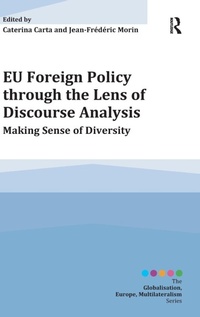
EU Foreign Policy through the Lens of Discourse Analysis
Making Sense of Diversity
1st Edition
Published on 28. April 2014
Book
Hardback
290 pages
978-1-4094-6375-7 (ISBN)
Description
Leading scholars in discourse analysis and European foreign policy join forces in this book, marking a real breakthrough in the literature. Not only do they offer original perspectives on European foreign policy, but they bring together various theories on foreign policy discourses that remain too often isolated from each other.
This theoretical diversity is clearly reflected in the book's four-pronged structure: Part I - Post-structuralist Approaches (with contributions from Thomas Diez, Henrik Larsen and Beste Isleyen); Part II - Constructivist Approaches (with contributions from Knud Erik Jorgensen, Jan Orbie, Ferdi de Ville, Esther Barbe, Anna Herranz-Surralles and Michal Natorski); Part III - Critical Discourse Analytical Approaches (with contributions from Senem Aydin-Duezgit, Amelie Kutter, Ruth Wodak, Salomi Boukala and Caterina Carta); Part IV - Discursive Institutionalist Approaches (with contributions from Ben Rosamond, Antoine Rayroux and Vivien A. Schmidt). The volume is the first full-length study on how to apply different discourse analytical approaches and methodologies to European foreign policy. The paperback edition makes for a unique selling point as a course text.
This theoretical diversity is clearly reflected in the book's four-pronged structure: Part I - Post-structuralist Approaches (with contributions from Thomas Diez, Henrik Larsen and Beste Isleyen); Part II - Constructivist Approaches (with contributions from Knud Erik Jorgensen, Jan Orbie, Ferdi de Ville, Esther Barbe, Anna Herranz-Surralles and Michal Natorski); Part III - Critical Discourse Analytical Approaches (with contributions from Senem Aydin-Duezgit, Amelie Kutter, Ruth Wodak, Salomi Boukala and Caterina Carta); Part IV - Discursive Institutionalist Approaches (with contributions from Ben Rosamond, Antoine Rayroux and Vivien A. Schmidt). The volume is the first full-length study on how to apply different discourse analytical approaches and methodologies to European foreign policy. The paperback edition makes for a unique selling point as a course text.
Reviews / Votes
'Honouring both the plurality and fecundity that characterises discursive approaches, this book demonstrates the pertinence of focussing on discourses, in their many different hues, for understanding one of the most salient developments of the contemporary international system: the production, reproduction and transformation of Europe. It will be of great interest all at once to students and scholars interested in the role of language in international politics, the workings of international governance, or indeed in the great European project.' Charlotte Epstein, University of Sydney, Australia 'With its unique collection of essays, this book celebrates two kinds of diversity: the highly diverse discursive environment that constitutes the EU's multifaceted identities, and the many academic approaches to analysing these multiple intersecting narratives. A fascinating read celebrating what we need to accept as the EU's irredeemable polyphony.' Kalypso NicolaA?dis, University of Oxford, UK 'This book represents an excellent contribution to the literature. First, it unpacks discourse analysis and demonstrates the diversity of the various discursive approaches. Second, it uses these discourse analytical lenses to shed new light on EU foreign policy. Essential reading for anybody interested in the application of discourse analysis to real world? issues!' Thomas Risse, Freie UniversitA?t Berlin, Germany 'EU Foreign Policy through the Lens of Discourse Analysis is the most comprehensive collection to date covering the broad array of discourse analytic approaches to the study of international relations and foreign policy. The chapters make clear that discourse, as a concept, an object of analysis, and a method crosses ontological and epistemological stances and is significant for a diversity of researchers.' Roxanne Lynn Doty, Arizona State University, USA '... to those who are looking for innovative and creative theoretical contributions or new insighMore details
Series
Language
English
Place of publication
London
United Kingdom
Publishing group
Taylor & Francis Ltd
Target group
College/higher education
Dimensions
Height: 240 mm
Width: 161 mm
Thickness: 20 mm
Weight
605 gr
ISBN-13
978-1-4094-6375-7 (9781409463757)
Copyright in bibliographic data and cover images is held by Nielsen Book Services Limited or by the publishers or by their respective licensors: all rights reserved.
Schweitzer Classification
Other editions
Additional editions
Caterina Carta | Jean-Frederic Morin
EU Foreign Policy through the Lens of Discourse Analysis
Making Sense of Diversity
E-Book
04/2016
Routledge
€67.49
Available for download
Caterina Carta | Jean-Frederic Morin
EU Foreign Policy through the Lens of Discourse Analysis
Making Sense of Diversity
E-Book
04/2016
Routledge
€67.49
Available for download
Caterina Carta | Jean-Frederic Morin
EU Foreign Policy through the Lens of Discourse Analysis
Making Sense of Diversity
Book
04/2014
1st Edition
Routledge
€74.20
Shipment within 10-20 days
Persons
Caterina Carta is Assistant Professor at Vesalius College (VUB), Belgium, where she teaches Introduction to Political Theory, Introduction to International Relations and Theories of European Integration. She holds a Ph.D. in Comparative and European Politics from the University of Siena. She is associated researcher at the Institute d'etudes europeennes (IEE) at ULB, Brussels. Her articles have been published in Cooperation and Conflict, the British Journal of Politics and International Relations, and European Foreign Affairs Review.
Jean-Frederic Morin is Professor of International Relations at the Universite libre de Bruxelles (ULB), Belgium, where he teaches international political economy, foreign policy analysis, and global environmental politics. His current research projects explore the global politics of intellectual property rights as well as the international biodiversity regime. His work has been published in leading journals such as International Studies Review, Global Governance, European Journal of International Politics, Review of International Political Economy, and Review of International Studies.
Jean-Frederic Morin is Professor of International Relations at the Universite libre de Bruxelles (ULB), Belgium, where he teaches international political economy, foreign policy analysis, and global environmental politics. His current research projects explore the global politics of intellectual property rights as well as the international biodiversity regime. His work has been published in leading journals such as International Studies Review, Global Governance, European Journal of International Politics, Review of International Political Economy, and Review of International Studies.
Content
Introduction: EU Foreign Policy through the Lens of Discourse Analysis
Part I: Poststructuralist Approaches
1. Speaking Europe, Drawing Boundaries: Reflections on the Role of Discourse in EU Foreign Policy and Identity
2. Continuity or Change in National Foreign Policy Discourses Post-Lisbon? The Case of Denmark
3. Protection or Prevention? Different Visions of EU International Terrorism Policy
Part II: Constructivist Approaches
4. Constructing European Diplomacy in a Changing World
5. 'A Boost to our Economies that Doesn't Cost a Cent': EU Trade Policy Discourse since the Crisis
6. Model, Player or Instrument for Global Governance: Metaphors in the Discourse and Practice of EU Foreign Policy
Part III: Critical Discourse Analytical Approaches
7. Unravelling European Union Foreign Policy through Critical Discourse Analysis: Guidelines for Research
8. (De-)Constructing the EU as a Civilising Power: CFSP/CSDP and the Constitutional Debate in Poland and France
9. Talking about Solidarity and Security in the Age of Crisis: The Revival of Nationalism and Protectionism in the European Union - a Discourse-Historical Approach
10. From the 'Magnificent Castle' to the Brutish State of Nature: Use of Metaphors and the Analysis of the EU's International Discourse
Part IV: Discursive Institutionalist Approaches
11. The EU's Normative Power and Three Modes of Liberal Communicative Discourse
12. Understanding 'Constructive Ambiguity' of European Defence Policy: A Discursive Institutionalist Perspective
13. EU Leaders' Ideas and Discourse in the Eurozone Crisis: A Discursive Institutionalist Analysis
Part I: Poststructuralist Approaches
1. Speaking Europe, Drawing Boundaries: Reflections on the Role of Discourse in EU Foreign Policy and Identity
2. Continuity or Change in National Foreign Policy Discourses Post-Lisbon? The Case of Denmark
3. Protection or Prevention? Different Visions of EU International Terrorism Policy
Part II: Constructivist Approaches
4. Constructing European Diplomacy in a Changing World
5. 'A Boost to our Economies that Doesn't Cost a Cent': EU Trade Policy Discourse since the Crisis
6. Model, Player or Instrument for Global Governance: Metaphors in the Discourse and Practice of EU Foreign Policy
Part III: Critical Discourse Analytical Approaches
7. Unravelling European Union Foreign Policy through Critical Discourse Analysis: Guidelines for Research
8. (De-)Constructing the EU as a Civilising Power: CFSP/CSDP and the Constitutional Debate in Poland and France
9. Talking about Solidarity and Security in the Age of Crisis: The Revival of Nationalism and Protectionism in the European Union - a Discourse-Historical Approach
10. From the 'Magnificent Castle' to the Brutish State of Nature: Use of Metaphors and the Analysis of the EU's International Discourse
Part IV: Discursive Institutionalist Approaches
11. The EU's Normative Power and Three Modes of Liberal Communicative Discourse
12. Understanding 'Constructive Ambiguity' of European Defence Policy: A Discursive Institutionalist Perspective
13. EU Leaders' Ideas and Discourse in the Eurozone Crisis: A Discursive Institutionalist Analysis