

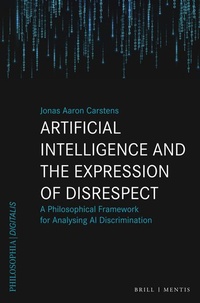
Artificial Intelligence and the Expression of Disrespect
A Philosophical Framework for Analysing AI Discrimination
1st Edition
Published on 1. June 2026
Book
Hardback
XVIII, 303 pages
978-3-95743-354-1 (ISBN)
Description
From image recognition that fails to process darker skin to disadvantaging minority neighbourhoods in the credit market, examples of discrimination through artificial intelligence are easy to find, and yet it is unclear why and when such cases are wrong. Jonas Carstens shows that a concept of discrimination built on the expression of disrespect and the social status of those who are disadvantaged can help us make sense of AI discrimination.
AI discrimination sparks moral unease. It poses novel questions and reopens existing debates. What if the programmers of an AI model did not intend any disadvantages, but the model learned discriminatory correlations from the data? Who, if anybody, has discriminated here? Jonas Carstens discusses existing approaches to discrimination, develops a unique synthesis, and uses it to analyse AI discrimination.
AI discrimination sparks moral unease. It poses novel questions and reopens existing debates. What if the programmers of an AI model did not intend any disadvantages, but the model learned discriminatory correlations from the data? Who, if anybody, has discriminated here? Jonas Carstens discusses existing approaches to discrimination, develops a unique synthesis, and uses it to analyse AI discrimination.
More details
Series
Edition
2026
Language
English
Place of publication
Netherlands
Publishing group
Brill | mentis
Target group
Professional and scholarly
Product notice
sewn/stitched
Cloth over boards
Illustrations
3
1 s/w Tabelle, 2 s/w Abbildungen
2 schwarz-weiße Abbildungen, 1 schwarz-weiße Tabellen
Dimensions
Height: 241 mm
Width: 160 mm
Thickness: 28 mm
Weight
707 gr
ISBN-13
978-3-95743-354-1 (9783957433541)
Schweitzer Classification
Person
Jonas Aaron Carstens works at the Institute for Political Philosophy and Ethics at the Heinrich-Heine-University in Düsseldorf. He has studied English, Philosophy and Practical Philosophy of the Environment and the Economy in Kiel and Halifax and primarily works on the ethics of AI. His research focuses on the role that AI plays in upholding inequalities, when such reproduction is wrongful, and which duties exist in the context of developing AI.