

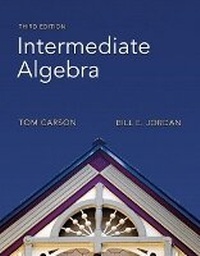
Intermediate Algebra
3rd Edition
Published on 1. January 2010
Book
Hardback
792 pages
978-0-321-60711-9 (ISBN)
Description
The Carson algebra series addresses two fundamental issues-individual learning styles and comprehension of key mathematical concepts-to meet the needs of today's readers. Carson's Study System, presented in the To the Student section at the front of the text, adapts to the way each reader learns to ensure their success in this and future courses. The consistent emphasis on the big picture of algebra, with pedagogy and support that helps readers put each new concept into proper context, encourages conceptual understanding.
More details
Edition
3rd edition
Language
English
Place of publication
United States
Publishing group
Pearson Education (US)
Target group
College/higher education
Dimensions
Height: 276 mm
Width: 216 mm
Weight
1805 gr
ISBN-13
978-0-321-60711-9 (9780321607119)
Copyright in bibliographic data is held by Nielsen Book Services Limited or its licensors: all rights reserved.
Schweitzer Classification
Other editions
New editions
Tom Carson | Bill Jordan
Intermediate Algebra
Book
03/2014
4th Edition
Pearson
€210.45
Shipment within 10-20 days
Previous edition

Tom Carson | Bill E. Jordan
Intermediate Algebra
Book
03/2006
2nd Edition
Pearson
€105.22
Article exhausted; check for reprint
Persons
Tom Carson's first teaching experience was teaching guitar while an undergraduate student studying electrical engineering. That experience helped him to realize that his true gift and passion are for teaching. He earned his MAT. in mathematics at the University of South Carolina. In addition to teaching at Midlands Technical College, Columbia State Community College, and Franklin Classical School, Tom has served on the faculty council and has been a board member of the South Carolina Association of Developmental Educators (SCADE). Ever the teacher, Tom teaches outside the classroom by presenting at conferences such as NADE, AMATYC, and ICTCM on topics such as Combating Innumeracy, Writing in Mathematics, and Implementing a Study System. Bill Jordan received his BS from Rollins College and his MAT from Tulane University. A decorated teacher for more than 40 years, Jordan has served as the chair of the math department at Seminole Community College and has taught at Rollins College. He has been a member and leader of numerous professional organizations, including the Florida Two-Year College Mathematical Association (president), Florida Council of Teachers of Mathematics (district director), and others. In addition to his work on the Carson series, Jordan is also the lead author of _Integrated Algebra and Arithmetic, 2/e, also published by Pearson. In his spare time, he enjoys fishing, traveling, and hiking.
Content
1. Real Numbers and Expressions1.1 Sets and the Structure of Algebra1.2 Operations with Real Numbers; Properties of Real Numbers1.3 Exponents, Roots, and Order of Operations1.4 Evaluating and Rewriting Expressions 2. Linear Equations and Inequalities in One Variable2.1 Linear Equations and Formulas2.2 Solving Problems2.3 Solving Linear Inequalities2.4 Compound Inequalities2.5 Equations Involving Absolute Value2.6 Inequalities Involving Absolute Value 3. Equations and Inequalities in Two Variables; Functions3.1 Graphing Linear Equations3.2 The Slope of a Line3.3 The Equation of a Line3.4 Graphing Linear Inequalities3.5 Introduction to Functions and Function Notation 4. Systems of Linear Equations and Inequalities4.1 Solving Systems of Linear Equations in Two Variables4.2 Solving Systems of Linear Equations in Three Variables4.3 Solving Applications Using Systems of Equations4.4 Solving Systems of Linear Equations Using Matrices4.5 Solving Systems of Linear Equations Using Cramer's Rule4.6 Solving Systems of Linear Inequalities 5. Exponents, Polynomials, and Polynomial Functions5.1 Exponents and Scientific Notation5.2 Polynomials and Polynomial Functions5.3 Multiplying Polynomials5.4 Dividing Polynomials5.5 Synthetic Division and the Remainder Theorem 6. Factoring6.1 Greatest Common Factor and Factoring by Grouping6.2 Factoring Trinomials6.3 Factoring Special Products and Factoring Strategies6.4 Solving Equations by Factoring 7. Rational Expressions and Equations7.1 Simplifying, Multiplying, and Dividing Rational Expressions7.2 Adding and Subtracting Rational Expressions7.3 Simplifying Complex Rational Expressions7.4 Solving Equations Containing Rational Expressions7.5 Applications with Rational Expressions; Variation 8. Rational Exponents, Radicals, and Complex Numbers8.1 Radical Expressions and Functions8.2 Rational Exponents8.3 Multiplying, Dividing, and Simplifying Radicals8.4 Adding, Subtracting, and Multiplying Radical Expressions8.5 Rationalizing Numerators and Denominators of Radical Expressions8.6 Radical Equations and Problem Solving8.7 Complex Numbers 9. Quadratic Equations and Functions9.1 Completing the Square9.2 Solving Quadratic Equations Using the Quadratic Formula9.3 Solving Equations That Are Quadratic in Form9.4 Graphing Quadratic Functions9.5 Solving Nonlinear Inequalities 10. Exponential and Logarithmic Functions10.1 Composite and Inverse Functions10.2 Exponential Functions10.3 Logarithmic Functions10.4 Properties of Logarithms10.5 Common and Natural Logarithms10.6 Exponential and Logarithmic Equations with Applications 11. Conic Sections11.1 Parabolas and the Circles11.2 Ellipses and Hyperbolas11.3 Nonlinear Systems of Equations11.4 Nonlinear Inequalities and Systems of Inequalities AppendicesA. Arithmetic Sequences and SeriesB. Geometric Sequences and SeriesC. The Binomial TheoremD. Permutations and Combinations (available online via MyMathLab)E. Probability (available online via MyMathLab)