

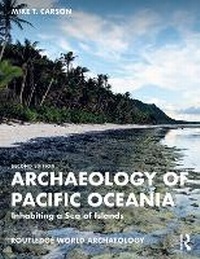
Archaeology of Pacific Oceania
Inhabiting a Sea of Islands
2nd Edition
Published on 11. October 2023
Book
Paperback/Softback
400 pages
978-1-032-48637-6 (ISBN)
Description
Archaeology of Pacific Oceania, now in its second edition, offers a state-of-the-art and fully detailed chronological narrative of how Pacific Oceania came to be inhabited over a long time scale, posing fundamental questions both for Pacific Oceania and for global archaeology.
The Pacific Ocean covers 165 million sq. km, nearly one-third of the world's total surface area, yet its thousands of islands and their diverse cultural histories are scarcely known to the other two-thirds of the world. This book asks how and why did this vast sea of islands come to be inhabited over the last several millennia, transcending significant change in ecology, demography, and society? What were the roles of overseas contacts in the development of social networks, economic trade, and population dynamics? What can any or all of the thousands of islands offer as ideal model systems for comprehending globally significant issues of human-environment relations and coping with changing circumstances of natural and cultural history? What do the island archaeology records reveal about coastal setting as part of the larger human experience? How does Pacific Oceanic archaeology relate with a larger Asia-Pacific context or with the scope of world archaeology? The new second edition of Archaeology of Pacific Oceania addresses these questions and more, providing an updated synthesis of this important region.
Archaeology of Pacific Oceania is for scholars of Asia-Pacific archaeology and anthropology and will support students investigating the archaeology of Pacific Oceania.
The Pacific Ocean covers 165 million sq. km, nearly one-third of the world's total surface area, yet its thousands of islands and their diverse cultural histories are scarcely known to the other two-thirds of the world. This book asks how and why did this vast sea of islands come to be inhabited over the last several millennia, transcending significant change in ecology, demography, and society? What were the roles of overseas contacts in the development of social networks, economic trade, and population dynamics? What can any or all of the thousands of islands offer as ideal model systems for comprehending globally significant issues of human-environment relations and coping with changing circumstances of natural and cultural history? What do the island archaeology records reveal about coastal setting as part of the larger human experience? How does Pacific Oceanic archaeology relate with a larger Asia-Pacific context or with the scope of world archaeology? The new second edition of Archaeology of Pacific Oceania addresses these questions and more, providing an updated synthesis of this important region.
Archaeology of Pacific Oceania is for scholars of Asia-Pacific archaeology and anthropology and will support students investigating the archaeology of Pacific Oceania.
More details
Series
Edition
2nd edition
Language
English
Place of publication
London
United Kingdom
Publishing group
Taylor & Francis Ltd
Target group
College/higher education
Professional and scholarly
Academic and Postgraduate
Illustrations
204 s/w Photographien bzw. Rasterbilder, 204 s/w Abbildungen
204 Halftones, black and white; 204 Illustrations, black and white
Dimensions
Height: 246 mm
Width: 189 mm
Weight
1080 gr
ISBN-13
978-1-032-48637-6 (9781032486376)
Copyright in bibliographic data and cover images is held by Nielsen Book Services Limited or by the publishers or by their respective licensors: all rights reserved.
Schweitzer Classification
Other editions
Additional editions
E-Book
10/2023
2nd Edition
Routledge
€53.99
Available for download
E-Book
10/2023
2nd Edition
Routledge
€53.99
Available for download
Book
10/2023
2nd Edition
Routledge
€230.62
Shipment within 10-20 days
Previous edition
Book
03/2018
1st Edition
Routledge
€73.22
Article exhausted; check for reprint
Person
Mike T. Carson (Ph.D. in Anthropology, University of Hawai'i, 2002) has investigated the broad geographic range and chronological scope of archaeological landscapes throughout the Asia-Pacific region. He was author of several books about Pacific Oceanic archaeology and ancient landscapes, editor of Palaeolandscapes in Archaeology: Lessons for the Past and Future (Routledge, 2022), and co-editor of Asian Perspectives: The Journal of Archaeology for Asia and the Pacific (University of Hawai'i Press, 2014-2020). He currently is Associate Professor of Archaeology at the Richard F. Taitano Micronesian Area Research Center at the University of Guam.
Content
Chapter 1 Research themes in Pacific Oceanic archaeology
Chapter 2 Regional context and perspectives
Chapter 3 Substance and scope of Pacific Oceanic archaeology
Chapter 4 Hunter-gatherer traditions in the western Asia-Pacific region
Chapter 5 Following the Asia-Pacific pottery trail, 4000 through 800 B.C.
Chapter 6 First contact with the Remote Oceanic environment
Chapter 7 A siege of ecological imperialism
Chapter 8 The end of an era
Chapter 9 A broad-spectrum revolution? 500 B.C. through A.D. 100
Chapter 10 The atoll highway of Micronesia, A.D. 100 through 500
Chapter 11 Ethnogenesis and polygenesis, A.D. 500 through 1000
Chapter 12 An A.D. 1000 event? Formalization of cultural expressions
Chapter 13 Expansion and intensification, A.D. 1000 through 1800
Chapter 14 Living with the past
Chapter 2 Regional context and perspectives
Chapter 3 Substance and scope of Pacific Oceanic archaeology
Chapter 4 Hunter-gatherer traditions in the western Asia-Pacific region
Chapter 5 Following the Asia-Pacific pottery trail, 4000 through 800 B.C.
Chapter 6 First contact with the Remote Oceanic environment
Chapter 7 A siege of ecological imperialism
Chapter 8 The end of an era
Chapter 9 A broad-spectrum revolution? 500 B.C. through A.D. 100
Chapter 10 The atoll highway of Micronesia, A.D. 100 through 500
Chapter 11 Ethnogenesis and polygenesis, A.D. 500 through 1000
Chapter 12 An A.D. 1000 event? Formalization of cultural expressions
Chapter 13 Expansion and intensification, A.D. 1000 through 1800
Chapter 14 Living with the past