

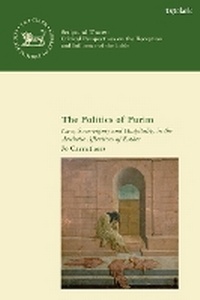
The Politics of Purim
Law, Sovereignty and Hospitality in the Aesthetic Afterlives of Esther
Published on 21. October 2021
Book
Paperback/Softback
224 pages
978-0-567-70231-9 (ISBN)
Description
This book approaches the holiday of Purim as profane, freed to human use and ends, in order to consider the political legacy of the biblical story of Esther in festival and art works. Jo Carruthers explores carnival and synagogue practices, the purimshpil (Purim's own dramatic genre), illuminated Esther scrolls, as well as artworks by Botticelli, Millais and Jan Steen. The complex and astute interrogation of political life in such festival and artworks is analysed through theories of sovereignty, law, precarity and hospitality by key political thinkers such as Giorgio Agamben, Hannah Arendt, Walter Benjamin, Judith Butler, Jacques Derrida, and Jacques Ranciere.
Carruthers considers different motifs of boundary conservation and dissolution, as a means of contemplating the political implications of Purim and the Esther story for diaspora politics. How is sovereignty aspired to and attained by marginalized and threatened communities? How can one respond to the ethical call of hospitality to relax sovereign boundaries whilst protecting and celebrating that which is exceptional? The practice of giving gifts, mishloach manos, offers a model of hospitality that together with Purim's profane impulse is epitomized in the final chapter's discussion of a 2018 Brooklyn purimshpil, that offers a riotous ridiculing of white supremacist rhetoric, norms of domination, capitalist inequalities, modern slavery and ablest identities and assumptions.
Carruthers considers different motifs of boundary conservation and dissolution, as a means of contemplating the political implications of Purim and the Esther story for diaspora politics. How is sovereignty aspired to and attained by marginalized and threatened communities? How can one respond to the ethical call of hospitality to relax sovereign boundaries whilst protecting and celebrating that which is exceptional? The practice of giving gifts, mishloach manos, offers a model of hospitality that together with Purim's profane impulse is epitomized in the final chapter's discussion of a 2018 Brooklyn purimshpil, that offers a riotous ridiculing of white supremacist rhetoric, norms of domination, capitalist inequalities, modern slavery and ablest identities and assumptions.
Reviews / Votes
This is a brilliant and refreshing look at an ancient, well-worn text and its reception. The writing is lucid, the arguments subtle and complex without being cluttered with literary jargon. The indices are thorough-including an index of primary references, of authors, and of subjects ... I delighted in reading the book. * The Bible and Critical Theory * [T]he book offers fascinating insights on how Purim and its customs embody a minority's profound reflections on its own political status, identity and (in)security. * Journal for the Study of the Old Testament *More details
Series
Language
English
Place of publication
Edinburgh
United Kingdom
Publishing group
Bloomsbury Publishing PLC
Target group
College/higher education
Illustrations
8 bw illus
Dimensions
Height: 232 mm
Width: 154 mm
Thickness: 12 mm
Weight
340 gr
ISBN-13
978-0-567-70231-9 (9780567702319)
Copyright in bibliographic data and cover images is held by Nielsen Book Services Limited or by the publishers or by their respective licensors: all rights reserved.
Schweitzer Classification
Other editions
Additional editions
Jo Carruthers
The Politics of Purim
Law, Sovereignty and Hospitality in the Aesthetic Afterlives of Esther
E-Book
02/2020
1st Edition
T.& T.Clark Ltd
€36.49
Available for download
Jo Carruthers
The Politics of Purim
Law, Sovereignty and Hospitality in the Aesthetic Afterlives of Esther
E-Book
02/2020
1st Edition
T.& T.Clark Ltd
€36.49
Available for download
Person
Jo Carruthers is Senior Lecturer at the University of Lancaster, UK.
Content
Introduction: The Politics of Persecution
I. Lawlessness, Sovereignty and In-hospitality
1. Carnival, Lawlessness and Sovereignty
2. The State of Exception, Amalek and Sovereign Hospitality
II. Purim and the Enemy
3. The Anti-Memorial of Remembering to Forget
4. The Art of Exception in the Illuminated Megillah
5. Bare Life and Sovereignty
III. The Secular Politics of Esther: Sovereign and Legal Fallibility
6. Law's Limitations
7. Creaturely Sovereignty
IV. Purim and Hospitality
8. Esther the Good Host and the Good Sovereign
9. Mordecai's Mourning: Exclusion and Vulnerability
10. 'Shalokh Manos Re-mixed': An Aftselakhis Purimshpil
Conclusion
I. Lawlessness, Sovereignty and In-hospitality
1. Carnival, Lawlessness and Sovereignty
2. The State of Exception, Amalek and Sovereign Hospitality
II. Purim and the Enemy
3. The Anti-Memorial of Remembering to Forget
4. The Art of Exception in the Illuminated Megillah
5. Bare Life and Sovereignty
III. The Secular Politics of Esther: Sovereign and Legal Fallibility
6. Law's Limitations
7. Creaturely Sovereignty
IV. Purim and Hospitality
8. Esther the Good Host and the Good Sovereign
9. Mordecai's Mourning: Exclusion and Vulnerability
10. 'Shalokh Manos Re-mixed': An Aftselakhis Purimshpil
Conclusion