

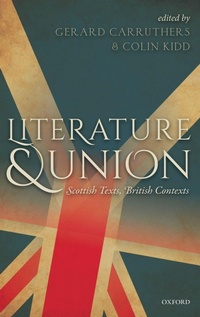
Literature and Union
Scottish Texts, British Contexts
Published on 18. January 2018
Book
Hardback
444 pages
978-0-19-873623-3 (ISBN)
Description
Literature and Union opens up a new front in interdisciplinary literary studies. There has been a great deal of academic work--both in the Scottish context and more broadly--on the relationship between literature and nationhood, yet almost none on the relationship between literature and unions. This volume introduces the insights of the new British history into mainstream Scottish literary scholarship. The contributors, who are from all shades of the political spectrum, will interrogate from various angles the assumption of a binary opposition between organic Scottish values and those supposedly imposed by an overbearing imperial England. Viewing Scottish literature as a clash between Scottish and English identities loses sight of the internal Scottish political and religious divisions, which, far more than issues of nationhood and union, were the primary sources of conflict in Scottish culture for most of the period of Union, until at least the early twentieth century.
The aim of the volume is to reconstruct the story of Scottish literature along lines which are more historically persuasive than those of the prevailing grand narratives in the field. The chapters fall into three groups: (1) those which highlight canonical moments in Scottish literary Unionism--John Bull, 'Rule, Britannia', Humphry Clinker, Ivanhoe and England, their England; (2) those which investigate key themes and problems, including the Unions of 1603 and 1707, Scottish Augustanism, the Burns Cult, Whig-Presbyterian and sentimental Jacobite literatures; and (3) comparative pieces on European and Anglo-Irish phenomena.
The aim of the volume is to reconstruct the story of Scottish literature along lines which are more historically persuasive than those of the prevailing grand narratives in the field. The chapters fall into three groups: (1) those which highlight canonical moments in Scottish literary Unionism--John Bull, 'Rule, Britannia', Humphry Clinker, Ivanhoe and England, their England; (2) those which investigate key themes and problems, including the Unions of 1603 and 1707, Scottish Augustanism, the Burns Cult, Whig-Presbyterian and sentimental Jacobite literatures; and (3) comparative pieces on European and Anglo-Irish phenomena.
Reviews / Votes
A landmark collection: it raises significant questions to which no single volume could offer definitive answers; the editors' attempt to set a new agenda for Scottish literary research is to be welcomed. * Alex Thomson, University of Edinburgh * ... the most interesting Scottish book published all year. * Alex Massie, The Sunday Times * A significant intervention in Scottish literary studies, and all the contributors deserve commentation. * Stuart Kelly, The Scotsman *More details
Language
English
Place of publication
Oxford
United Kingdom
Target group
College/higher education
Dimensions
Height: 240 mm
Width: 161 mm
Thickness: 28 mm
Weight
828 gr
ISBN-13
978-0-19-873623-3 (9780198736233)
Copyright in bibliographic data and cover images is held by Nielsen Book Services Limited or by the publishers or by their respective licensors: all rights reserved.
Schweitzer Classification
Other editions
Additional editions
E-Book
01/2018
1st Edition
OUP eBook
€21.99
Available for download
E-Book
01/2018
1st Edition
OUP eBook
€24.49
Available for download
Persons
Gerard Carruthers is General Editor of the OUP Collected Works of Robert Burns, author of Scottish Literature, A Critical Guide (EUP, 2009) and Robert Burns (Northcote, 2004). He has edited a dozen essay-collections or critical editions and written many essays in literary studies. He is a Fellow of the Royal Society of Edinburgh.
Colin Kidd is Wardlaw Professor at the University of St Andrews and a Fellow of all Souls College, Oxford. He is the author of several books on the history of ethnic and national identities, including Subverting Scotland's Past (CUP, 1993), British Identities before Nationalism (1999), The Forging of Races (CUP, 2006), and Union and Unionisms (CUP, 2008). He was elected a Fellow of the British Academy in 2010. His most recent book, The World of Mr Casaubon (CUP, 2016) is a study of George Eliot's deluded mythographer and his Key to All Mythologies.
Colin Kidd is Wardlaw Professor at the University of St Andrews and a Fellow of all Souls College, Oxford. He is the author of several books on the history of ethnic and national identities, including Subverting Scotland's Past (CUP, 1993), British Identities before Nationalism (1999), The Forging of Races (CUP, 2006), and Union and Unionisms (CUP, 2008). He was elected a Fellow of the British Academy in 2010. His most recent book, The World of Mr Casaubon (CUP, 2016) is a study of George Eliot's deluded mythographer and his Key to All Mythologies.
Content
1: Colin Kidd: Union and the Ironies of Displacement in Scottish Literature
2: Alasdair Raffe: John Bull, Sister Peg and Anglo-Scottish Relations in the Eighteenth Century
3: Richard Holmes: 'Bagpipes no Musick': Allan Ramsay, James Arbuckle and the significance of the 'Scots' poetic revival
4: Ralph Mclean: James Thomson and 'Rule, Britannia'
5: Thomas Keymer: Fictions, Libels and Unions in the long Eighteenth Century
6: Gerard Carruthers: Jacobite Unionism
7: Alison Lumsden: Inclusion and Exclusion in the British State: Walter Scott's Ivanhoe and The Fortunes of Nigel
8: Andrew R. Holmes: Union and Presbyterian Ulster Scots: William McComb, James McKnight, and The Repealer Repulsed
9: Valerie Wallace and Colin Kidd: Between Nationhood and Nonconformity: the Scottish Whig-Presbyterian Novel and the Denominational Press
10: Christopher Whatley: Contested commemoration: Robert Burns, urban Scotland and Scottish nationality in the nineteenth century
11: Catriona Macdonald: Rogue Element: Charles Rogers and the Scotching of British History
12: David Goldie: Unspeakable Scots: dialogues and dialectics in Scottish / British literary culture before the First World War
13: Donald Mackenzie: Once and Future Kingdoms
14: Brian Young: A.G. MacDonell's England, their England
15: Robert Crawford: England's Scotland
16: Gerard Carruthers: Postscript: The Death of Literary Unionism
2: Alasdair Raffe: John Bull, Sister Peg and Anglo-Scottish Relations in the Eighteenth Century
3: Richard Holmes: 'Bagpipes no Musick': Allan Ramsay, James Arbuckle and the significance of the 'Scots' poetic revival
4: Ralph Mclean: James Thomson and 'Rule, Britannia'
5: Thomas Keymer: Fictions, Libels and Unions in the long Eighteenth Century
6: Gerard Carruthers: Jacobite Unionism
7: Alison Lumsden: Inclusion and Exclusion in the British State: Walter Scott's Ivanhoe and The Fortunes of Nigel
8: Andrew R. Holmes: Union and Presbyterian Ulster Scots: William McComb, James McKnight, and The Repealer Repulsed
9: Valerie Wallace and Colin Kidd: Between Nationhood and Nonconformity: the Scottish Whig-Presbyterian Novel and the Denominational Press
10: Christopher Whatley: Contested commemoration: Robert Burns, urban Scotland and Scottish nationality in the nineteenth century
11: Catriona Macdonald: Rogue Element: Charles Rogers and the Scotching of British History
12: David Goldie: Unspeakable Scots: dialogues and dialectics in Scottish / British literary culture before the First World War
13: Donald Mackenzie: Once and Future Kingdoms
14: Brian Young: A.G. MacDonell's England, their England
15: Robert Crawford: England's Scotland
16: Gerard Carruthers: Postscript: The Death of Literary Unionism